

KDP Income Calculator
Combine compatible royalty and activity inputs for one defined period, with subscription reading kept separate.
The default amounts are fictional. The result is conditional on your quantities, rates, currency and cost boundary, not a prediction of demand.
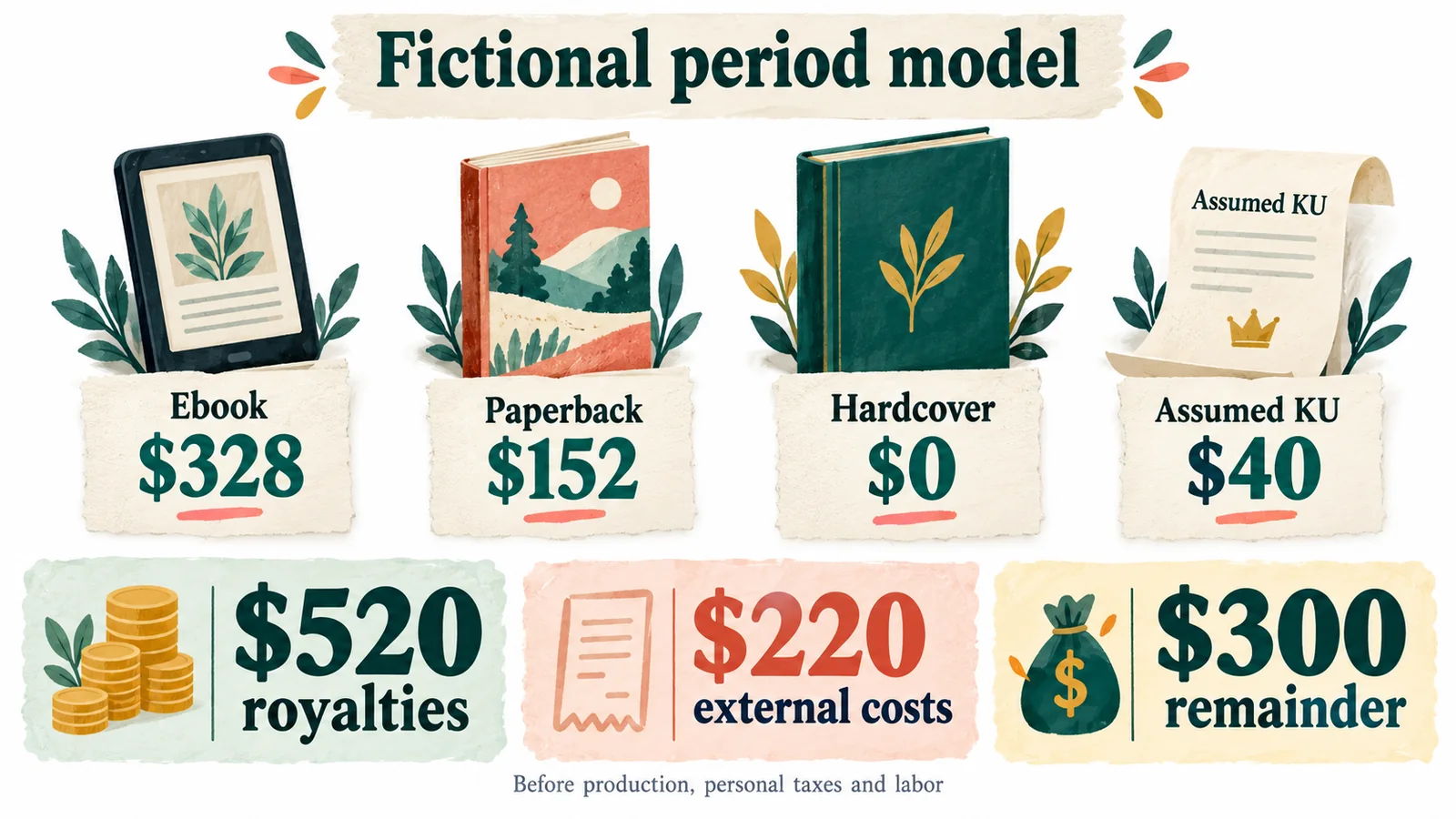
An income calculator combines inputs for one defined period
This worksheet adds ebook, paperback and hardcover royalties, then a separate assumed reading royalty. It subtracts the external period costs you enter to show a defined operating remainder. The starting values are fictional teaching inputs, not an average author's earnings or an estimate of the demand for your book.
Before calculating, name the window in your working notes: a calendar month, a complete launch period or another explicit interval. Every quantity and cost must cover that same scope. The form does not convert daily units into monthly units or annualize a short promotion automatically. A precise total cannot repair incompatible periods.
Know what the result excludes
The remainder excludes upfront production, personal taxes and unpaid author labor. It is not take-home pay or cash received. Use the project ROI worksheet for a separately defined production-recovery question. If the per-copy amount is still unclear, start with the royalty calculator rather than entering retail price as royalty.
Prepare compatible units, currency and cost records
| Input group | Use | Do not substitute |
|---|---|---|
| Paid-copy counts | Net paid units for the named editions and period | Gross orders, free downloads, reservations or pages read. |
| Royalty per copy | A documented, compatible amount or explicit assumption | List price, ad-attributed retail revenue or an unrelated format's royalty. |
| Reading stream | KENP and an explicitly identified assumed page rate | Physical page count or a count of unique readers. |
| External period costs | Included operating expenses counted once | Platform deductions already inside royalties or an unlabelled production outlay. |
Currency is a unit, not a conversion service
Choose a display currency only after all inputs use it. Combining dollars and pounds by entering their numerical amounts under one label is invalid. If you convert source records, retain the exchange basis separately. This calculator neither fetches live exchange rates nor forecasts the rate applied to a future payment.
Keep observations, estimates and chosen assumptions labeled in your notes. An actual count paired with an assumed royalty is still a modeled amount, not a finalized statement. A planned future count should not be described as observed demand because the arithmetic is correct.
The form accepts nonnegative whole-unit counts and nonnegative rates, with each input capped at 1,000,000. A refund-adjusted period with negative net units or other statement reversals is outside this form's model. Do not replace a negative record with zero to make it fit; reconcile the signed statement entries separately. A calculated operating remainder can still be negative when included costs exceed royalties.
Calculate each paid-copy stream before summing
Paid royalties equal net paid units multiplied by the compatible royalty per copy for that stream. The worksheet keeps three format rows so they can be checked independently. In the fictional default, 100 ebook copies at $3.28 contribute $328, while 40 paperback copies at $3.80 contribute $152. Hardcover contributes zero because its assumed count is zero.
Split records when the unit economics differ
If one format has several prices, marketplaces or royalty treatments, a single amount may not describe every unit. Calculate homogeneous groups separately and retain the subtotals. If you use a weighted average, document the matched quantities and calculation; do not take a simple average of two rates when the unit counts differ.
For example, 10 copies at an assumed $2 royalty and 90 at $3 produce $290, or $2.90 per copy across the 100 units. A simple midpoint of $2.50 would imply $250 and lose $40 from the model. These values are fictional arithmetic, not measured pricing behavior.
Model KU as a separate earning stream
KDP's KU guidance uses eligible normalized pages read. The calculator multiplies the KENP input by your explicitly assumed page rate. It does not derive unique readers, completed readings or paid-copy equivalents from that quantity.
A planning rate is not a current guaranteed payout
The fictional default uses 10,000 KENP at $0.004, producing $40. That rate is deliberately a teaching assumption. The KDP Royalties Estimator guidance explains that the KENP rate changes monthly and that estimated earnings can differ from actual records. Replace assumptions with matching finalized amounts during reconciliation.
If the project has no subscription reading, enter zero KENP. Do not increase that row simply to make a desired income total appear. Separate reading assumptions should have the same observation window and evidence standard as paid-copy assumptions.
Reconcile the default case from royalties to remainder
| Stream or deduction | Calculation | Amount |
|---|---|---|
| Ebook | 100 x $3.28 | $328 |
| Paperback | 40 x $3.80 | $152 |
| Hardcover | 0 x $0 | $0 |
| Assumed KU | 10,000 x $0.004 | $40 |
| Total royalties | $328 + $152 + $0 + $40 | $520 |
| External period costs | Explicit fictional operating-cost input | -$220 |
| Period remainder | $520 - $220 | $300 |
The paid-copy total is 140, not 10,140. The 10,000 reading pages remain a separate activity unit even though their modeled royalty joins the monetary total. The $300 remainder is before the exclusions stated above and says nothing about the timing of receipts.
Keep costs from appearing twice
If the paperback royalty already reflects printing, do not deduct manufacturing again under external costs. Conversely, advertising, software and other genuine operating bills do not disappear merely because they are outside the platform royalty formula. Use the catalog workflow to allocate shared expenses without charging a full catalog bill to every title.
Test the input that could change the decision
Start with a single change rather than increasing every row. In the fictional case, halving paid units to 50 ebooks and 20 paperbacks while leaving KU and external costs unchanged produces $164 + $76 + $40 = $280 royalties and a $60 remainder. The unchanged costs and reading are assumptions, not claims about how a real campaign behaves.
Retain a zero-activity case
With all paid counts and KENP set to zero while costs remain $220, the remainder is -$220. A zero-sales period need not be cost-free. If the budget depends on every projected unit occurring, identify that risk before committing to invoices or recurring subscriptions.
Use scenario review for a wider sensitivity analysis. The worksheet does not assign probabilities, fit a demand curve or validate a BSR-derived volume. Confirm a measured input through sales reconciliation rather than treating an unsupported forecast as a record.
Separate earning-period income from received cash
KDP's payment schedule places payments after the earning period, subject to applicable requirements and delivery timing. The calculator does not predict your bank balance. A current operating remainder cannot automatically fund an invoice due before the associated money arrives.
Keep the bridge outside this estimate
Follow the royalties and payment guide to match statements, payment status and bank receipts. Do not add a later receipt to the royalty that generated it as a second earning stream. Document currency and adjustments when totals differ.
Review the output before using it for a commitment
- Retain the defined period, edition scope and currency.
- Mark which counts and rates are assumptions.
- Check that operating costs are complete and counted once.
- Keep production recovery and personal obligations separate.
- Choose a small next test rather than treating the result as a forecast.
For production recovery, continue to the ROI calculator. For recurring household commitments, use the livelihood review. Return to the earnings hub when a different evidence question is blocking the decision.
For a stated surplus goal, follow the required-copy calculation. This worksheet answers what entered volumes would produce, not what minimum volume would meet a target or what the market will buy.
Sources and scope
Primary KDP references checked on 17 October 2026. Inputs, rates and worked results are fictional educational examples. Money calculations retain six decimal places internally and display two; no platform rounding parity is claimed. This local planning tool does not access accounts, send inputs, supply live exchange rates or establish expected future earnings.
Frequently asked questions
Does this calculator predict future sales?
No. It calculates the result of the counts and rates you enter. Assumed sales remain assumptions, and the output does not establish their probability.
What does the period remainder include?
Total modeled royalties minus the external period costs entered. It excludes upfront production, personal taxes and unpaid labor as stated, and it is not cash received.
Can KENP be added to paid-copy counts?
No. Pages remain a separate activity unit. Only their separately modeled monetary royalty joins the royalty total.
Is the default KU page rate current or guaranteed?
No. It is an explicit fictional teaching assumption. Use a relevant estimate or matching finalized amount and retain its period and source.
What if one format has several royalty values?
Calculate compatible groups separately or document a quantity-weighted amount. A simple average of rates can misstate the total when unit counts differ.
Can I subtract printing costs again under external expenses?
Not if they are already reflected in the per-copy royalty input. Count genuine external expenses once and keep production costs in the separately defined project view.