

KDP Keyword Research Without Tools
Use the manuscript, public search interface and a notebook to investigate candidates without a paid subscription, AI generator or automated scraper.
Keep observations separate from decisions. The output is a justified shortlist, not verified search volume or a complete map of the market.
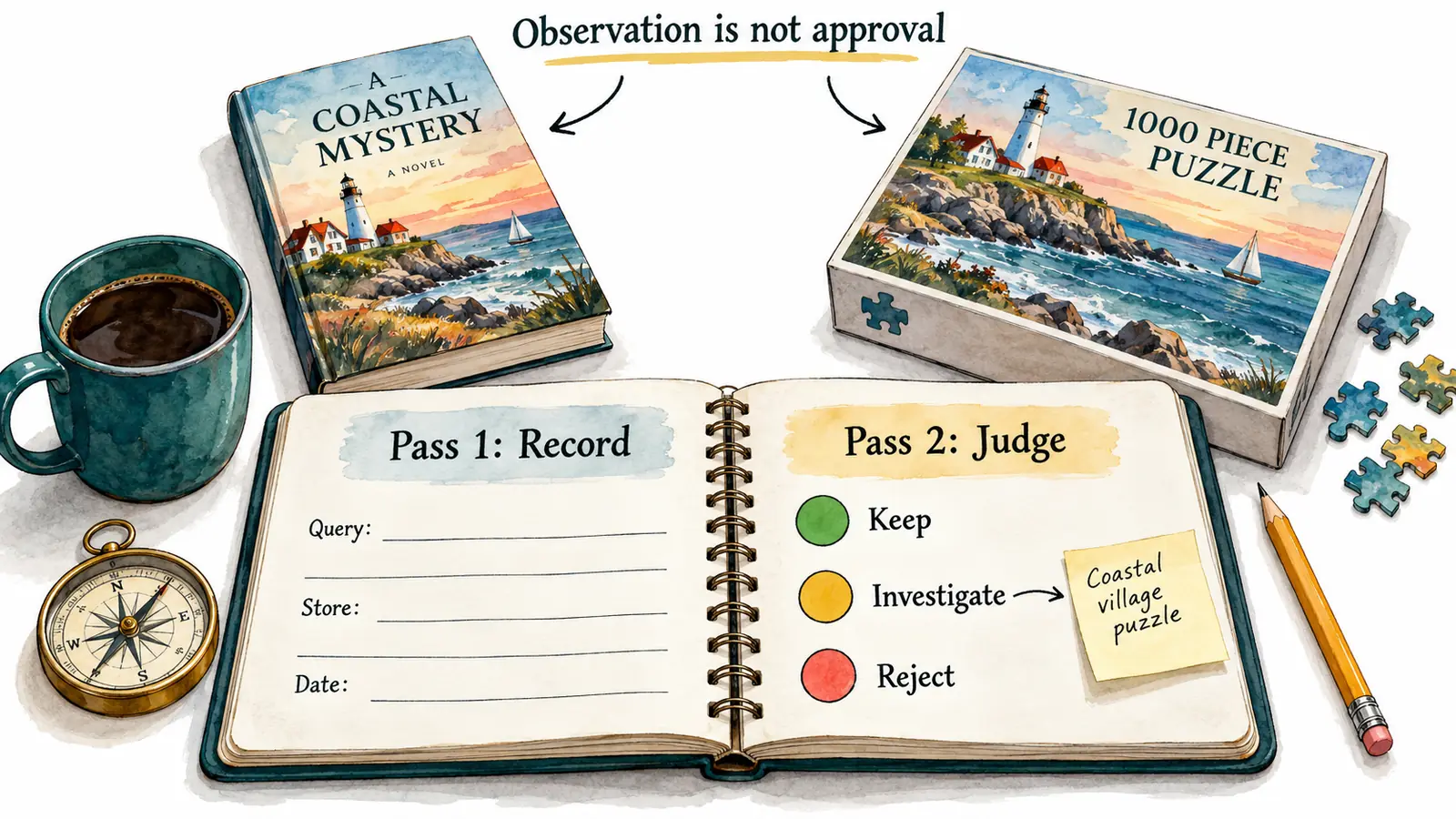
Manual research can produce a shortlist, not a demand forecast
You can investigate KDP keyword candidates with the manuscript, Amazon's public search interface and a notebook. No paid keyword subscription, AI generator or automated scraper is required for that bounded task. What the process cannot provide is verified search volume, a complete competitive census or a guaranteed ranking opportunity.
The useful output is a small set of candidates with manuscript evidence, recorded context and a reason to keep, investigate or reject each one. That is different from producing a large spreadsheet whose precision exceeds its evidence.
Choose the question before browsing
For an invented gentle coastal mystery, investigate whether a candidate describes readers seeking an archive-based puzzle rather than a practical lighthouse guide. Do not set a target number of phrases to collect.
Use the general candidate workflow for the complete research-to-entry chain. This guide supplies a repeatable manual session within that chain, without claiming that hand collection validates demand.
Prepare the book brief and the observation context
The Lantern Room is a fictional cozy mystery featuring an amateur archivist in a coastal town. The plot uses records and local relationships to resolve a puzzle. It is not a travel guide, a lighthouse maintenance manual or a graphic crime thriller.
Write a similarly concrete brief for your book, including exclusions. Select the intended store and department, note the date, and choose the result range you can inspect carefully. Use KDP's contextual search guidance without treating any session setup as a universal neutral view.
Keep the setup small and explicit
- Identify the manuscript and intended edition.
- State the audience and central reading task.
- Record store, department and filters.
- Choose an inspection range in advance.
- Keep proposed terms separate from observed wording.
A larger inspection is not automatically better. It can add unrelated phrases faster than you can evaluate them. The purpose is to answer a defined question with a record you could revisit.
Use the first pass to collect language, not approve it
Start from a few manuscript-led ideas. For the fictional mystery, these might concern an amateur investigator, archival clues or a coastal setting. Inspect a query and any suggestions, recording exact wording when it is relevant to investigate.
KDP recommends considering candidate searches and suggestions. A suggestion is a language clue, not a verified number of searches or purchases. No suggestion is not the same as zero demand.
Separate your idea from the platform observation
If you write "archive mystery" before searching, label it a manuscript seed. If different wording appears in the interface, label it an observed suggestion with its context. Do not later describe every item in the notebook as an Amazon-generated or frequently searched phrase.
Do not mass-collect unrelated suggestions or automate interactions to make the work look more comprehensive. A few relevant observations with clear origins are more useful than an undocumented dump.
Use the second pass to check the implied reading task
Revisit the promising candidates separately. Inspect the kinds of books returned, ordinary and sponsored placements, descriptions and samples where available. Ask what a reader would expect to buy after using that wording.
| Candidate direction | Question to inspect | Provisional decision |
|---|---|---|
| Amateur archivist mystery | Does the intended task concern fiction and investigation? | Keep for further review if the manuscript supports it |
| Coastal village puzzle | Does the wording imply a novel or a puzzle activity book? | Investigate ambiguity before entry |
| Lighthouse travel guide | Does the novel provide travel instruction? | Reject: setting does not make it a guide |
| Graphic crime thriller | Does the tone and content match that promise? | Reject: the fictional brief excludes it |
Do not pick one favorable result and ignore the rest
One comparable cover is not a complete explanation of a query. Note the dominant task within the inspected range and conflicting examples. If context is mixed, retain the uncertainty rather than labeling the candidate easy or proven.
You do not know a comparable book's backend entries by looking at its title. Study the reader promise without copying identities or claiming to have uncovered its actual keyword setup.
Keep observations and decisions in separate columns
| Field | Write down | Do not replace it with |
|---|---|---|
| Candidate and origin | Seed, observed wording or reader-language hypothesis | A claim of verified popularity |
| Observation context | Query, store, department, filters, date and range | A context-free screenshot |
| Reader task and manuscript basis | Expected reading experience and supporting passages | A vaguely related noun |
| Decision and open question | Keep, investigate or reject with a reason | An unexplained opportunity score |
Use absence precisely
Record "not observed within the inspected range" when appropriate. Do not assign an exact outside-range position, call the phrase unused or infer a global indexing failure. Your notebook contains a bounded observation, not a census of Amazon.
For position checks, use the query-observation guide. Manual collection does not remove the need to distinguish query placement, category rank and orders.
Stop when another observation would not change the decision
Use a time allowance and a short list of open questions. Stop collecting when the remaining work is policy review or a manuscript mismatch rather than lack of suggestions. Do not browse indefinitely to avoid rejecting an attractive but unsupported phrase.
For a fictional 20-minute session, reserve 5 minutes for the brief and scope, 8 for recording language and 7 for checking fit: 5 + 8 + 7 = 20. This is a time allowance, not a platform rule or phrase quota. When time runs out, mark unfinished checks unresolved rather than forcing a final entry.
Keep an unresolved candidate unresolved
If the task remains ambiguous, keep it out of final entry. You can review it later with a better sample or a different research question. Uncertainty does not need to become a fabricated volume estimate.
A manual method is inexpensive in subscription fees, not free of time cost. Record whether the session produced a useful decision, not just how many rows were added.
Session conclusion for the four listed candidates: one direction deserves further review, one remains ambiguous and two are rejected on manuscript fit. The notebook does not establish search demand or sales potential.
Hand off the shortlist to policy and field review
Use the rule preflight and the field-planning guide before entry. Compare surviving candidates with the book's actual metadata; a research direction is not yet final wording.
Use examples to test your reasoning
The example catalog shows how the same pattern can be useful for one manuscript and wrong for another. Adapt the reasoning rather than importing a complete list.
Check the mistake diagnostic if the shortlist mainly contains repeats, broad claims or unsupported audiences. Do not repair a poor notebook by filling every field.
Review the next check without overclaiming
After submitting a change, record the operation and later confirmation using the relevant KDP timelines. Backend text need not be displayed as a readable storefront field. A saved draft is not a completed update.
Separate the outcome from its explanation
A later appearance or order change does not isolate the keyword edit from promotions or changing demand. Search placement is not guaranteed. Keep the same context where practical and note what changed.
Return to the discovery hub when the real issue concerns the audience or route. Manual research succeeds when it produces a truthful, inspectable decision, not when it imitates a proprietary data product.
Return to the KDP keyword research guides for the full workflow, genre examples and keyword tools.
Sources and scope
Official sources checked: 17 October 2026. Book, candidates, observations and session conclusions are fictional. No live searches, paid tools or account results were audited. The two-pass session is an editorial workflow, not a demand forecast or placement guarantee.
Frequently asked questions
Can I research KDP keywords without paid tools?
Yes. A manuscript, public search interface and notebook can support a bounded candidate investigation. They do not establish verified search volume or guaranteed placement.
What is the purpose of the two passes?
The first pass records language and origin. The second inspects the implied reader task and manuscript fit. Keeping them separate prevents collection from becoming automatic approval.
Are Amazon suggestions a demand forecast?
No. They can be language clues, but are not verified counts of searches or purchases. An absent suggestion is not proof of zero demand.
How much should I inspect manually?
Choose a manageable range and open questions before browsing. Record the scope rather than presenting a limited session as a complete marketplace census.
When should I stop collecting phrases?
Stop when more observations would not change the decision, or the remaining issue is manuscript fit or policy review. Do not collect indefinitely to avoid rejecting a candidate.
What happens after the manual shortlist?
Review current policy and field roles, compare existing metadata and record the final selection separately. A research direction is not yet final publishing wording.