

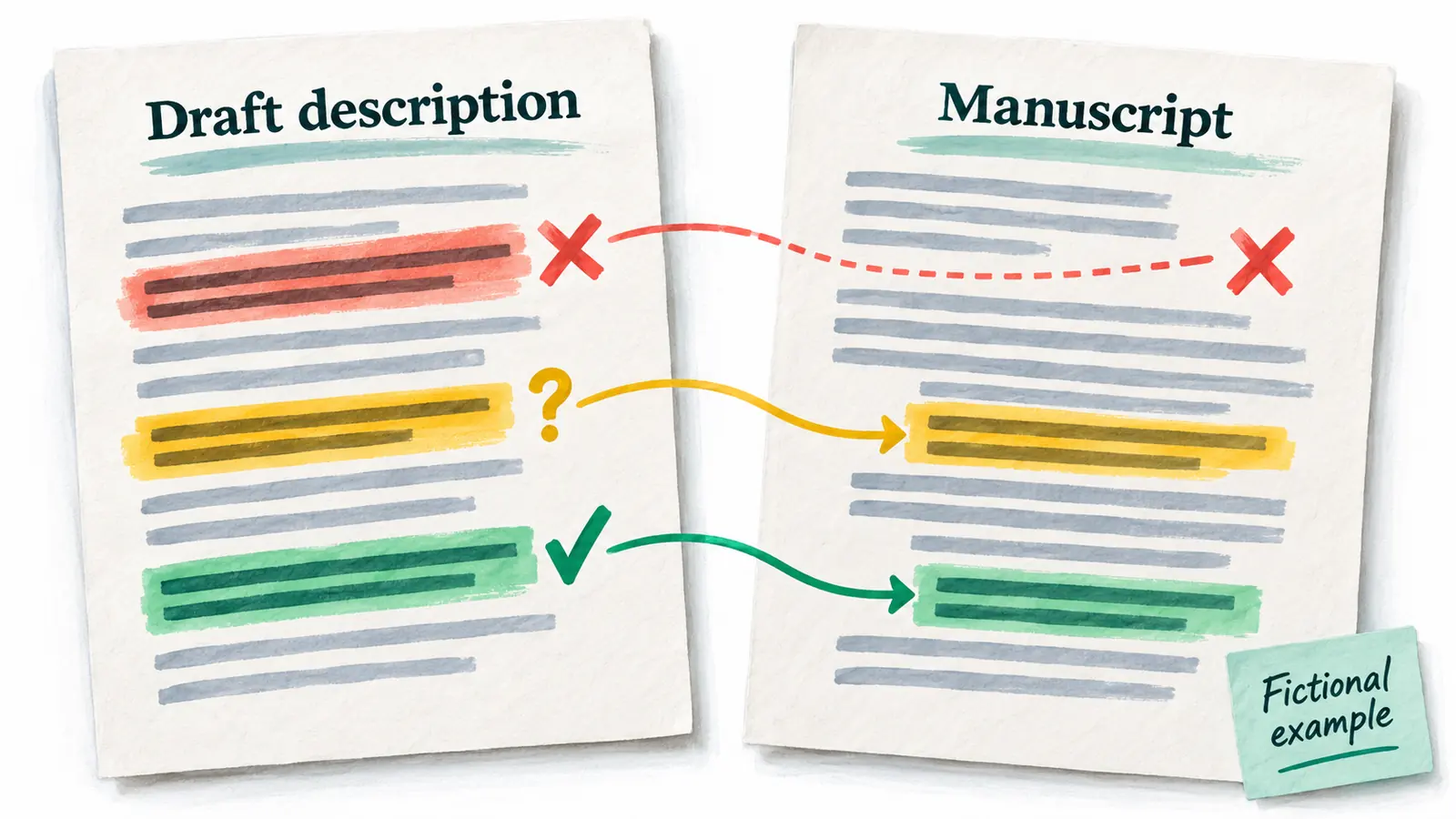
Give the draft something reliable to work from
An AI description can sound polished while promising a different book. Start with a short inventory you can verify: intended reader, subject or genre, format, actual scope, distinctive material and important limits. Use your manuscript and final contents list, not another AI answer, as the source of truth.
For fiction, identify the central character, situation, stakes and tone without adding a plot event the manuscript does not contain. For nonfiction, list what readers can learn or do, the assumed starting knowledge and what is outside scope. A practical handbook should not become an expert certification course because a model likes a stronger headline.
Virtalibry's description assistant produces suggestions, not a verified manuscript audit. Its AI requests use an external provider. Share only material you are entitled to provide, remove personal information and never include passwords or private account tokens.
Mark every claim that needs evidence
Read the draft sentence by sentence. Classify statements as supported, unsupported or requiring clarification. Numbers, credentials, awards, research claims, included extras and time-to-result promises deserve particular attention. Fluency is not evidence.
| Draft claim | Evidence available | Decision |
|---|---|---|
| 100 projects for every climate | The manuscript has 24 projects and discusses a limited set of growing conditions. | Correct the number and remove the universal claim. |
| Written by an award-winning botanist | No such credential or award is documented in the author information. | Remove it. Do not replace it with another invented credential. |
| Guaranteed harvest in seven days | No evidence supports that outcome; conditions and plant development vary. | Remove the guarantee rather than soften it into an implied promise. |
| Planting and watering checklists | Both are included in the manuscript. | Keep the concrete feature without inventing a result. |
This is an invented editing exercise, not a customer case or a captured output from a live AI request. The same audit applies to a human-written blurb. If you cannot identify the source of a claim, omit it until you can.
Rewrite around a specific reader promise
Fictional flawed draft
“An award-winning botanist reveals 100 foolproof projects for every climate. Grow a guaranteed harvest in seven days with the ultimate gardening system, complete with exclusive bonus downloads.”
The problem is not merely the tone. The draft changes the count, invents expertise, claims universal suitability, guarantees an outcome and adds material that is not in the inventory. Changing “guaranteed” to “easy” would not fix the other inaccuracies.
A supported replacement
“Start a small herb-growing project with a guide built for container spaces. Explore 24 projects covering eight common herbs, with planting and watering checklists to help you plan each setup. The book explains the growing conditions discussed in each project so you can compare them with your own space before choosing where to begin.”
This version says what is included and how the reader can use it. It does not promise a harvest date or imply suitability for every setting. Before publishing even this replacement, check that its wording accurately matches the finished manuscript.
Keep the description focused on the book
Lead with the relevant situation or story promise, then support it with concrete scope. Remove repetitive superlatives and keyword lists that interrupt meaning. The description should help the right reader recognize a fit, not hide the book's level, length or limitations.
Read it next to the actual cover and sample. A restrained practical guide with a sensational blurb creates a mismatch even if each isolated sentence sounds plausible. If feedback questions remain, use a clearly scoped presentation comparison rather than treating favorable votes as proof that every statement is true.
Check the rules for the field you will publish
KDP's metadata guidance specifies description restrictions, including review quotes, review requests, contact information and certain promotional content. Check that field's current rules and supported formatting; a sentence allowed in your newsletter is not automatically suitable for a retailer description.
Do not rely on a generator to certify compliance. A clean preview only shows how the text renders. It does not prove accurate claims, valid rights or approval by KDP. Keep author, title, subtitle and format details consistent with the book you are submitting.
Distinguish AI assistance from AI-generated publication content
KDP's content guidelines distinguish AI-generated from AI-assisted content and explain disclosure requirements for publishing through KDP. Substantial edits do not by themselves change material generated by AI into material originally created by a person. Review the scope of the current policy for your actual use; this article does not determine a particular submission's disclosure answer.
Keep a note of what the tool generated and what you wrote yourself. Do not ask a second model to provide a reassuring policy answer in place of reading the source. Publishing responsibility remains with the author or publisher.
Use a release checklist that can fail
- Every factual promise has a manuscript or other valid source.
- Counts, credentials, included material and reader level are accurate.
- No unsupported results, endorsements or promotional extras remain.
- The text fits the retailer field and current rules.
- The cover, description and sample make a consistent promise.
- You have saved the approved version and the date of the check.
If a claim fails, stop and repair it. After publishing a change yourself, inspect the actual live listing; the tool does not update KDP for you. A later increase in sales does not isolate the description's effect if price, advertising or audience exposure also changed.
Use the description tool for drafting, the marketing checklist for a wider launch review, and the blog for related articles. Sources checked on 15 October 2026; all book details and draft excerpts here are original fictional examples.