

AI Book Keyword Generator
Explore candidate wording from your title and optional book context, then check what the book actually delivers. Generated intent explanations are not evidence of search volume.
Use the generator for brainstorming, with a separate manuscript review and distinct decisions for KDP publishing fields and Amazon Ads.
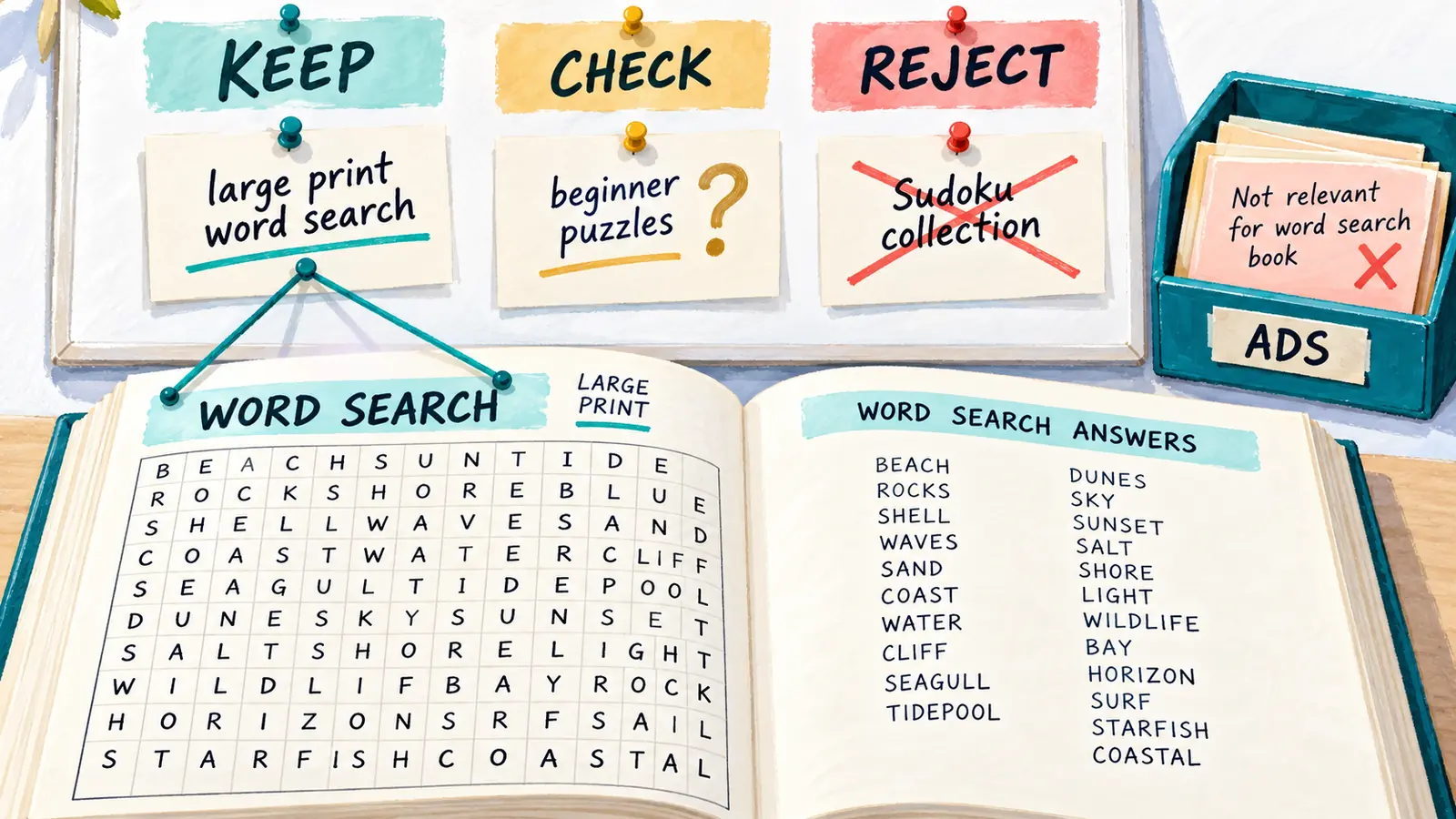
Use an AI keyword generator to expand possibilities, not certify demand
An AI book keyword generator can suggest alternative ways to describe a subject, reader or use case. That is a brainstorming task. A plausible phrase, fluent explanation or well-organized cluster does not establish that people search for it, that it fits the finished book or that KDP will approve its use.
The useful output is a candidate list for review. Keep generated wording separate from observed marketplace language and final publishing fields. A phrase can be specific, grammatically clean and confidently explained while still describing a different book.
Set a bounded question
Ask what is missing from your current vocabulary: a subject direction, an audience description or a way to name a practical task. Do not treat generation as a search for a secret ranking formula. A smaller response that exposes a few new directions is often easier to assess than repeated large batches.
Use the research hub when you need to choose a workflow, and the full research method when you are ready to move from book evidence to candidate decisions.
Supply a title and optional book context, not assumptions
The Virtalibry generator takes a book title, requested phrase count and style choice, with an optional context field for contents, audience and exclusions. It asks for structured ideas. It does not inspect your complete manuscript or independently verify the supplied facts, and it does not supply search-volume measurements. Do not assume that a confident output knows facts you never provided.
A title can under-specify the book
A title such as Small Spaces, Living Leaves could describe balcony plant care, houseplant photography or an illustrated gift book. An informative existing subtitle may narrow the context, but the title still cannot prove which chapters, exercises or species actually appear in the manuscript.
Use the real title as the starting context and put the subject, audience, format and exclusions in the optional book-context field. Keep manuscript references in a separate review record. Do not rename the published book or submit private reader data to make a brainstorming response more detailed. Requests pass through an external model provider.
Count and style do not change the evidence
Requesting more phrases increases the requested output, not the amount of verified market knowledge. A long-tail or buyer-intent style is a generation direction, not a measured label. The model may return repetition, unsupported assumptions or a different quantity than requested. Review the result rather than treating the setting as a certification.
Read phrases, explanations and clusters as one generated response
The response can contain candidate phrases, intent and why explanations, clusters and proposed negative keywords. Those parts share the same generated origin. An explanation that repeats the candidate's promise is not independent evidence that the promise is true.
A cluster is an organizational suggestion, not a discovered Amazon category or an audited market segment. A negative-keyword suggestion is not an instruction to paste exclusions into KDP publishing fields. Keep that proposed advertising decision separate, as explained below.
Generated explanation: "This phrase targets beginner readers." Evidence question: "Does the book actually teach the task from a beginner's starting point?"
Structured JSON helps preserve the response for later inspection, but valid syntax does not validate meaning. If a response cannot be parsed, preserve the raw text if useful and treat the generation as incomplete. If it parses successfully, still inspect every retained claim.
Review six fictional candidates against one book brief
For this original teaching example, Small Spaces, Living Leaves is a practical paperback about caring for potted plants on a small balcony. It contains basic watering and light observations with worked examples. It does not teach landscape construction, vegetable production or a botanical certification course. No universal plant-health outcome is promised.
The following response is written for illustration; it was not produced by a live generator call or observed in Amazon searches. It has no verified volume or ranking data.
| Generated direction | Evidence question | Editorial decision |
|---|---|---|
| Balcony plant care | Do the main instructions concern potted plants in that setting? | Keep: supported by the central subject. |
| Container watering basics | Are practical watering observations explained and demonstrated? | Keep: supported by the worked examples. |
| Gardening for absolute beginners | Are prerequisites, terms and a first complete attempt explained? | Investigate: basic topics alone do not prove a beginner course. |
| Drought-tolerant balcony plants | Does the actual species coverage support that emphasis? | Investigate: the brief does not establish it. |
| Small-space vegetable harvests | Does the book teach growing and harvesting vegetables? | Reject: attractive wording for a different task. |
| Guaranteed thriving plants | Can the book establish that result for every reader and environment? | Reject: unsupported outcome, not a content description. |
The correct next step for an uncertain phrase is a manuscript check, not another generated explanation of why the phrase is good. Keep decisions are only permission to research further, not final publishing approval.
Check the book, public language and policy independently
Check manuscript fit first
Attach a chapter, exercise or representative example to each retained direction. Reject any phrase that implies an absent method, audience, format or outcome. If the candidate exposes a genuine content gap, decide deliberately whether to revise the book; do not let the label silently become the new promise.
Inspect language in context
Record marketplace, language, date, department and query when examining public suggestions or comparable listings. Those observations can clarify how a phrase is used. They do not establish verified demand, disclose competitor backend entries or guarantee placement.
Use the current rules, not the model's reassurance
The official KDP keyword guidance governs accuracy and restricted wording. A model-generated phrase is not an exception. Check the metadata guidelines when reviewing the actual title, audience and presentation.
Use the manual notebook for contextual observations, cleanup for a messy response and mistake diagnosis when the problem is not a shortage of ideas.
Publishing keywords and advertising targets need separate decisions
A list labeled for both KDP and Amazon Ads is not ready for both destinations. Publishing metadata describes the book. An advertising plan also involves targets, match types, bids, budgets and evidence from campaign reports. Do not copy another author's identity into publishing fields because it appears in an advertising discussion.
Amazon Ads' targeting guide explains negative targeting as a way to exclude advertising placements or queries. It is not a negative-keyword field in the KDP publishing workflow. Review campaign relevance before using any generated exclusion; the generator has not audited your campaign performance.
For publishing entry mechanics, use the rules guide and the field guide. For advertising, use Ads keyword strategy. Keep those exports distinct even when some candidate wording overlaps.
Prepare a reviewable handoff
| Record | What to save | What it does not prove |
|---|---|---|
| Generation context | Title, requested style, count, date and unedited response. | That the model read or understood the full book. |
| Content review | Candidate, manuscript reference and keep/investigate/reject reason. | That readers search for the wording. |
| Public observation | Actual query context and visible reader expectations. | Search volume or a guaranteed conversion rate. |
| Destination review | Publishing shortlist or a separate Ads investigation, with relevant restrictions. | Platform approval or campaign profitability. |
- Preserve the original output before cleaning it.
- Flag every feature inferred from an ambiguous title.
- Keep advertising exclusions out of publishing keyword exports.
- Do not mark generated intent explanations as observed facts.
Stop when the next question requires evidence, not more phrases
More generation will not establish an exercise's existence, a recipe's total time, a puzzle's correctness or a romance's ending. Use the relevant genre test: cookbooks, puzzle books, romance or self-help.
After choosing final wording, save the edition, previous fields and submission date. Confirm the visible update and record overlapping price, cover or promotional changes. A later sales movement does not retrospectively certify that the AI found a winning phrase. For broader visibility issues, use the discoverability hub.
Sources and scope
Official KDP and Amazon Ads references were checked on 16 October 2026. Local SPA and Astro forms share title, optional context, count and style inputs, response validation and copying. No live AI request, demand study, campaign change or sales test was performed. The sample response and illustration are original conceptual examples.
For the rest of the listing, use the title generator, description generator and category finder. Return to AI Tools for KDP or KDP Tools for the full directory.
Frequently asked questions
What information does this keyword generator use?
The tool uses a book title, requested phrase count and style, with optional context for contents, audience and exclusions. These inputs do not supply the complete manuscript or verified Amazon search-volume data.
Does the generator prove that readers search for its phrases?
No. A generated phrase, intent label or explanation is a candidate for investigation, not an observed search query or audited demand measurement.
Does requesting more phrases make the results more reliable?
No. Count affects the requested output size, not the amount of verified evidence. More output can also create more repetition and unsupported assumptions to review.
Is valid JSON enough to approve the output?
No. Structured syntax helps preserve a response, but it does not verify manuscript fit, factual claims, policy compliance or reader demand.
Where do proposed negative keywords belong?
They require a separate advertising review. They are not exclusions to paste into KDP publishing keyword fields, and the generator has not audited campaign performance.
What should I do with an uncertain candidate?
Attach a manuscript reference or mark the evidence missing. Check public language and current rules independently; another generated explanation does not resolve a missing fact.