

How Many Keywords Does KDP Allow?
KDP allows up to seven keywords or short phrases. That is not seven individual words, and it is a limit rather than a quota.
Plan distinct truthful contributions, compare existing metadata and check the live form. Leave unsupported space unused rather than maximizing character utilization.
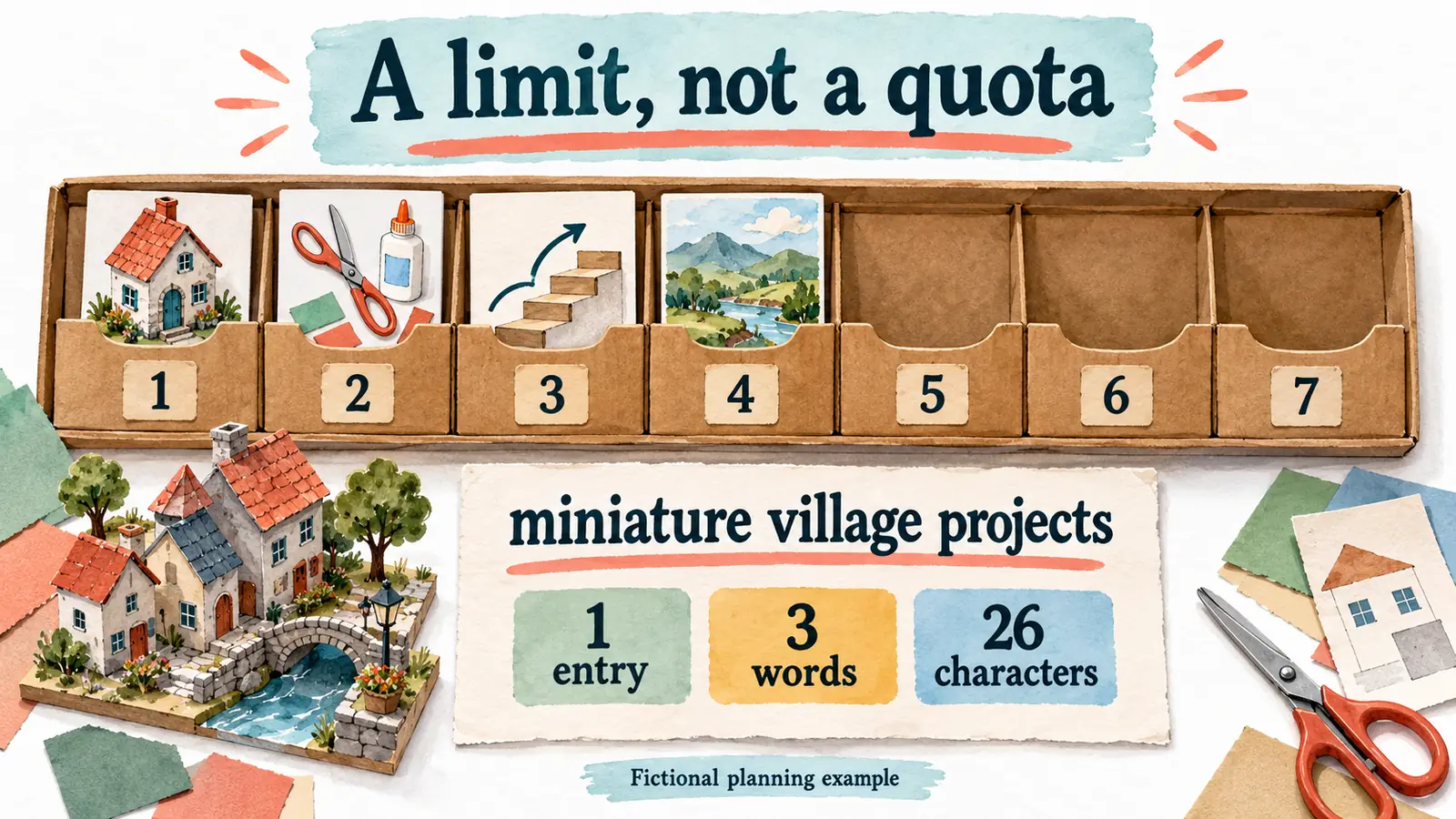
KDP allows up to seven keywords or short phrases
That is the wording of KDP's keyword guidance. It does not mean seven individual words across the entire setup, and it does not mean you must fill every available entry. A useful selection is a small set of truthful contributions, not a packing contest.
Keep a research list separate from the final entries. You may investigate many ideas, reject most and retain fewer candidates than the form permits. The remaining spaces do not need unsupported content.
Answer the quantity question before planning the content
Confirm the intended edition and current publishing form. Then decide what useful information is still missing. An inherited spreadsheet from a different book is not a good reason to fill the same number of entries again.
An entry, a word and a character count are different units
A short phrase can contain several words while remaining one proposed entry. Spaces also contribute to the length of the examples below. These counts illustrate the difference; they do not establish that the phrases belong in another book's metadata.
| Proposed phrase | Words | Characters |
|---|---|---|
miniature village projects | 3 | 26 |
cut and assemble scenes | 4 | 23 |
beginner hobby crafting | 3 | 23 |
paper landscapes | 2 | 16 |
In the first row, the entire phrase occupies one proposed entry: three words, two separating spaces and 26 ASCII characters. The code styling is only for reading this article; do not copy backticks or surrounding quotation marks into the field. The four rows demonstrate units, not a recommended finished list for another book.
Use the current field's actual counter
KDP tells authors to watch the field's character limit. Check the live form rather than relying on a copied third-party checklist. A local count helps prepare text, but the form's current validation remains the operational check, especially for non-ASCII characters.
Metadata guidance recommends concise phrases; a recommendation is not a rule that every phrase must have exactly the same word count. Meaning and fit come before an arbitrary word total.
Inventory the metadata already doing the work
Write down the actual title, subtitle, contributor details and relevant category wording. Compare each candidate's contribution with that inventory before deciding where it belongs. Do not mistake a longer list for broader useful coverage.
Look for genuinely additional information
A technique, project scope or intended level may add a meaningful distinction. Repeating an already obvious label may not. KDP advises avoiding redundant metadata and cosmetic variants; use the space to represent the book more clearly rather than repeat a phrase in different capitalization.
Keep meaningful distinctions intact. Cutting and folding are not interchangeable just because both use paper. Beginner and professional promises describe different tasks. A duplicate cleaner should not erase a distinction central to reader fit.
Plan distinct contributions before entering anything
Small Paper Worlds is a fictional adult beginner guide to cutting and assembling miniature village scenes. The following is a planning memo for candidate families, not seven approved phrases. Final wording still needs research, policy review and comparison with actual metadata.
| Position | Possible contribution | Evidence needed | Decision |
|---|---|---|---|
| 1 | Project scale or scene type | Several central miniature-scene projects | Investigate additional wording |
| 2 | Actual assembly technique | Instructions support cutting and assembly | Review fit and duplication |
| 3 | Intended experience level | Projects genuinely accessible to the stated beginner | Check existing metadata coverage |
| 4 | Landscape or scene scope | Complete environments, not just isolated houses | Investigate reader language |
| 5 | No supported additional direction | None established | Leave unused |
| 6 | No supported additional direction | None established | Leave unused |
| 7 | No supported additional direction | None established | Leave unused |
A planning direction is not a final keyword
The first row does not grant permission to paste every miniature-related term into one box. It identifies a question to investigate. Only a justified phrase should survive the handoff to final entry.
Use the candidate research workflow for that investigation and the rule review before submitting.
Shorten a candidate without altering its promise
Start by removing internal notes or unnecessary filler, not the words that make the audience or technique accurate. If a phrase still cannot fit the current field, choose a clearer alternative or reject it. Do not hide the lost meaning in an unrelated field.
Check the shortened reading task
For the fictional guide, replacing a specific assembly direction with a broad professional-modeling term would not be harmless compression. It would change the reader's expected level and purpose.
Read the revised wording against the manuscript brief. A shorter phrase is not automatically better; a longer phrase is not automatically more specific in a useful way. Keep the decision tied to the content rather than character utilization.
Leave unused space rather than add false variety
Unused positions are preferable to unsupported audiences, unrelated subjects or repeated cosmetic variants. They are also preferable to filling a gap with a competitor identity or a promotional claim.
Do not treat completion as seven nonempty entries
Completion means the selected entries are explainable and the review is recorded. If the shortlist contains only four useful contributions, do not turn three weak suggestions into mandatory additions.
Likewise, an entirely new list is not required whenever performance is disappointing. First identify the actual problem: availability, query fit, audience, offer or promotion cost. The number of entries is not a diagnosis.
Record the selection before using the publishing form
Save the previous entries, the new candidates and the reason each adds useful information. Check the correct format and edition before submission. Keep research comments and acceptance notes outside the actual fields.
Use a short preflight
- Each selected entry has a manuscript basis.
- The current policy review is complete.
- Existing metadata has been considered.
- The live field validates the proposed text.
- The previous setup and rationale are retained.
Use the applicable operation timelines after submitting. An unsent draft and a submitted update are different states.
Review the update separately from its commercial effect
Confirm the operational change where possible, then make a contextual query observation if that is the question. Backend values need not appear as visibly readable storefront fields. A lack of visible keyword text is not by itself a failed update.
If a setup appears ineffective, diagnose the observed failure before adding entries. A draft saved for a different format cannot be tested by filling unused positions in the current one.
Keep the placement claim modest
Filling all positions does not guarantee a result. KDP does not promise top search placement. Record concurrent promotions and do not assign every later order to one metadata edit.
Return to the discovery hub or the keyword strategy when the broader plan needs work. The useful outcome is a truthful, selective setup, not a maximized character count.
Return to the KDP keyword research guides for the full workflow, genre examples and keyword tools.
Sources and scope
Official sources checked: 17 October 2026. Book, phrase counts and seven-position memo are original fictional examples. The live field's numeric character cap is not asserted from documentation that only instructs authors to check the counter. No final list is pre-approved or guaranteed to rank.
Frequently asked questions
How many KDP keyword entries can I use?
KDP guidance allows up to seven keywords or short phrases. You do not need seven individual words or seven nonempty entries.
Can one entry contain a phrase?
Yes. The guidance permits short phrases. In the original counting example, miniature village projects is one proposed entry containing three words and 26 ASCII characters including spaces.
Do I have to use every available entry?
No. Use only justified contributions. An unused position is preferable to an unsupported promise, redundant variant or prohibited claim.
How should I check the character limit?
Use the current publishing field's counter and validation. Local counts can help prepare text, but do not replace the live form, especially for non-ASCII characters.
Should each phrase have exactly three words?
No. Concise wording is guidance, not a requirement that every phrase has the same word count. The reading task, accuracy and current field validation matter.
Does filling all entries guarantee visibility?
No. Quantity is not a ranking formula. Verify the operational update and review the actual discovery question with contextual observations.