

Amazon Book Reviews for Business and Money Books
Find readers who can assess the explanations, assumptions and examples your business book uses.
A clear reading experience is not proof of financial results. Keep technical checks and public opinions separate.
Business book reviews should describe the book, not promise a financial result
A first-time manager, a founder learning cash-flow terminology and an experienced investor are not interchangeable readers. They bring different knowledge and expect different depth. Start with the task the book claims to help with, then decide what a reader can reasonably assess.
Private prepublication feedback can reveal an unexplained term, a missing assumption or an example that does not follow its own numbers. A public customer review records an independent impression. Neither establishes that a business strategy will succeed or that an investment will produce a return. This guide is an editorial workflow, not investment, tax or accounting advice.
For the broader process, use the Amazon book review guide. If the book teaches software implementation, also use the technology-book workflow to check the accompanying files rather than relying on a favorable reading response.
Recruit by role, knowledge and context
Describe the intended audience precisely: new managers in small teams, self-employed people learning basic financial vocabulary, or readers comparing approaches to business planning. State the assumed knowledge, country or market where relevant, and whether the material is introductory or specialist. Do not imply that one book answers every financial situation.
Invite through your opted-in audience, relevant professional reading groups or communities that permit author invitations. Check the group's rules before posting. Ask applicants about reading experience and topic interest, not bank balances, account statements, portfolio holdings or confidential company records. Use invented examples when sensitive information is unnecessary.
| Reader or reviewer | Useful assignment | Not established |
|---|---|---|
| Intended beginner | Identify terms and steps that need explanation | That the advice fits every reader's finances |
| Practitioner in the stated setting | Flag missing context and unrealistic assumptions | Guaranteed results in another business or market |
| Qualified technical reviewer | Check a defined financial, legal or numerical scope | A public endorsement or approval outside that scope |
| Independent customer | Describe their own reading experience | Proof that sales, profits or rankings will improve |
A paid technical assessment should have a separate written deliverable. Do not turn the fee into an obligation to leave a customer review. Check relevant qualifications rather than adding a broad expert-approved label to the cover.
Keep evidence beside the claim it supports
Make a claim ledger: the statement, page, source, source date, assumptions and checking owner. Distinguish a historical case, a hypothetical calculation and an author's recommendation. If a case involves a real business, confirm permission and whether the supporting information can actually be published.
For financial examples, label currency, period, gross or net amounts, and exclusions. A percentage needs a named denominator. A business anecdote without a comparison cannot establish that a framework caused the outcome. Avoid turning an illustrative spreadsheet into a forecast for the reader.
Investor.gov's fraud guidance identifies promises of high investment returns with little or no risk as a warning sign. Do not use reader enthusiasm to lend credibility to such promises. This reference does not certify the contents of a book or determine whether a particular author is giving regulated advice.
Where the book depends on tax rules, legal requirements or local financial products, record the jurisdiction and date and arrange appropriate specialist review. Do not assume a generic disclaimer repairs an inaccurate calculation or a claim that is broader than its evidence.
Send a version readers can inspect
Include the chapter, footnotes, example inputs, definitions and any worksheet needed to follow the reasoning. Mark the edition and draft date. A worksheet named final is not enough to identify which manuscript it accompanies; use an explicit version and keep a change record.
Inspect tables, minus signs, decimal separators and formulas in the delivered format. A spreadsheet formula and the printed explanation may disagree even when each looks plausible alone. If a workbook is supplied, state the software requirements and distinguish editable cells from calculated outputs. Use synthetic data and do not ask readers to upload private accounts.
KDP's content-quality guidance helps with publishing checks, not financial validation. Use the ARC handoff guide for copy versions, access and destinations, and check distribution rights before sharing a digital edition.
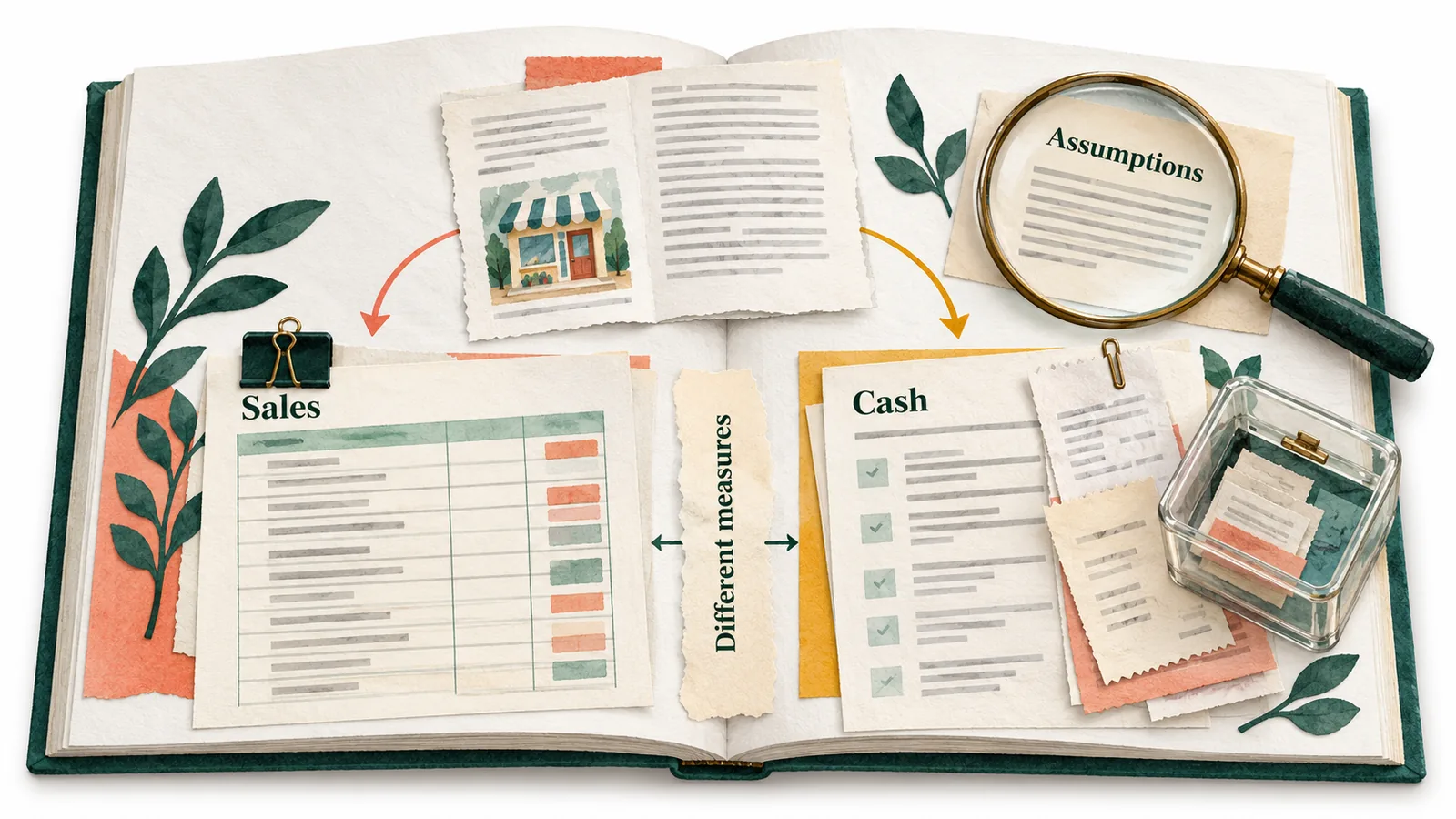
Show why sales, a simplified remainder and cash are different
Fictional worksheet B-040 describes one example period in USD. It assumes sales of $1,000, variable costs of $400 and fixed operating costs of $300. The simplified remainder is $1,000 - $400 - $300 = $300. That is not a complete net-profit calculation: owner compensation, tax, financing and capital items are outside this example.
A separate cash record for the same period contains $700 received and $600 paid, a net cash movement of $100. These are different inputs and measures. Without the opening balance and a reconciliation, neither an ending balance nor the full explanation of the timing difference is known.
| Observation | Editorial check | Permitted conclusion |
|---|---|---|
| Sales 1,000; costs 400 and 300 | Confirm common period, currency and stated exclusions | Simplified remainder 300 under those assumptions only |
| Receipts 700; payments 600 | Keep the cash record distinct from the sales example | Cash movement +100, not net profit or ending cash |
| Opening cash not supplied | Mark the ending balance unavailable | No inferred account balance |
| Reader finds the example clear | Record a comprehension observation | No evidence of future business or investment success |
Ask a reader to explain the difference in their own words. If they call the cash movement profit, investigate the wording before praising the worksheet as effective. Have an appropriate reviewer verify any substantive revision; do not silently invent the missing reconciliation.
Request page-specific observations
Give readers a short private brief: Which step was unclear? Where was prior knowledge assumed? Could you identify the inputs and exclusions? Does the example support the conclusion stated in the text? Ask for page references, not a summary of how much money the reader made.
Do not require readers to invest, borrow, buy a subscription, change a business process or disclose financial results. They can assess explanations using the supplied fictional material. A separately commissioned implementation or consulting project is not the same as a reading invitation.
For each issue, retain the copy version, observation, checking owner and decision. Mark a preference as a preference. A reader who dislikes the management style has not necessarily found a factual error, but their reaction may reveal that the audience promise is wrong.
Do not exchange access for a public verdict
KDP's book-copy guidance does not permit requiring or influencing a review. Inspect benefits and completion conditions through the review-rules guide, not just the word optional in an invitation.
Would you like to read this introductory business guide and comment on the clarity of its examples? You can use the supplied fictional figures; no investment or purchase is needed. You may decline or stop. Public reviews and favorable opinions are not conditions of access.
The actual offer must match this wording. Do not send review links only to satisfied readers, reclaim a benefit for nonposting or provide a ready-made endorsement. If a contribution is missing, use the review timeline rather than pressure or promises of publication.
Close one useful editorial cycle
Choose a representative chapter, check the examples and send a versioned copy to a relevant group. Track working deliveries, documented issues and verified corrections. Do not translate private feedback into a promised star average or attribute later business outcomes to the book without evidence.
Browse the public ARC library for actual titles and access conditions; this page does not promise a Business & Money inventory or a format. For technical operations material, use engineering and transportation feedback. For team communication, use the ARC team workflow.
For current listings, browse the Business & Money books in the ARC library. Compare each title's intended reader, examples and access details; inclusion does not validate a method or its financial claims.
Sources and scope
Official KDP and Investor.gov references checked on 18 October 2026. B-040 is an original fictional editing exercise, not a financial forecast, professional advice, review-service certification or guarantee of Amazon publication.
Frequently asked questions
Who should read a Business & Money draft?
Match the stated role, knowledge level and setting. Beginners can flag missing explanations; appropriately qualified reviewers can assess a defined technical scope.
Should readers apply the strategy before reviewing?
Do not require investment, borrowing, purchases or business changes. Readers can assess explanations using supplied fictional examples without risking money.
What should a financial example include?
Name the currency, period, inputs, calculation and exclusions. Keep sales, cash movement and a simplified remainder distinct, and mark missing information as unavailable.
Does positive feedback validate financial advice?
No. Reader satisfaction does not establish suitability, future returns or legal compliance. Consequential claims need appropriate evidence and review.
Should I collect readers' statements or portfolios?
Not for an ordinary reading brief. Use synthetic figures and ask about reading fit rather than private accounts, holdings or confidential company records.
Does this page guarantee business-book copies or reviews?
No. Inspect actual library listings and conditions. No inventory, format, star average, sales result or Amazon publication is guaranteed.