

Amazon Reviews for Engineering and Transportation Books
Make diagrams, units, references and assumptions inspectable by the right reader.
Reader feedback is not engineering sign-off, professional certification or permission to build, repair or operate equipment.
Technical reader feedback is not permission to build or operate
An introductory engineering text, transport history and maintenance reference make very different demands. One explains concepts, another documents events, and another may contain instructions with real consequences. Name the discipline, audience, jurisdiction where relevant and intended use before recruiting readers.
Private feedback can locate an unreadable diagram, a missing unit or an unexplained assumption. Independent customer reviews can describe reading experience. Neither replaces qualified engineering assessment, applicable rules, model-specific documentation or authorization to perform work. This guide contains no construction, repair or operating instructions.
Use the Amazon book review hub for general conditions. A software-heavy title also needs the technology-book version checks. For financial or operational business examples, use Business & Money feedback.
Choose competence for the actual question
A student can identify an unexplained symbol. A practitioner familiar with one machine cannot automatically validate another. A transport enthusiast can comment on narrative clarity without reviewing operational procedures. Describe the role you need rather than treating a general interest in engineering as technical qualification.
Recruit through relevant learning or professional groups that allow invitations. Check a technical reviewer's relevant experience and credentials for the assigned work. Obtain permission before sharing restricted diagrams or employer material; readers should not have to provide confidential records to prove their knowledge.
| Role | Useful task | Not established |
|---|---|---|
| Intended learner | Find undefined notation and gaps in explanation | Structural, mechanical or operational safety |
| Subject specialist | Assess named examples and references within competence | Approval of every discipline or future revision |
| Production editor | Check labels, units, captions and cross-references | That a correctly printed specification is technically valid |
| Independent customer | Describe the usefulness of the stated edition | Certification, licensing or permission to perform work |
Keep commissioned technical review separate from public customer opinions. A fee can pay for a scoped report; it must not be described as buying independent approval on Amazon. Retain what was checked and what was explicitly excluded.
Record source, revision and applicability
For each consequential statement, record the source title, issuer, revision or date, relevant section and scope. Distinguish a historical explanation from a current requirement, an illustrative model from an equipment specification, and an author's calculation from a published reference value.
For aviation material, the FAA handbook and manual directory is a route to official references. Its existence does not make a general book appropriate for a particular aircraft or operation. Check the actual document, revision, applicable requirements and equipment-specific information through appropriate professional processes.
For unit presentation, the NIST manuscript checklist provides an editorial reference for quantities and SI usage. Use it for that limited purpose, not as a certificate of design accuracy or a substitute for current discipline-specific standards. A standards number printed in a footnote is not evidence that the relevant text was checked.
Do not reproduce copyrighted standards, proprietary drawings or manuals without appropriate rights. Where the reader needs to consult a separate source, identify it clearly and state access requirements. Do not imply that a review copy includes a license to every cited document.
Inspect the exported diagram, not just the source artwork
Give the manuscript a version and date. Check subscripts, decimal points, unit symbols, legends, reference numbers and the distinction between similar line types. Inspect images at the actual reading size. A readable original drawing can become unusable after conversion or reduction.
If meaning depends on color, inspect the offered grayscale version too. Check that figure references point to the intended diagram and that a caption states whether an illustration is schematic or to scale. Never let an attractive image imply usable dimensions when the drawing was only conceptual.
KDP's content-quality guidance addresses publishing issues such as legibility; it does not validate a design. Use the ARC handoff guide for copy versions and access. Check rights and distribution conditions before offering a technical digital file.
Treat an unlabeled dimension as unresolved
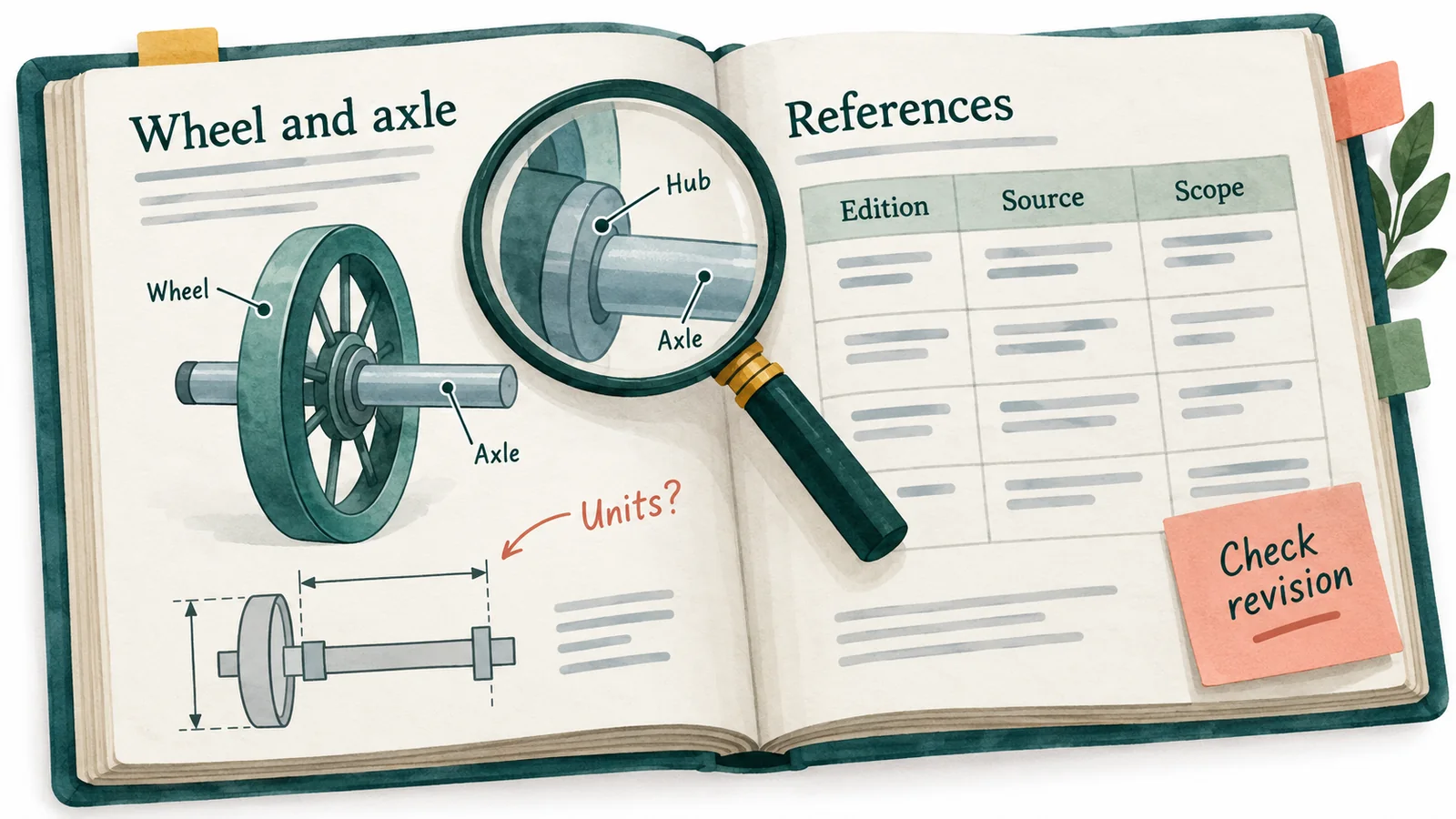
Fictional proof E-040 contains a schematic wheel-and-axle figure and a length marked only 250. A reader must not assume the missing unit from the picture. The editorial action is to consult the author and the relevant source, not choose a unit because it looks plausible.
If the checked source later identifies the illustrative length as 250 mm, the conversion is 250 mm = 0.25 m. That conversion alone establishes neither a usable manufacturing dimension nor a tolerance, material, load capacity or safe design. No real equipment specification is supplied by this example.
| Reported issue | Action | Evidence and limit |
|---|---|---|
| Length shown as 250 without a unit | Ask the author and check the source before changing it | Unresolved until confirmed; no guessed unit |
| Confirmed illustrative value is 250 mm | Check notation and any stated conversion | 0.25 m is the equivalent length, not design validation |
| Diagram label cannot be read | Revise the artwork and inspect the delivered format | Readable export, not a physical equipment test |
| Reference revision is not identified | Assign an applicability and source check | Current status unknown until the actual source is inspected |
Retain the issue, checking owner, source and corrected file revision. Do not mark the entire chapter technically approved because a unit was added. If a potentially unsafe instruction is reported, pause the affected material and obtain a competent assessment before redistributing it.
Ask for evidence without asking readers to perform hazardous work
A useful private brief asks for the page, figure or equation, the unclear point, the relevant source and the reading conditions. Have readers distinguish an unreadable label from a disputed calculation. Ask them to flag uncertainty, not to resolve a safety-critical ambiguity by experiment.
Do not require readers to assemble machinery, service a vehicle, work on live equipment, fly an aircraft or test a system to earn or retain reading access. Do not ask them to reproduce a suspected dangerous instruction. Any separate professional testing project needs its own authorized scope, competence and safeguards; it is not a customer-review task.
Use minimal redacted reports rather than plant drawings, vehicle identifiers, passenger data or restricted maintenance records. A reader can comment on terminology or navigation without disclosing their employer's operations. Do not turn an ordinary feedback form into a collection of sensitive technical documents.
Separate a reading opinion from a technical sign-off
KDP's book-copy permission excludes required or influenced reviews. Check all benefits and completion conditions with the review-rules guide; the label technical reviewer does not remove those boundaries.
Would you like to read this introductory technical text and flag unclear explanations or diagrams? No assembly, repair or operational testing is requested. You may decline or stop. Public reviews and favorable opinions are not conditions of access.
Use this only when the actual offer agrees. Do not ask for a minimum star rating, a claim of professional approval or removal of criticism as the price of a corrected file. Keep voluntary public comments separate from a commissioned report. Use the review timeline for a missing contribution, not workarounds or publication guarantees.
Finish one traceable set of checks
Choose a representative chapter with its diagrams and source list. Verify permissions and versions, assign the appropriate reviewers, then recheck the corrected export. Track confirmed corrections and open questions separately; do not count a delivery or favorable response as proof of technical accuracy.
Browse the public ARC library for actual titles and access conditions. This page does not promise an engineering inventory, a copy format, review publication or any professional validation by Virtalibry. Use the ARC team workflow for communication without a public-posting obligation.
Sources and scope
KDP, NIST and FAA references checked on 18 October 2026. E-040 is a fictional publishing example, not an engineering drawing, inspection, current standards audit, operating procedure or safety approval. No machinery, vehicle or aircraft was tested.
Frequently asked questions
Does a favorable review validate a technical design?
No. Reader experience is separate from qualified engineering assessment, applicable requirements, equipment-specific documentation and authorization to perform work.
How should I choose a technical reviewer?
Match competence and relevant experience to the assigned discipline and scope. Record what was checked and excluded rather than claiming universal approval.
What should I do with an unlabeled dimension?
Keep it unresolved until the author and relevant source establish the intended quantity and unit. Do not infer a unit from the picture.
Should readers test machinery or repair instructions?
Not as a condition of reading access. Separate professional testing needs an authorized scope, competence and safeguards; do not ask readers to repeat suspected dangerous instructions.
Which source details belong in the editorial record?
Record issuer, document title, revision or date, relevant section and applicability. A general reference or standards number is not proof of a current scope check.
Can I request confidential technical records as proof of expertise?
An ordinary reading brief should not require plant drawings, vehicle identifiers or restricted maintenance records. Use minimal redacted observations and appropriate separate processes for professional work.