

Amazon Book Reviews for Computers and Technology Books
Give readers a clear learning goal, a stated environment and companion files that match the chapter.
Reproducing an example is a bounded check, not security certification, exam approval or a guarantee across future releases.
A technology book needs a reproducible learning path
A reader should be able to tell what they will learn, what they need beforehand and which environment the examples target. A beginner programming tutorial, certification study guide and advanced systems reference need different readers and different evaluation tasks. A vague request to tell you whether the book is good will not locate the first broken step.
Separate private technical feedback from an independent Amazon customer review. A useful report may identify a missing fixture or an outdated screenshot. A positive review does not establish that code is secure, that a system is production-ready or that a reader will pass an exam.
Start with the review guide hub for general conditions. If a technology book includes business claims, use the business-book workflow; for physical equipment, use engineering and transport feedback.
Match prerequisites, platform and time commitment
State the assumed language knowledge, operating system, software versions and access requirements. Ask whether the reader is comfortable with the prerequisites, not whether they promise to finish every chapter or award a particular rating. A reader outside the target environment can still comment on prose, but their run is not evidence for the supported configuration.
Invite through relevant learning communities or an opted-in audience where author invitations are permitted. Describe any optional lab separately, including expected setup work and possible costs. Do not conceal a paid cloud account, licensed application or specialist hardware requirement until after the reader accepts.
| Participant | Useful question | Limit |
|---|---|---|
| Intended beginner | Can I identify the prerequisites and follow the explanation? | Not a security or architecture assessment |
| Reader in the stated environment | Does the supplied fixture produce the documented result? | Evidence for that configuration and example only |
| Technical reviewer | Are the assigned examples and claims correct within scope? | Not a guarantee across future tool releases |
| Independent customer | How useful was this edition for my reading goal? | Not exam certification or production approval |
Ship the exact files the chapter describes
Create a small manifest linking manuscript edition, example identifier, companion-file revision, environment, input data, expected output and known limitations. Use stable revision identifiers rather than a download that silently changes under an old printed link. Keep a dated errata page so corrections remain distinguishable from the original exercise.
For a Node.js example, npm's versioned lockfile documentation explains how a package lock records the dependency tree. That helps identify dependencies; it does not capture every operating-system, external-service or configuration difference. Record those separately. The linked documentation is for npm CLI v11, not a recommendation to use it as the latest release.
Use synthetic fixtures, remove secrets and check redistribution rights for code and datasets. Provide the same file revision that the chapter uses. A current repository branch may be useful for a new edition but unsuitable for reproducing the old one. Do not force readers to discover that distinction through trial and error.
Inspect code indentation, punctuation, line wrapping and links in the delivered book. Text that copies incorrectly from an exported page can fail even when the original source works. KDP's quality guidance supports the publishing check; it does not certify software behavior.
Make execution optional and keep it away from real systems
A reader may assess clarity without running anything. If you invite a separate voluntary lab, restrict it to the supplied harmless example in an appropriate isolated environment. Explain what the activity does before asking anyone to execute a file. Do not ask for administrator access merely to make a tutorial easier.
Never make access to a reading copy depend on testing against employer systems, real customer data, production accounts or third-party networks. Security exercises require explicit authorization and an appropriate scope. Do not ask readers to bypass protections or probe a live target as proof they read the chapter.
Do not collect passwords, tokens, private repositories or raw logs containing personal data. Accept a minimal redacted report. If a reader cannot run an example without exposing something sensitive or incurring an unagreed charge, stop that task and improve the fixture instead.
Diagnose the file revision before blaming the algorithm
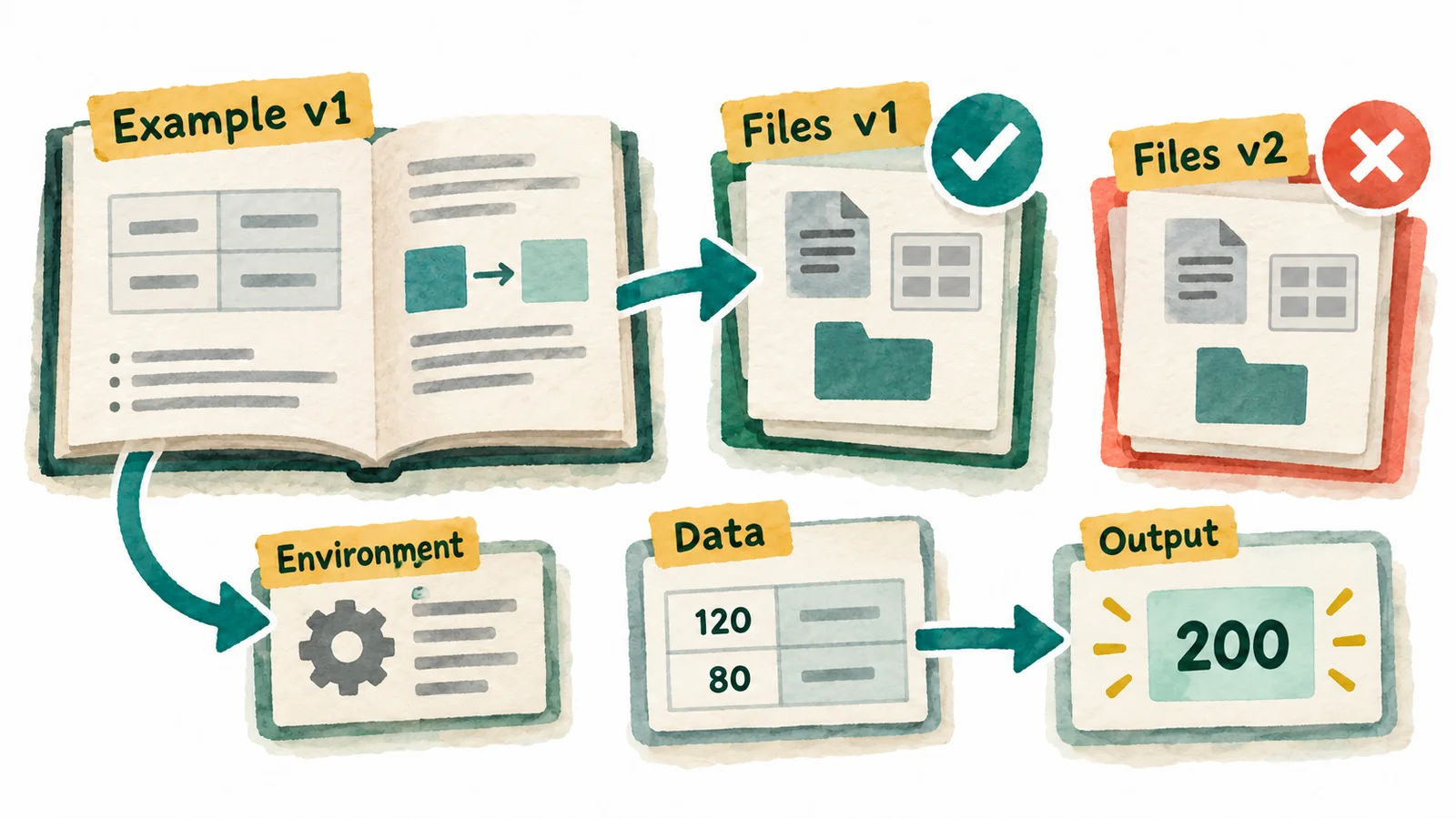
Fictional exercise T-040 sums two synthetic values, 120 and 80, for an expected total of 200. The book's Example v1 uses Files v1. A newer Files v2 adds a third value, 20; its total is 220. That newer fixture is not inherently defective, but it does not match the two-record exercise printed in the old chapter.
| Configuration or report | What can be concluded | Next check |
|---|---|---|
| Example v1; Files v1; values 120 and 80 | Documented fixture has two records and expected total 200 | Inspect the actual run and environment before marking it passed |
| Example v1; Files v2; extra value 20 | The fixture does not match this chapter; total 220 is plausible | Restore the matching fixture or revise the exercise explicitly |
| Reader cannot open the companion link | Access problem, not a failed calculation | Repair delivery without requesting a public review |
| No execution report supplied | Run status remains untested | Keep clarity feedback separate from execution evidence |
The arithmetic is illustrative; no software implementation was run for this guide. A reproducibility record needs the actual inputs, environment and result, not just a green mark in a diagram. Passing this toy exercise would not demonstrate security, scalability or correctness for unrelated data.
Collect the smallest report that identifies the obstruction
Ask for the chapter and step, manuscript edition, file revision, relevant environment, expected result and observed result. Separate a broken link, installation problem, confusing explanation and incorrect output. This lets the author fix delivery without rewriting an algorithm or changing prerequisites to hide a genuine gap.
A short redacted error excerpt may be enough. Do not require full screen recordings, account access or a copy of a reader's working project. Let someone report uncertainty rather than forcing a success/failure choice when they did not execute the example.
For certification material, identify the intended exam or syllabus version and check its current official scope separately before publication. Do not advertise authorization, accreditation or a passing outcome based on customer enthusiasm. Paid technical review is a private deliverable, not a purchase of a public verdict.
Leave the public opinion with the reader
KDP's copy guidance excludes required or influenced reviews. Use the review-rules guide to inspect the complete arrangement, including credits and future access.
Would you like to read the stated tutorial edition? Notes on unclear steps or mismatched companion files are welcome. Running examples is optional; do not use real accounts or private data. You may decline or stop. No public review or favorable opinion is required.
Use that wording only if the offer agrees. Do not withhold a corrected file from a critical reader, send review links only to satisfied participants or impose a rating as a completion condition. Keep copy and version records separate from any voluntary public contribution.
Maintain the book as a versioned learning resource
Start with one representative chapter and a matching fixture. Repair the first reproducible obstruction, recheck the corrected export and record what remains untested. Track deliveries and verified fixes, not a promised stream of reviews or a guarantee that examples will work forever.
Browse the public ARC library for real listings and conditions; no technology inventory or file format is promised here. Use the ARC team workflow for communication and the review timeline for a missing public contribution. No service can force its publication.
Sources and scope
KDP and versioned npm references checked on 18 October 2026. T-040, its revisions and figures are fictional. This is a publishing workflow, not an executed software test, security assessment, certification endorsement or guarantee of external-policy compliance.
Frequently asked questions
What information should a technology reading invitation include?
State the intended level, prerequisites, operating environment, example versions and any optional lab requirements or costs before the reader accepts.
Must every reader execute the code?
No. Clarity feedback can be given without running examples. Any voluntary lab should be separately scoped and must not involve real accounts, private data or unauthorized systems.
What makes a companion example traceable?
Record the manuscript edition, example identifier, file revision, environment, input fixture, expected output and known limits. A silently changing download is not a stable reference.
Does a lockfile capture the entire environment?
No. It identifies the dependency tree within its tool's scope. Operating systems, external services, configuration and other assumptions still need records.
Can a successful example prove production readiness?
No. A result for one fixture and configuration does not establish security, scalability, general correctness or success on an exam.
What should a useful technical issue report contain?
Provide the chapter and step, relevant revisions and environment, expected and observed results, and minimal redacted context. Do not send secrets or full private projects.