

Amazon Book Reviews for Art and Photography Books
Ask the right readers to inspect image choices, captions and the experience of your visual book.
A digital reading copy cannot establish print colour accuracy, image rights or a guaranteed public review.
Art-book reviews start with the edition readers will actually see
A photography monograph, a drawing lesson and an exhibition catalogue need different reading briefs. A monograph may depend on sequence and visual rhythm. A lesson needs understandable demonstrations. A catalogue needs dependable captions and useful context. Name the book's job before looking for people who might review it. A reader can like the subject yet be unable to assess the task you have in mind.
Keep three activities distinct: private editorial feedback, checking a specific production file or physical proof, and a reader's optional public opinion. None substitutes for the others. A positive response to a PDF does not establish how a bound spread reproduces; an attractive spread does not establish permission to use the photograph. Start with a bounded brief rather than a target number of Amazon stars.
This page is an editorial guide, not a live genre inventory. Browse actual listings in the ARC library and inspect their conditions. Use the book-review guide hub for the broader workflow. Availability, reading formats and Amazon publication are not guaranteed.
Match visual experience to the question
Recruit for a stated interest and level of experience. A beginner can tell you where a drawing explanation loses them. A practising photographer can identify an unexplained lighting assumption. A reader interested in the location may assess the sequence of a travel collection without being qualified to judge technical colour reproduction. Ask only for the experience necessary to choose a useful reading task.
| Book | Useful reader | Bounded question |
|---|---|---|
| Photography collection | Reader interested in its subject | Where does the image sequence feel repetitive or unclear? |
| Drawing introduction | Beginner matching the stated level | Which demonstrated transition lacks an explanation? |
| Exhibition catalogue | Reader familiar with the context | Which caption needs a date, source or clearer identification? |
Use your opt-in audience or communities that permit invitations. Do not message a scraped list of photographers or imply affiliation with a museum. A qualified paid editorial assignment should have its own scope and deliverable; do not attach a requirement to post a customer review. Let readers decline without explaining their taste or providing private account details.
Prepare a versioned copy and state what it cannot show
Label the supplied edition, export date and page references. Explain whether readers are seeing a screen PDF, a Kindle file, a print proof or finished stock. Include the captions and credit section that belong with that version. Do not distribute a small gallery of highlights and call it the complete reading copy.
For your own inspection, check full-page images, facing spreads, captions near a gutter, fine line work and the smallest text. Try the intended reading size before zooming. Ask readers to distinguish unreadable text from information they simply wish were included. Record device, orientation and file version when a problem is reported, without collecting unrelated identifiers.
KDP's quality guide addresses legible images and text. It is a publishing reference, not a colour-management certificate. A screen preview cannot establish paper texture, binding loss or colour accuracy in a printed copy. Arrange the relevant production check separately and avoid describing an uninspected print edition as approved.
Keep the credit and permission record outside the popularity test
Create an image register containing an asset identifier, creator, source, permission or licence evidence, permitted use and required credit. Match that identifier to the actual file placed in the book. Keep uncertainty visible: an empty evidence field is not permission. A familiar signature, a search-result thumbnail or a reader recognising the image is not your clearance record.
KDP's intellectual-property FAQ places responsibility for publishing rights on the publisher. If material uses a Creative Commons licence, inspect the specific licence conditions: attribution alone does not remove noncommercial or no-derivatives restrictions. This guide does not determine whether a particular crop is an adaptation or whether additional rights are needed. Resolve specific uncertainty with appropriate advice before use.
A-041: separate a crop observation from a rights decision
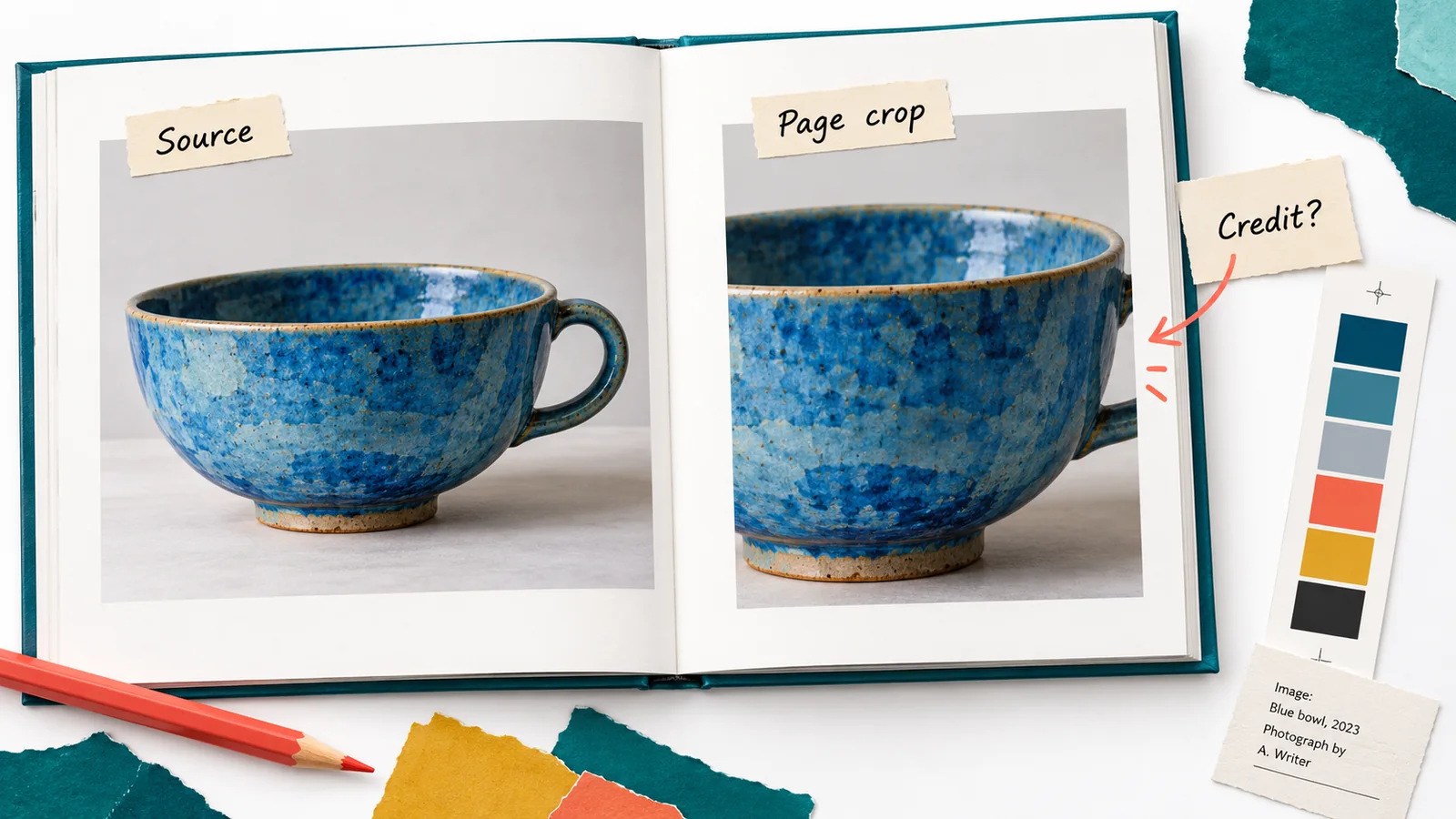
Consider a fictional book spread, A-041. The supplied source image shows a ceramic bowl with its handle intact; export v1 cuts off that handle at the right edge. One reader says the crop distracts from the object. Another prefers the tighter composition. Those preferences disagree, but both can be recorded alongside the observable difference.
| Record | Known evidence | Still unresolved |
|---|---|---|
| Source and v1 crop | Handle visible in source; cut off in export | Whether the crop serves the intended composition |
| Credit entry | Creator field exists in the working register | Permission scope and exact credit wording |
| Print appearance | Only screen files were supplied | Colour, binding and paper result |
The author might restore the full object, change the layout or retain the crop after a documented editorial decision. None of those choices resolves the missing permission evidence. Mark the screen-file issue and rights question separately. Recheck the changed page in v2, including its caption and facing page; do not label the entire edition validated after one correction.
Ask for reading feedback without directing a public opinion
A practical invitation is: "This is a screen reading copy of my photography collection. If the subject interests you, I would value notes on sequence and unclear captions. Reading or commenting does not oblige you to post publicly, and you can decline." Include the format and expected scope before the reader accepts, not after delivery.
KDP's review-copy guidance allows book copies without requiring or influencing reviews. This is not blanket approval of a service's incentives. Inspect actual conditions using the review-rules guide; a promised credit or future benefit can change the arrangement.
Do not supply review wording, ask only satisfied readers to post, require a minimum rating or reclaim access because no review appears. Agree on limited contact and respect a stop request. Keep sensitive draft images out of public screenshots unless their use is authorised.
Turn comments into a short revision list
Group notes by file defect, unclear context and taste. "Caption is clipped in this export" needs a file check. "I wanted more architectural photographs" may be outside the collection's stated scope. Preserve a minority observation when it identifies a reproducible issue; do not dismiss it because several readers liked the page.
Give each accepted change a page reference, owner, revised version and recheck result. Track deliveries and useful editorial observations separately from public opinions. A download is not proof of reading, and feedback counts do not predict sales or establish a review conversion rate without a valid denominator.
Choose one next action
Prepare a small, versioned brief before recruiting. For demonstrated projects, use craft and home-book feedback. For sequential images and lettering, use comic and graphic-novel feedback. The ARC-to-Amazon guide explains the separate handoff to an optional public opinion.
Sources and limits
Official references checked on 18 October 2026: the linked KDP review-copy, quality and rights guidance, and Creative Commons licence overview. The reading brief and A-041 record are original fictional editorial examples. No real image licence, printer, device, inventory or reader account was audited.
Frequently asked questions
Who should review an art or photography draft?
Choose readers who match the subject and the question. Beginners can flag missing explanations; production and rights questions need their own appropriate checks.
Can a PDF establish print colour quality?
No. State that it is a screen copy. Paper, binding and colour reproduction require checks of the relevant physical production output.
Can I crop a licensed image if I credit the creator?
Credit alone does not establish permission to crop or otherwise adapt an image. Check the actual licence and any other applicable rights; resolve uncertainty before use.
What should a visual feedback note contain?
Record file version, page, viewing conditions, the observable issue and its effect. Keep a preference separate from a reproducible defect.
Must a reader post on Amazon after receiving a copy?
Do not make the reading copy conditional on a public review or attempt to influence the opinion. Check the actual arrangement against applicable rules.
Does this page guarantee available art-book copies?
No. It is a guide, not a live inventory. Check actual library listings and conditions; formats, reviews and sales are not guaranteed.