

Amazon Book Reviews for Comics and Graphic Novels
Test whether readers can follow the page, read the lettering and understand the intended story sequence.
Private story feedback, format testing and optional public reviews are separate. Free-copy availability is not guaranteed.
Comic-book feedback must distinguish the story from the reading interface
A reader who loses the plot may have missed an implied action, encountered an ambiguous page layout or opened an export with the wrong panel order. Those are different problems. Before seeking Amazon book reviews for a comic or graphic novel, decide what you can usefully check in a private reading round: story comprehension, lettering, page flow or the behaviour of a particular edition.
A storyboard is not the final ebook. A page PDF is not proof that an interactive sequence works. Likewise, a correctly ordered export does not prove that the story is compelling. Keep observations tied to the supplied version and ask one clear question at a time. You can investigate a production fault without asking a reader to endorse the book.
Despite the historical word free in this URL, this guide does not promise free comic copies. Check actual ARC library listings and conditions. See the book-review guide hub for other tasks. Access, supported formats, ratings and Amazon review publication remain separate questions.
Recruit for the story and reading convention
Name genre, intended audience, language, reading direction and whether this is a complete volume or an excerpt. An experienced manga reader and a newcomer to graphic novels can reveal different issues. Neither should have to guess whether the first spread is intended to run right-to-left. State the convention before collecting notes about navigation, but do not coach readers through every story beat in advance.
| Question | Useful reading context | Evidence to request |
|---|---|---|
| Story comprehension | Reader matching the intended audience | Page and point where an action became unclear |
| Lettering legibility | Reader using the stated edition and display | Balloon, orientation and actual viewing conditions |
| Panel sequence | Reader inspecting that exported build | Observed order compared with the intended sequence |
Invite through communities that allow it or an opt-in author audience. Ask about relevant reading interests, not willingness to award high stars. Keep content information clear so people can decline. Do not request private account credentials, require screenshots of purchasing history or assume that familiarity with comics qualifies someone to perform accessibility or rights certification.
Send the edition you want feedback on
Label file version, page numbering, intended direction and the relevant device or app context. Include covers, credits and the necessary opening pages so an excerpt is not mistaken for a complete volume. If you send an extract, explain what context has been omitted and do not interpret the response as an assessment of the full ending.
KDP's fixed-layout guidance describes image pop-ups, panel presentation and reading-order metadata for relevant formats. Features depend on the chosen format and supported reading environment. This is not a promise that every panel feature works on every device.
Use Kindle Previewer as one inspection tool and check the relevant export in its intended reading context where available. Record what you actually tested. Do not call an emulator result a physical-device test, or a screenshot an interactive navigation test. If you cannot inspect a claimed feature, leave that feature's result unresolved.
Ask questions that lead to an actionable page note
A short first-read brief can ask: Where did you hesitate about which panel comes next? Which speaker was unclear? At what point did an action need information from an earlier page? Ask the reader to identify the first confusing moment before explaining your intended interpretation. That preserves useful evidence about what was communicated without coaching.
On a second pass, inspect the smallest balloon, sound-effect text near a crop, a two-page spread and a scene transition. Do not treat the availability of zoom as proof that the ordinary reading size is comfortable. Note whether text is unreadable, the speaker is ambiguous or the order is wrong; those require different repairs.
Give the reader a spoiler preference for private reports. Ask them not to publish unreleased pages or substantial panels without permission. A private excerpt for locating a defect is not automatically permission to reproduce the artwork in promotion. Keep original art, lettering, translation and contributor permissions in a separate record.
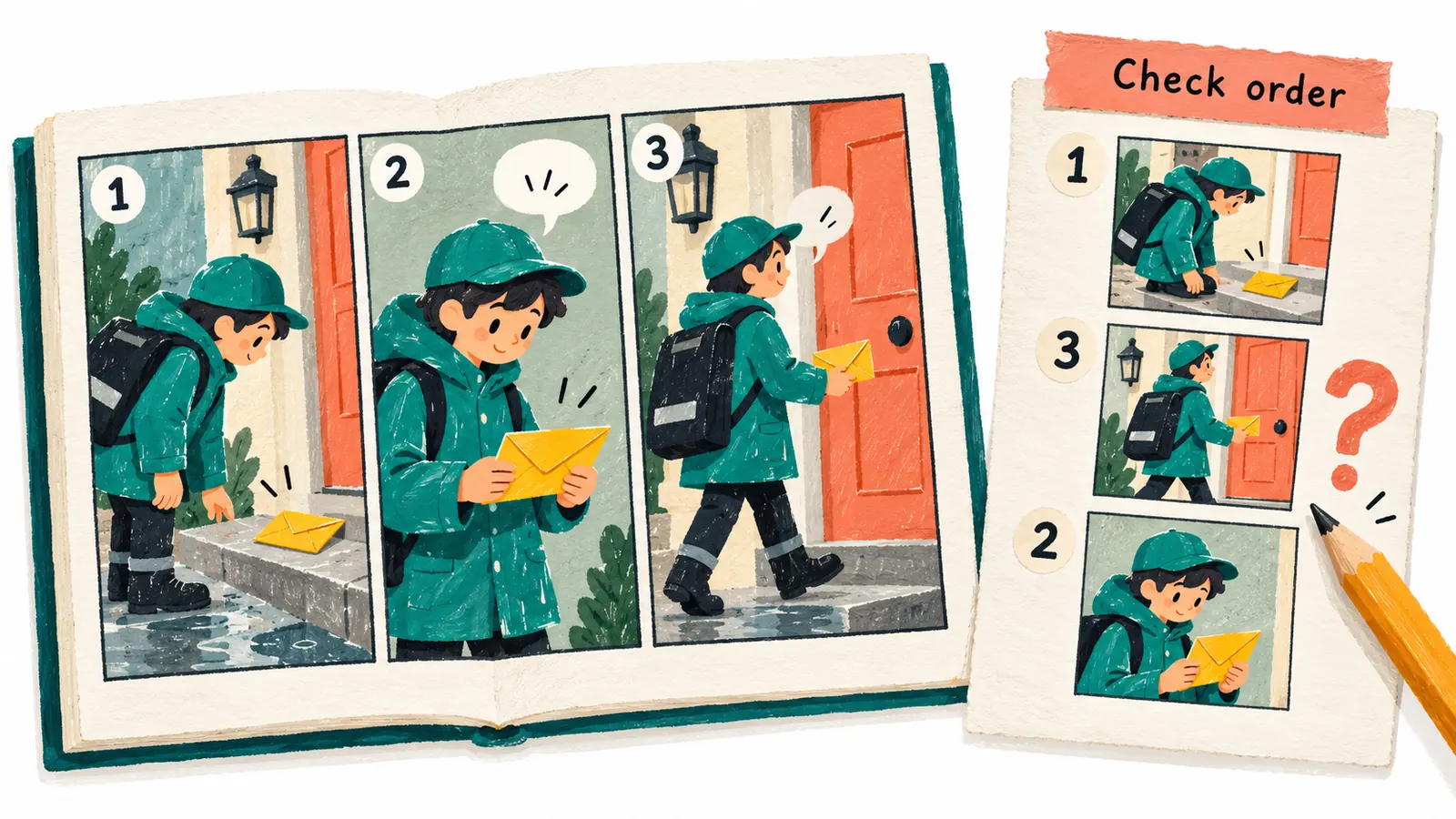
G-041: correct page art, incorrect panel sequence
In fictional record G-041, a three-panel page shows a courier noticing a yellow envelope, picking it up and carrying it to a door. The intended sequence is 1, 2, 3. A proof strip instead presents 1, 3, 2. The final action therefore appears before the pickup, even though no artwork file is missing.
| Check | Recorded result | Next action |
|---|---|---|
| Page sequence | Intended order: 1, 2, 3 | Retain as the comparison reference |
| Proof strip | Observed order: 1, 3, 2 | Inspect the export's sequence definition |
| Revised build | No rerun recorded yet | Repeat navigation before marking the issue closed |
The set of panels is unchanged, but the ordered sequence is different. "All three images are present" is therefore insufficient acceptance evidence. Correct the relevant sequence and recheck the exported build, including any affected page transitions. This is a conceptual example, not a live Kindle implementation, and it establishes neither universal device support nor accessibility compliance.
Keep public opinions independent of copy access
A suitable invitation might say: "This is the first volume of my graphic novel, supplied as a versioned reading file. I would value private notes on unclear actions or lettering. You may decline or stop, and a public review is not required." State the available format and any agreed follow-up before sending the file.
KDP's customer-review guidance permits book copies without requiring or influencing a review. Do not convert that limited permission into extra incentives, approved wording or a posting gate. The review-rules guide helps distinguish the actual conditions.
Do not solicit public opinions only from readers who praised the ending, penalise critical feedback or demand proof that a review was posted. A response about one confusing page can be useful even if the reader decides the story is not for them. Read the ARC-to-Amazon handoff before treating reading completion as a public-review event.
Recheck the exported file, not just the working page
Classify each note as narrative clarity, lettering, ordering, navigation or personal preference. A request for more action is not necessarily a defect; an incorrectly ordered panel needs a reproducible file check. Preserve the reader's original observation even when your interpretation changes after investigation.
Record the affected page, export version, expected behaviour and actual recheck. A revision to a balloon may change wrapping or obscure artwork; a sequence repair may affect a spread transition. Do not close every issue because one new screenshot looks correct. If the reading environment is unavailable, identify that limitation rather than assigning a pass.
Choose one next action
Prepare the version and a brief that separates first-read comprehension from second-pass format checks. Use art and photography feedback for crops and captions, or craft-book feedback for missing instructional transitions. Keep a short issue log before recruiting a larger group.
Sources and limits
The linked KDP customer-review, fixed-layout and Previewer references were checked on 18 October 2026. The brief and G-041 sequence are original fictional exercises. No real Kindle file, panel implementation, reader device, rights agreement or accessibility conformance was tested. No copy availability or review outcome is promised.
Frequently asked questions
Are free comic review copies guaranteed?
No. This guide does not promise inventory or free access. Inspect the actual library listing, available format and conditions.
Can readers review a comic from a page PDF?
They can comment on that PDF and its story presentation. It does not establish that an interactive Kindle edition behaves the same way.
How should panel-order feedback be recorded?
Record the file version, page, expected sequence and observed sequence. Having all panels present does not establish their correct order.
Does zoom make lettering automatically acceptable?
No. Inspect the stated reading conditions and distinguish unreadable text from navigation or speaker-identification problems.
Can I require an Amazon review after providing a copy?
Do not require or influence a customer review in exchange for a book copy. Check the actual incentives and conditions rather than relying on a label.
Does this guide certify accessibility or device compatibility?
No. It offers a reading brief and issue-record method. Accessibility and compatibility require appropriately scoped checks of the actual edition.