

Amazon Book Reviews for Crafts, Hobbies and Home Books
Find readers who can tell you where your project instructions become difficult to follow.
A finished sample is not proof that a beginner can follow the book. Reading feedback is not a safety assessment.
A craft-book reading brief should name what the reader can assess
Craft, hobby and home books range from paper projects to complex renovations. A general request to "try the book and leave a review" hides different levels of effort, cost and risk. Decide whether you need comments on wording, a check of diagrams, a separately arranged project trial or a reader's ordinary impression. Define that task before choosing participants.
A reader can identify an unexplained abbreviation without making the project. An experienced maker may complete it by filling in missing steps from memory. Neither result proves that the instructions work for the beginner described on the cover. Keep reading feedback, technical validation and optional Amazon customer reviews as distinct activities with distinct evidence.
This is a planning guide rather than a live collection of available books. Use actual ARC library listings for available formats and conditions, and the review guide hub for the wider process. There is no promise of particular copies, participants, ratings or publication.
Match skill, materials and practical access
State the intended level in observable terms: first paper-folding project, familiar with basic hand stitches, or able to read a specified type of pattern. Ask about the relevant experience, not whether the person is likely to enjoy the result. Someone outside the intended audience can still give useful notes, but label that context instead of treating all comments as interchangeable.
| Task | Reader fit | Useful question |
|---|---|---|
| Beginner instructions | Reader new to the stated technique | Which term or transition is not explained? |
| Pattern presentation | Reader familiar with that notation | Do labels and references match across pages? |
| Home-project planning | Reader matching the intended setting | Are prerequisites and exclusions clear before starting? |
Invite through your opt-in audience or communities that allow recruitment. Explain whether any physical work is requested; do not make the reader discover that requirement after accepting a copy. Do not require purchases, specialist equipment or photographs of their home for ordinary reading feedback. A separate paid testing arrangement needs its own terms and must not purchase a public customer opinion.
Package the instructions, not just the finished photographs
Supply a versioned file with its material list, terminology, diagrams and referenced templates. Name the units and identify which dimensions refer to a finished object versus a starting piece. Keep substitutions separate from the original specification. If you have not checked an alternative material, say so rather than suggesting it is equivalent.
For a printable template, include a labelled reference measurement and an instruction to check the actual printout before use. A display zoom percentage is not a physical scale measurement. If the reference does not match, stop treating that printout as correctly scaled. Do not compensate by guessing a different project dimension.
Ask readers to record the page or step where an explanation breaks down. Where they cannot reasonably continue, that stopping point is useful evidence. They do not need to buy more supplies or improvise the missing operation to earn the right to comment. KDP's content-quality guidance also addresses image and text legibility; a sharp diagram can still omit an essential transition.
Do not turn a reading copy into an unsafe practical assignment
For a potentially hazardous instruction, collect the location and description of the concern rather than asking the reader to reproduce it. Household electrical, structural, chemical and powered-tool work calls for an appropriate separate review, not an informal ARC task. A warning paragraph alone does not establish that a procedure is suitable.
Even for a simple paper project, do not infer child suitability, product compliance or general safety from a successful adult sample. A whole book can contain different risk levels. Define what was inspected and what was not; "instructions read" is a narrower and more accurate completion label than "project verified".
Check permissions for borrowed diagrams, patterns and photographs separately. The KDP rights FAQ is a starting reference, not a clearance of your materials. Permission for a finished-object photograph does not automatically cover a third party's pattern or diagram.
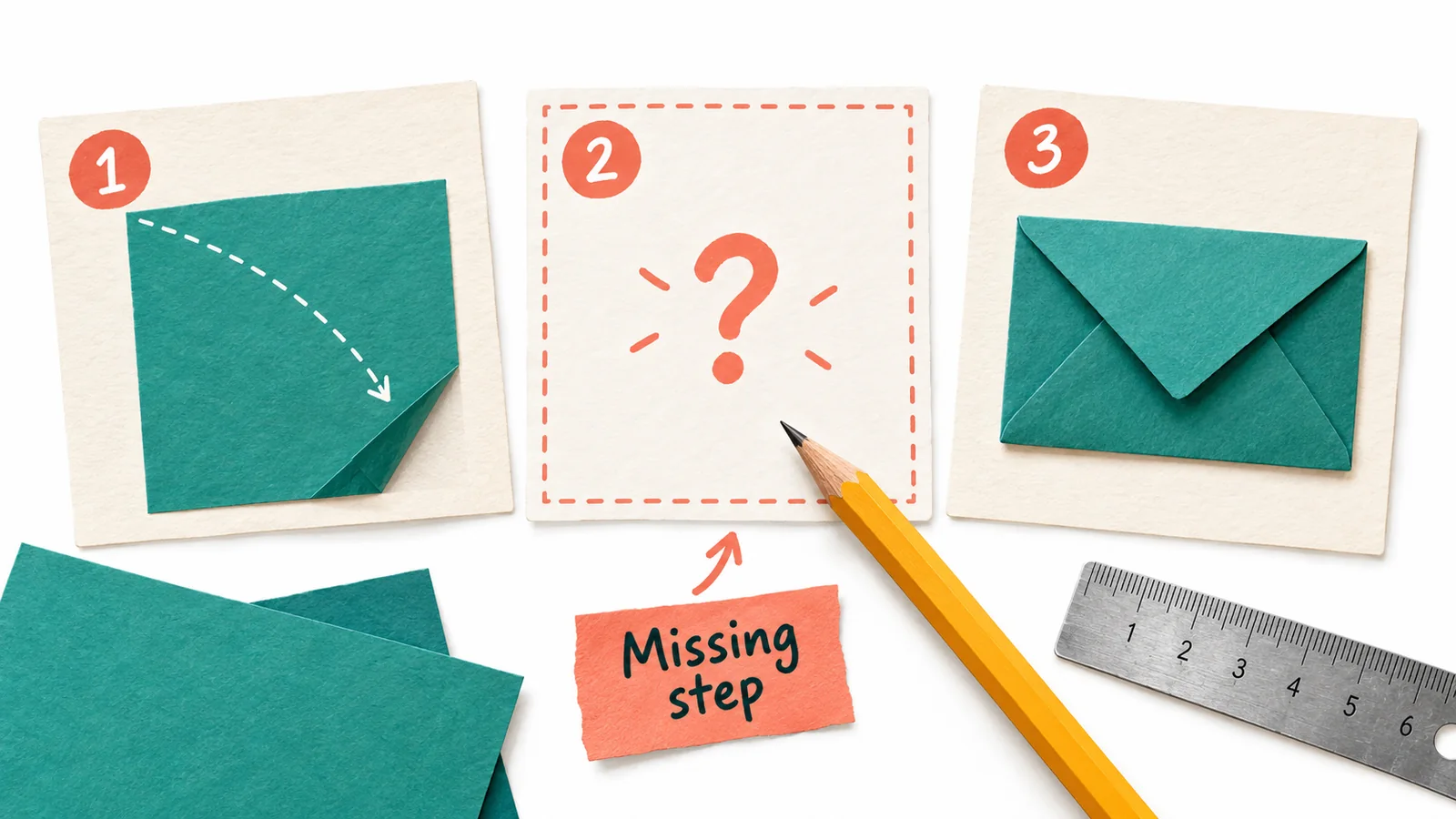
C-041: a completed envelope conceals an unexplained transition
In fictional record C-041, a paper-craft draft moves from step 1, a first fold, directly to step 3, the completed envelope. An experienced reader recognises the missing operation and finishes a sample. A beginner stops between the two illustrations. Their differing outcomes do not cancel the evidence that step 2 is absent from the supplied file.
| Observation | What it supports | What it does not establish |
|---|---|---|
| Steps labelled 1 and 3 | The supplied sequence has a visible gap | The correct missing operation |
| Experienced reader finishes | That person supplied extra knowledge | Beginner completeness or general repeatability |
| Step 2 added to v2 | A proposed revision exists | That the exported revision was successfully rechecked |
The next action is to document and illustrate the intended transition, then recheck v2 with someone matching the beginner brief. Preserve the original page reference and mark the new result explicitly. This example does not provide an actual folding method, measured materials or a tested pattern; do not use the illustration as a project tutorial.
Explain the task without creating a posting obligation
An invitation might say: "I am looking for readers new to this paper-craft technique. This version needs comments on unclear terms and missing steps; no making or purchases are required. You may decline or stop. A public review is not a condition of receiving the copy." Add the format and any agreed contact limit.
The KDP review-copy rule does not permit requiring or influencing a review in exchange for a book. Check the actual incentives and conditions, not merely the word optional. Do not offer extra rewards for a rating or public screenshot.
Send only agreed practical updates and accept silence or a stop request. Do not select only enthusiastic comments for a public-review request, write the customer's opinion for them or penalise a critical response. The ARC handoff guide separates supplying a copy from the reader's later decision.
Fix instruction defects before expanding recruitment
Sort feedback into missing information, inconsistent notation, export defects and preferences about the project. "The word gusset is never explained" is different from "I prefer a larger finished bag." Check the actual brief before expanding a project to satisfy every preference. Keep a record of the proposed change and why it serves the stated reader.
Recheck references affected by an inserted step: numbering, contents, caption arrows and later instructions. A corrected working document can still export an old diagram. Record the distributed version rather than treating a change in the author's editor as proof of a repaired reading copy.
Track delivered files, blocked readers and resolved issues separately. Do not count a finished object as a public review or assume that the absence of objections validates the whole book. Report untested procedures and missing evidence as unresolved, not as a zero-defect result.
Choose one next action
Write a one-project brief with the intended skill level, file version and a clear stopping rule. Use art and photography feedback for crops and captions, and comic feedback for sequential visual explanations. Then recruit for one bounded question rather than a guaranteed outcome.
Browse current Crafts, Hobbies & Home books in the ARC library to compare project descriptions, editions and access details. A listing is not evidence that a pattern was measured or a procedure tested.
Sources and limits
Linked KDP customer-review, quality and rights references were checked on 18 October 2026. The brief, matching table and C-041 example are original editorial tools. No real project was made, template measured, procedure certified or household inspected. Reader comments are not a substitute for appropriate technical or safety review.
Frequently asked questions
Do readers need to make every project?
No. Define the agreed task first. Ordinary reading feedback can identify unclear terms, missing steps and inconsistent diagrams without purchases or physical work.
Does an expert's finished sample prove beginner instructions work?
No. An expert may supply missing knowledge. Recheck the actual instructions with the intended reader and record what they needed to infer.
How should readers report a potentially dangerous instruction?
Record the version, page and concern without reproducing the activity. Arrange appropriate separate assessment rather than informal testing by ARC readers.
How can I check a printable template?
Include a labelled reference measurement and check the actual printout. Screen zoom does not establish printed scale; a mismatch remains unresolved.
Can I reward readers for a favourable public review?
Do not attach rewards, ratings requirements or posting obligations to a customer opinion. Check the actual arrangement against the relevant platform rules.
Are craft-book copies guaranteed here?
No. This page is a guide. Actual listings, formats and conditions must be checked separately; no inventory, review count or result is promised.