

Amazon Book Reviews for History and Biography Books
Ask readers to inspect the narrative, chronology and evidence your history or biography actually supplies.
An engaging account is not a verified record. Keep reader opinions, source checks and publishing permissions separate.
History-book feedback needs a question more precise than accuracy
A reader can find a biography compelling while missing an unsupported date. A specialist can locate a factual problem without judging whether an introduction works for a newcomer. Before seeking Amazon book reviews for a history or biography title, decide whether you need narrative feedback, a chronology check, examination of selected claims or a separately scoped professional fact-check.
State what kind of account the book presents. A memoir reports a person's recollections; a biography assembles an account of another life; a history develops an interpretation from evidence. If dialogue or scenes are reconstructed, identify the method and its limits instead of allowing the reader to mistake invention for a transcript. Historical fiction should not be presented as a verified biography.
This is an editorial guide, not a live catalogue of free review copies. Inspect actual ARC library listings and conditions. The review guide hub covers the wider process. Copy availability, public opinions, historical accuracy and publishing rights are separate matters; none is guaranteed by this page.
Match experience to the part of the manuscript being examined
Recruit for a subject, period, language or reading task, not for agreement with the author's conclusion. A reader new to the period can identify where the narrative assumes too much context. A local historian may notice an unexplained place-name change. A language specialist may identify uncertainty in a translation that a fluent narrative conceals.
| Task | Relevant reader | Useful observation |
|---|---|---|
| Narrative clarity | Reader matching the intended audience | Where a person, place or time transition becomes unclear |
| Selected factual claim | Specialist in that topic or source type | Exact claim, cited evidence and unresolved discrepancy |
| Quotation or translation | Reader competent in the relevant language and context | Wording or meaning needing comparison with the original |
Define the limits of a paid editorial or research assignment separately. Reviewing one chapter does not validate the whole book. Familiarity with a subject does not establish access to an unavailable source. Ask people to label an uncertainty rather than fill the gap from memory or assume that another volunteer checked it.
Give readers enough information to locate the evidence
Provide a versioned manuscript and stable claim references. For a checkable source note, record author or creator, title or description, document date, repository or publication, locator and the relevant page or passage. Distinguish an original record, a transcription, a translation and a later account. If readers cannot inspect the underlying item, record that limitation instead of calling the claim verified.
The National Archives document-analysis resources encourage examining a source and its context before using it as evidence. Apply that distinction to the manuscript: who created the record, for what purpose, and what can the supplied passage support? The resource is a teaching aid, not an authentication of your archive material.
Keep the document's creation date separate from the event date. A booking can show an intention to travel rather than a completed journey. A letter can report an arrival without recording its exact day. Check whether two sources concern the same person and event before combining them into a timeline. Repetition across websites may reflect a shared source, not independent confirmation.
Mark uncertain transcription and translation openly. Do not silently replace an illegible word with the interpretation that best fits the chapter. Include the source wording needed to inspect the issue, subject to appropriate use conditions, without circulating unrelated private material.
Keep memory, interpretation and permission distinct
For personal accounts, identify whether a passage is a contemporary record, a later recollection or the author's interpretation. Differences between accounts need examination, not a vote on which storyteller seems most convincing. A narrator's perspective can be historically useful even when it does not settle a disputed detail.
The Oral History Association's core principles describe memory in social context and a collaborative process involving ongoing consent and decisions about access. Its ethics guidance addresses review, release and use of interview material. These are discipline-specific references, not a generic release form or certification that an author project meets every requirement.
Do not ask ordinary readers to contact relatives, investigate a living person's private life or publish sensitive allegations to complete a feedback task. Resolve consequential questions through appropriately scoped professional review. Sharing a draft for private feedback does not itself authorise public use of a contributor's letter, image or interview.
KDP's rights FAQ places responsibility for publishing rights on the publisher. Archive access, an accurate citation and permission to reproduce are different questions. Check the actual material and conditions; this guide makes no case-specific legal finding.
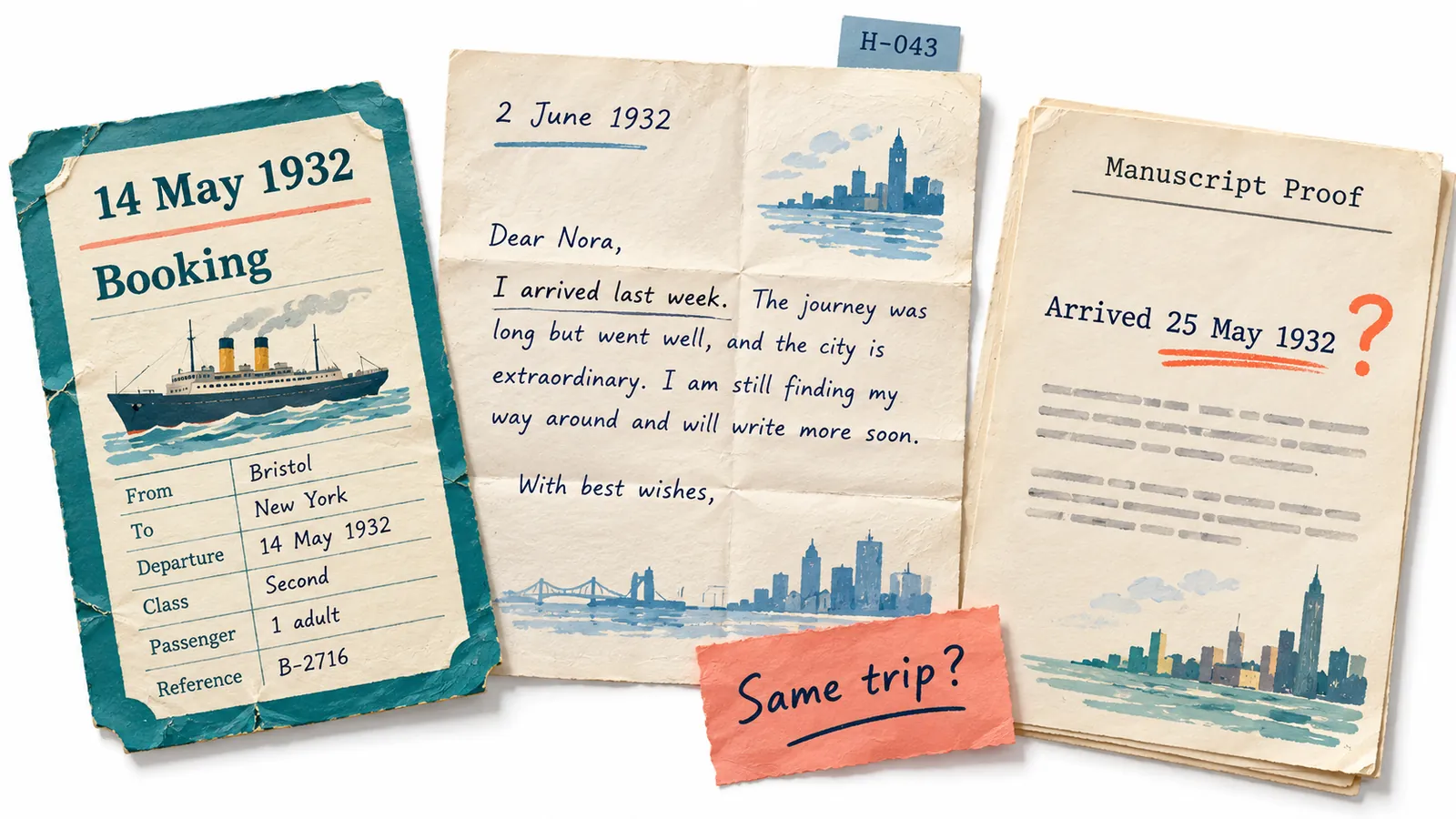
H-043: two dated records do not establish a precise arrival
Consider a fictional draft claiming that a traveller arrived on 25 May 1932. Its evidence file contains a booking dated 14 May 1932 and a letter dated 2 June 1932 saying, "I arrived last week." Those dates look compatible with a spring journey, but compatibility is not proof of the claimed day.
| Item | What is supplied | What remains open |
|---|---|---|
| Booking, 14 May 1932 | A planned journey is recorded | Whether that journey occurred and concerns this arrival |
| Letter, 2 June 1932 | The writer reports a recent arrival | Exact event date, identity and trip linkage |
| Manuscript claim | Arrival stated as 25 May 1932 | Evidence establishing that precise day |
Do not convert "last week" into one exact calendar date or count the booking and letter as two confirmations of 25 May. Check identity, provenance, surrounding text and whether the records concern the same trip. If that remains unresolved, a narrower statement could describe what the June letter reports, with the uncertainty preserved. Do not make a new factual assertion merely by removing a footnote.
H-043 is an invented editorial exercise. No real traveller, archive item or historical journey was investigated. The dates in the illustration are not authentic evidence, and the example establishes neither document authenticity nor a reliable arrival date.
Ask for a useful reading report without directing a public opinion
A practical invitation is: "I am looking for readers familiar with this period to comment on unclear chronology and missing context in this draft. Please distinguish a reading question from a claim you checked against a source. You can decline or stop; posting publicly is not required." State the format, version and agreed contact limit before delivery.
KDP's customer-review guidance permits book copies without requiring or influencing reviews. Inspect the actual incentives and conditions, not just the wording of the invitation. A research payment or editorial deliverable must not become a purchase of a favourable customer opinion.
Do not supply a review script, demand a rating or make future access depend on posting. Readers may disagree with an interpretation and still provide useful corrections. The ARC handoff guide separates supplying a copy from the reader's later public-review decision.
Record what changed and what is still uncertain
Classify each note as narrative context, chronology, source support, quotation, interpretation or permission. Keep the claim, supplied evidence, limitation and decision together. A missing source is not a confirmed error, but it is also not a successful verification. Avoid labels such as fully fact-checked when only selected passages were examined.
After a revision, check the distributed export, related timeline, index references and notes. Changing a date in one paragraph can leave a contradictory caption elsewhere. Preserve unresolved disagreements when the evidence cannot settle them. Report the scope of work performed rather than the number of readers who expressed confidence.
Choose one chapter and one review scope
Prepare the manuscript version, a short source register and a bounded question before recruiting. Use art and photography feedback for images and captions, or education-book feedback for teaching materials. Return to the review guide hub when deciding whether the next task is reading access, editorial work or a public-review question.
Sources and limits
The five linked KDP, National Archives and Oral History Association references were checked on 18 October 2026. The oral-history documents belong to the association's 2018 principles-and-practice suite; they are not a claim that every current local requirement has been checked. The brief and H-043 record are original fictional tools. No archive, narrator, rights agreement, live inventory or real reader account was audited.
Frequently asked questions
Who should read a history or biography draft?
Match the question to the reader: general readers for narrative clarity, subject specialists for a defined topic, and appropriate language or source specialists for specific records.
Does a positive reader review verify historical accuracy?
No. Engagement and confidence are not evidence that the sources support every claim. Fact-checking requires a separate, defined scope.
Can a document date establish an event date?
Not automatically. Distinguish when a record was created from the event it describes, and check identity, context, wording and corroboration.
Does finding a letter in an archive give publication permission?
Not automatically. Check the actual access and reuse conditions and applicable rights. A citation and a source check are not a rights clearance.
Should conflicting memories be settled by reader vote?
No. Preserve the disagreement and inspect the evidence. A recollection can be valuable without supporting an exact date or a single interpretation.
Are free history-book copies or Amazon reviews guaranteed?
No. Check actual library listings, formats and conditions. Do not require or influence a public review in exchange for a book copy.