

Amazon Book Reviews for Education and Teaching Books
Ask relevant educators to inspect whether the book's examples, tasks and checks match its stated teaching goal.
Usability feedback is not evidence of learning gains, curriculum approval or accessibility certification.
Education-book feedback needs a defined learner and teaching context
A classroom writing guide, a home-learning workbook and a professional teaching reference need different reviewers. Specify the learner stage, subject, prerequisite knowledge and setting before asking for feedback. An experienced secondary teacher may understand an explanation perfectly while overlooking the missing first step for a primary learner.
Distinguish four tasks: checking subject accuracy, examining instructions and materials, judging their usefulness in a stated context, and evaluating a claim about learning effects. A volunteer's positive reading experience cannot complete all four. State what your feedback round is meant to resolve and leave the other questions open.
This page is an editorial guide rather than an assurance that education books are available for review. Inspect real library listings for formats and conditions. Use the review guide hub for the broader process. No curriculum approval, teaching result or public-review publication is promised.
Recruit adults whose experience matches the intended use
Ask for relevant teaching or subject experience without collecting employer records, student files or credentials unrelated to the brief. A subject specialist can flag an incorrect example. A teacher at the intended stage can identify assumed vocabulary. A reader familiar with independent study can examine whether instructions work without a live instructor supplying missing context.
| Scope | Relevant adult experience | Useful deliverable |
|---|---|---|
| Subject accuracy | Knowledge of the specific topic | Located errors with reasoning and source questions |
| Instruction usability | Familiarity with the stated learner stage | Missing prerequisites, unclear directions and key mismatches |
| Context fit | Experience of the intended setting | Practical constraints and explicitly untested assumptions |
A paid editorial or subject review should have its own agreement and deliverable, not an obligation to post a customer opinion. Do not ask a teacher to test the material on a class as an undisclosed condition of accepting a copy. This workflow asks adults to inspect materials, not to provide identifiable student performance data.
Supply the goal, examples, tasks and answer material together
Label the edition and references, then provide the exact lesson goal, prerequisites, worked example, learner task and answer key. Identify whether an answer is unique, one of several valid possibilities or a model response. A key that gives a different task's answer can look authoritative while being unusable.
Ask the reviewer to follow references as written before adding their own explanation. Record where they supplied a definition, simplified an instruction or inferred a missing condition. Include printable material or companion files that the brief actually depends on, subject to the relevant publishing rules; do not imply that an absent resource has been inspected.
Check the actual export as well as the working document. KDP's quality guide covers matters such as legible diagrams and complete content. It does not validate an answer key or the instructional method. A task can display perfectly yet fail to request the skill named in its objective.
Keep design guidance, a reader's opinion and effectiveness evidence separate
CAST's UDL Guidelines offer design considerations including clear goals, representations and response options. Use them to ask specific questions about barriers, not as a badge proving that an entire book is accessible. State which material, format and use conditions were checked, and which were not.
The What Works Clearinghouse elementary writing guide, released in 2012 and revised in 2018, distinguishes recommendations and their supporting evidence. Its scope is elementary writing; it does not establish that your workbook or a different subject improves learning. Cite an applicable source for the actual claim rather than borrowing the authority of an unrelated guide.
For this editorial round, use synthetic tasks and adult comments. A real learner study, classroom trial or collection of student work needs separately appropriate permissions, safeguards and methods. Do not request student names, grades, diagnoses, recordings or identifiable classroom images through an ordinary author feedback form.
E-042: colouring is not yet evidence of comparison reasoning
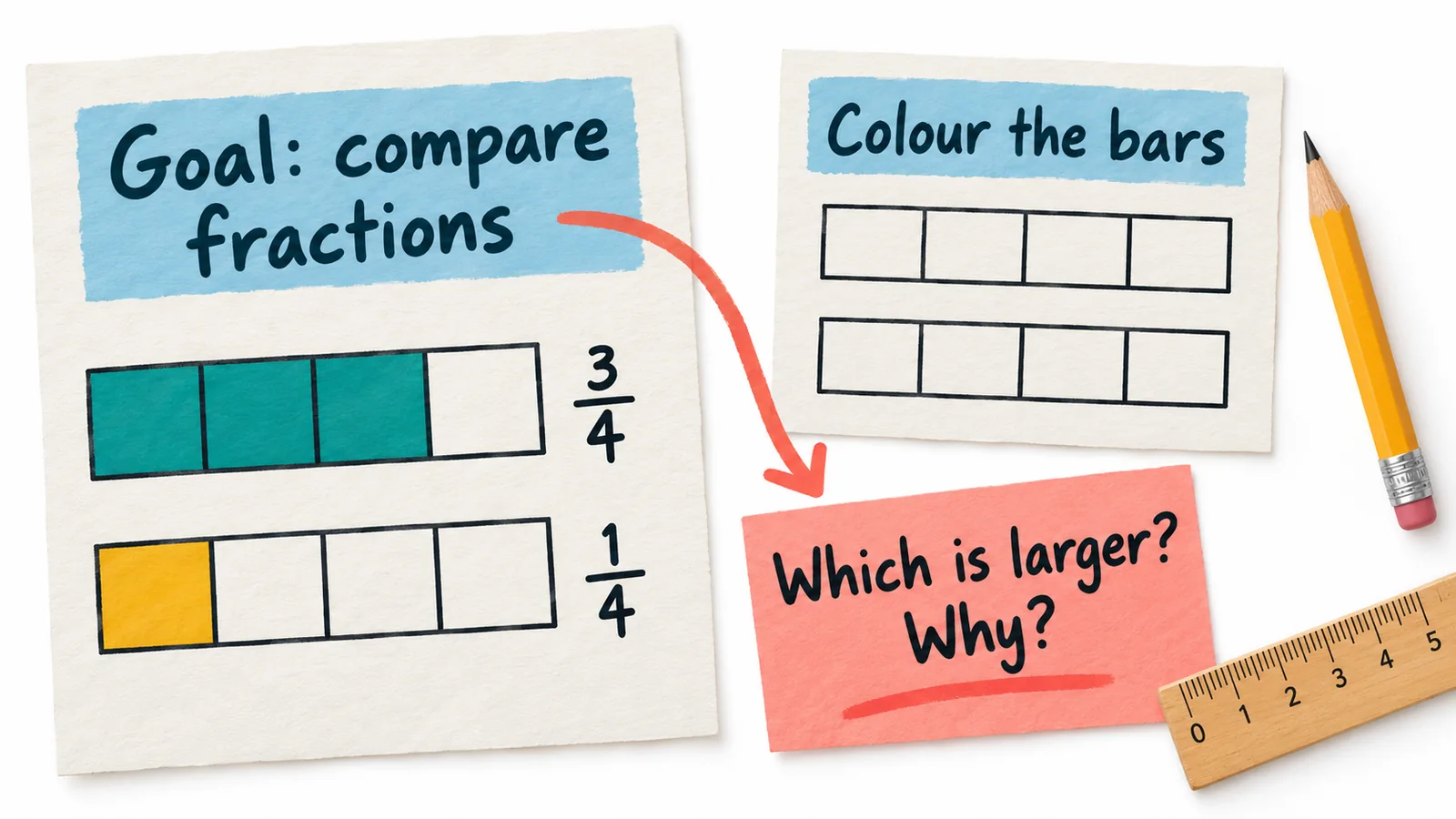
Consider fictional lesson E-042. Its goal is to compare fractions with the same whole and denominator. The page shows two equal-sized wholes, each divided into four equal parts: three parts shaded in one and one part shaded in the other. The task says only, "Colour the bars." Completing that instruction need not reveal whether the learner can compare the fractions.
| Element | Supplied material | Editorial finding |
|---|---|---|
| Goal | Compare fractions of the same whole | The response must address a comparison |
| Task v1 | Colour the bars | Colouring completion alone does not show reasoning |
| Proposed v2 prompt | Which is larger, 3/4 or 1/4? Explain using the equal parts | 3/4 is larger; reasoning refers to three versus one equal part |
The comparison depends on equal-sized wholes and equal partitions. The proposed prompt is a closer match to the stated goal, not proof of learning gains. No learners attempted either version, and no assessment instrument was validated. Record the proposal, check the mathematical content and plan an appropriate separate evaluation if making an effectiveness claim.
Ask for material-specific feedback without a public-review condition
A suitable invitation is: "I am seeking adult educators familiar with introductory fractions to inspect this version's directions, diagrams and answer key. No classroom trial or student information is requested. You may decline or stop, and a public review is not required." State the file format and agreed scope before delivering it.
KDP's book-copy guidance permits copies without requiring or influencing a review. Check the actual conditions if any benefit or completion rule is involved. A technical report and an optional customer opinion are not interchangeable deliverables.
Do not request favourable ratings, approved phrases or a screenshot proving publication. Do not turn a teacher's critical report into a reason to withhold an agreed editorial payment. Any paid professional assessment must remain distinct from obtaining public customer reviews.
Close the issue only after checking the distributed version
Classify notes as accuracy, prerequisites, instructions, answer-key consistency, format or preference. Assign an accepted correction to the affected page and version. If a task changes, update the key, worked example and any later reference too. Keep disputed answers open until the reasoning has been examined rather than resolving them by majority vote.
Track reviewed materials, corrections and rechecks separately from claims about pupils. A teacher's satisfaction is not a learning measurement, and a completed activity is not necessarily evidence of the intended skill. Avoid turning informal comments into percentages or advertising claims unsupported by the actual method.
Choose one teachable unit and one review question
Start with a complete unit and a clear scope before expanding recruitment. Use children's-book feedback for read-aloud and picture questions, or YA feedback for narrative expectations. The ARC handoff guide covers the separate path from a supplied copy to an optional public opinion.
Sources and limits
Linked KDP review and quality references, CAST guidelines and the WWC writing-guide page were checked on 18 October 2026. E-042 and the review brief are original fictional examples. No student data, classroom trial, learning gain, accessibility conformance or institutional approval was evaluated.
Frequently asked questions
Who should give feedback on an education book?
Choose adult educators or subject readers who match its learner stage, subject and intended setting. Separate content accuracy, usability and research claims into appropriate scopes.
Does a positive teacher review prove learning gains?
No. A teacher's opinion or a completed worksheet is not evidence that the book caused improved learning.
What makes an exercise match its goal?
The requested response should reveal the stated skill. If the goal is comparison, colouring a diagram alone does not establish comparison reasoning.
Should authors collect student names, grades or classroom recordings?
Not for this ordinary adult editorial workflow. Use synthetic examples and non-identifying page observations; any real learner study needs separate appropriate arrangements.
Can UDL guidance certify an entire book as accessible?
No. It can inform design questions, but a whole-book accessibility claim needs appropriately scoped checks of the actual materials and use conditions.
Are educators expected to post Amazon reviews?
No public review should be a condition of receiving the book copy. Keep technical feedback and an individual's optional customer opinion separate.