

Amazon KDP Keyword Strategy
Choose language the actual book can support, not phrases that merely look popular.
Screen candidates, give each metadata field its proper job and publish a reviewable change.
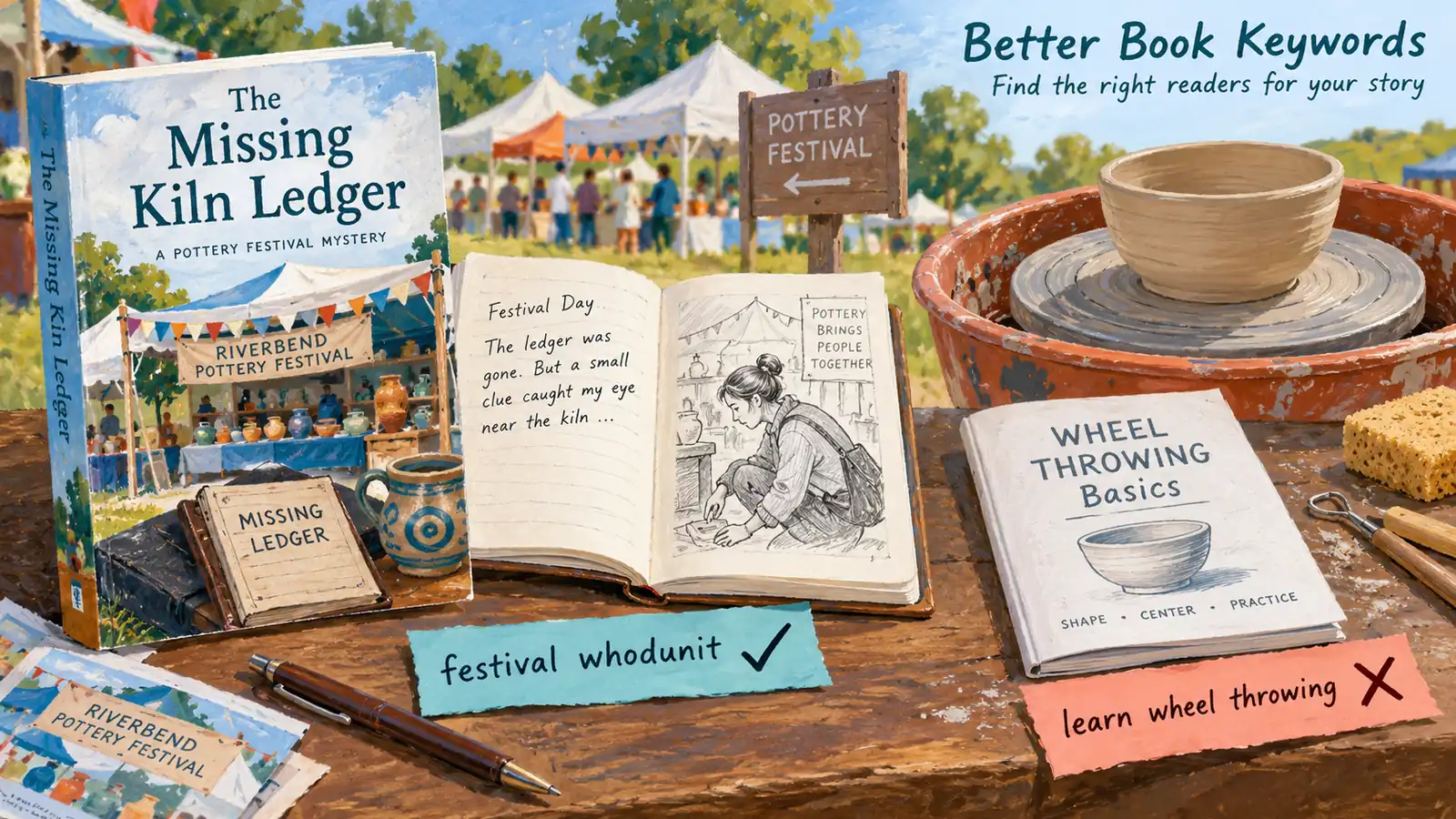
Build the strategy around the manuscript, not a popular phrase
An Amazon KDP keyword strategy connects the book with language a suitable reader might use. Start with genre or subject, audience, level, setting and a distinguishing feature. Require manuscript evidence for each candidate, not merely a competitor's listing or a placement promise.
This guide covers selection and controlled revision of book metadata. Advertising targets are a separate decision; use the Ads targeting guide for paid campaigns. A phrase useful for researching a market does not automatically belong in the KDP keyword field.
Original working brief
The Missing Kiln Ledger is a fictional adult cozy mystery about an amateur archivist investigating a disappearance during a small-town pottery festival. The story emphasizes clues, community relationships and a low-violence reading experience. It is not pottery instruction, romance-led fiction or a children's activity book.
This invented brief sets research boundaries. Popularity cannot justify a different plot, skill level or reading experience. A keyword edit does not change the interior.
Turn book features into candidate questions
Create a worksheet with candidate wording, the intended reader, manuscript evidence and a reason to keep or reject it. For fiction, distinguish the central reading experience from incidental scenery. For nonfiction, distinguish an actual method or task from a topic mentioned in passing. Keep the evidence specific enough that another reader could challenge it.
| Candidate wording | Evidence to require | Initial decision |
|---|---|---|
| Pottery festival whodunit | The festival and investigation structure are central | Inspect reader intent and existing metadata |
| Amateur archivist sleuth | The protagonist's role materially shapes the investigation | Keep as a hypothesis, not a volume claim |
| Small-town community mystery | Community relationships drive clues and conflict | Check whether it adds a distinct facet not already covered |
| Learn wheel throwing | The book would need genuine instructional content | Reject: this is fiction, not a craft manual |
| Romantic pottery escape | Romance would need to be a central promised experience | Reject for this working brief |
| The Missing Kiln Ledger | This is the title itself | Do not use a keyword slot to duplicate the title |
A candidate list is not a finished field allocation
Do not paste these examples into another book's metadata. Check its own audience, existing fields and current limits. The worksheet tests fit; it is not a universal phrase list.
Apply relevance and policy gates before comparing opportunities
KDP allows up to seven keywords or short phrases. Its keyword guidance calls for accurate wording and rejects misleading terms, unrelated authors, unauthorized brands, promotional claims and Amazon program names. Avoid redundant title or category information and artificial variants. Check the actual character limit displayed in the field rather than assuming a long phrase will fit.
Relevance is a gate. Reject a technique the book does not teach or a genre experience it does not provide. Apparently attractive demand cannot compensate for misleading readers.
Keep rejected candidates in the worksheet
Record missing content, wrong audience, duplication or policy problems so unsuitable ideas do not reappear with every tool run. Revisit a rejection only when its evidence changes.
Use storefront observations to understand language
Inspect a manageable set of candidate queries in the intended marketplace and appropriate book department. Read the kinds of books returned, the language readers encounter and the formats shown. Save the query and date. A result set dominated by instructional pottery books is a useful warning for the fictional mystery's phrase, even if the wording contains a shared subject.
Search suggestions are language clues, not verified search-volume counts. Result counts are not the number of interested buyers. A low count does not establish an easy ranking opportunity. Keep observed evidence distinct from a tool's modeled estimate and from your own inference about reader fit.
Look for a mismatch, not a flattering screenshot
Save contrary observations alongside supporting examples. Narrow or reject a different genre or task; keep mixed context uncertain. One similar cover does not outweigh the rest of the result set.
KDP's search explanation warns that results change and top placement is not guaranteed. This research does not expose a proprietary ranking equation. It gives you a better-informed wording decision.
Use the keyword research guides for the research sequence and the query-position explanation to record scoped observations rather than universal ranks.
Give the title, description, categories and keyword field different jobs
Use the actual title and an accurate subtitle, with cover and metadata aligned. Keep category selection focused on the book's central content. The keyword field can describe relevant facets not already covered; it is not a reason to turn every visible field into a string of search terms. Follow KDP's metadata guidelines.
| Field | Useful job | Avoid |
|---|---|---|
| Title and subtitle | Identify the real work and clarify its actual scope | Unrelated search strings or invented bestseller claims |
| Description | Explain the reading promise naturally | A pasted keyword list or tag block |
| Categories | Place the book in an appropriate browsing context | An unrelated shelf selected for an easier badge |
| Keyword field | Capture relevant additional reader language | Duplication, misleading terms or unsupported promises |
The description has its own restrictions. Do not add reviews, testimonials, review requests, external contact links, pricing, time-sensitive promotions or keyword-tag lists. See KDP's description rules. A natural explanation of the story is different from stuffing phrases into copy to imitate a search index.
Choose distinct supported facets, not seven versions of the same claim
Review the current title, description and category context beside the candidates. Favor wording that adds a useful, accurate distinction. Do not manufacture extra claims simply to fill every available slot. If the remaining ideas all duplicate existing information or imply content you do not have, stop and improve the candidate research.
Write a reason for each retained candidate
For the fictional mystery: the festival is central, the archivist's method shapes the plot and community relationships drive the experience. Each facet still needs wording, storefront and duplication checks; retention proves neither volume nor placement.
The AI keyword generator can draft phrases from your supplied context. It does not inspect the full manuscript, browse live results or verify volume, rights or compliance. Check every draft against the book and current rules. For shelves, use the category explanation and the selection workflow.
Publish one reviewable metadata change
Save the current field values, candidate rationale, edition, marketplace and date. Correct a clear policy or accuracy defect promptly; do not preserve misleading metadata merely to keep an experiment tidy. For a discretionary wording test, limit the intervention so a later observation has a useful interpretation.
Submit the change through the book's details workflow and verify the live state after the applicable processing period. KDP's timeline guidance distinguishes operations; a saved edit is not proof of an immediate storefront change. Keep an operational record of submission and confirmation without claiming that a keyword field must become visibly readable on the product page.
- Save the previous values and reason for the change.
- Identify the exact edition and market.
- Record any simultaneous price, cover or promotion changes.
- Keep query-check conditions stable where practical.
- Choose a review date and a time allowance.
Evaluate fit and outcomes without inventing query attribution
Compare the same scoped observations, not the most favorable search you can find afterward. A book appearing within an inspected range is an observation about that query and context. It is not a count of all organic impressions, and a later order cannot automatically be assigned to the changed phrase.
Use the measurement guide to separate observations, reported outcomes and unknown attribution. BSR movements do not supply missing organic click counts. If an email or advertising test overlapped, describe the comparison as confounded rather than proving the keyword worked.
End with a decision, not an algorithm story
Keep a clearly more accurate phrase, reject a misleading one or record that performance remains uncertain. Use the discovery plan when the real issue is the offer or introduction route. Keyword revision is one bounded publishing task, not a requirement to rewrite metadata every time a rank fluctuates.
When the candidate fits but the offer is unclear, follow the practical improvement workflow to diagnose and correct one specific mismatch.
Explore the KDP discoverability guides to connect this question with keywords, categories and ranking evidence.
Sources and scope
Official KDP sources checked: 16 October 2026. Book, candidates and worksheet decisions are fictional. No live keyword-demand or account audit was performed. Examples do not establish category nodes, search volumes, algorithm weights or guaranteed placement.
Frequently asked questions
What is an Amazon KDP keyword strategy?
It is a method for choosing accurate reader language, checking it against the book and current metadata, and reviewing changes under a defined scope. It is not a guaranteed search-position formula or a list of phrases that works for every title.
How many keyword fields should I fill?
KDP allows up to seven keywords or short phrases. Use supported, useful information within the displayed field limits; do not invent claims or add redundant variants merely to fill every slot.
Do search suggestions prove demand?
No. They can provide language clues, but they are not verified search-volume or purchase counts. Inspect the result context and keep observations, estimates and reader-fit inferences distinct.
Can I use another author's name in KDP keywords?
Do not use unrelated authors or unauthorized brands as metadata shortcuts. Check current KDP restrictions and require a truthful connection to the actual book. Advertising target research is a separate field and workflow.
Should keywords also be pasted into the description?
No. Write a natural explanation of the reading promise rather than a tag block or keyword list. Description restrictions are separate from keyword-field rules, and the title and categories also have their own jobs.
How do I know a keyword change worked?
Save prior values, scope, dates and concurrent promotions, then compare consistent observations. A rank movement or later order does not identify the changed phrase as its cause. Keep a more accurate choice while labeling performance uncertainty honestly.