

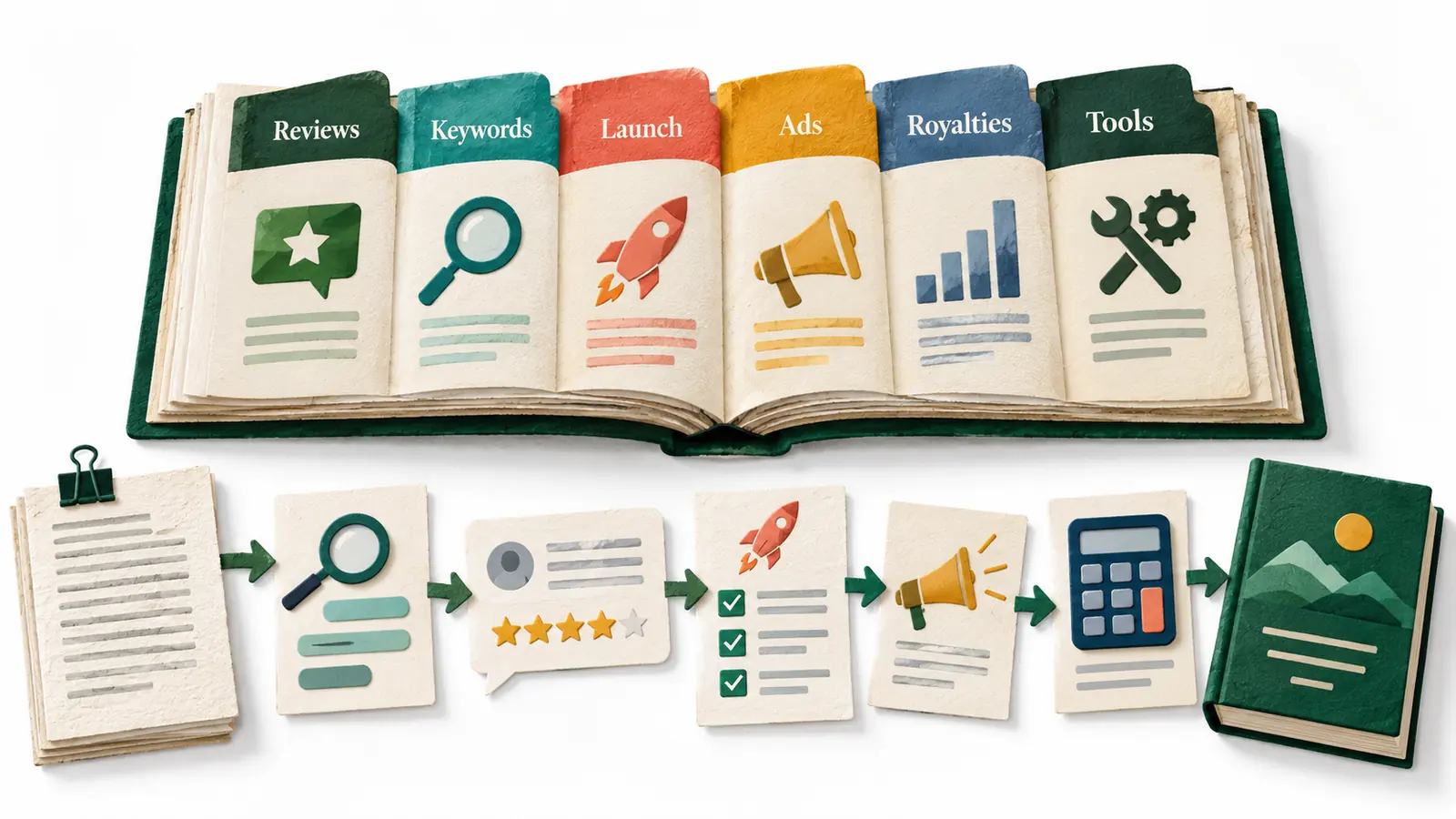
Virtalibry editorial update, revised October 19, 2026. This expanded article replaces the earlier announcement at the same address while retaining its original publication date. Virtalibry's public learning material now offers a broader set of routes through publishing questions: review practices, launch planning, catalogue research, advertising, royalties and practical tools. The purpose is not to turn every visitor into a reader of every page. It is to help an author find the information needed for the next decision.
A learning library organised around tasks
Publishing problems rarely arrive as neat academic subjects. A book is not appearing where its author expects. A promotion costs more than the royalties it produces. A reader cannot find an available copy. Someone offers a review package with unclear conditions. A useful guide starts with the decision or symptom, then identifies what evidence is needed.
The public guide collections and linked articles provide several entry points into those situations. Some explain a concept, some give a checklist and some help distinguish similar-looking problems. A diagnostic page should not be treated as a universal repair procedure. The relevant route depends on what is actually happening to the title and account.
This structure also supports returning visitors. An author who already understands a term should be able to reach the next practical step without rereading a general introduction. Related links connect the subject to adjacent decisions while keeping each article focused on its own question.
Review guidance starts with independence
The review materials distinguish public retailer reviews from private reader feedback and from the administrative work of delivering a copy. Those activities can involve the same book, but they are not interchangeable measures. An internal completion count should not be described as approved Amazon reviews.
Begin with the Amazon review rules overview when evaluating an invitation or service. Use the ARC reader guide to think about suitable readers and clear access conditions. If an existing review is missing, the review-disappearance guide provides a different starting question: what changed, where and when?
These routes are deliberately separate. A launch checklist does not override retailer policy, and a reader-access programme cannot guarantee that Amazon accepts an endorsement. The educational goal is to improve the author's decisions and language, not to supply a formula for controlling an independent review system.
Launch and marketing material connects preparation to measurement
A book launch involves more than a publication-day announcement. The launch checklist helps organise dependencies, while the marketing checklist supports a broader review of the offer, audience and channels. An author can use those resources at different stages without assuming that every tactic belongs in every launch.
Consider a fictional first-time nonfiction author with limited time. The next useful action might be clarifying the book description and fixing a confusing sample, not opening accounts on five additional networks. A checklist is most valuable when it helps prioritise work, including work that should wait.
The author-platform guide extends the discussion beyond a single release. It treats audience communication as an ongoing publishing activity rather than a last-minute demand for attention. The appropriate route depends on the reader, the type of book and what the author can maintain consistently.
Advertising and royalties should be read together
Advertising reports and author income describe different things. A campaign can show attributed sales while leaving little contribution after costs. A royalty estimate can look attractive while relying on an unrealistic sales assumption. The learning material encourages authors to inspect both sides of that relationship.
Start with Amazon Ads for KDP beginners for the advertising workflow and the royalties explanation for the separate revenue mechanics. Use the current platform documentation for live rates and eligibility. A teaching example is not a promise about an account's future performance.
A useful exercise is to write down the assumption behind each number. Is it observed expenditure, an attributed sale, an estimated unit count or a chosen scenario? Labelling those inputs prevents a planning spreadsheet from slowly becoming a forecast that nobody has actually validated.
Tools support judgement rather than replace it
The tools collection gives practical companions to the guides. A draft generator can help explore wording. A calculator can make assumptions explicit. Neither should be interpreted as independent market research merely because the output is formatted neatly.
For a generated title or description, compare the promise with the manuscript. Remove unsupported claims, check that the intended reader is clear and confirm that genre language fits the actual book. A polished sentence can still be inaccurate. The author's review remains part of the work.
For an estimate, change one assumption at a time and observe which results depend on it. That exercise is often more useful than keeping a single attractive number. If the source of a unit assumption is uncertain, carry that uncertainty into the conclusion rather than hiding it behind a precise currency amount.
News, blog articles and guides have different jobs
The news section reports dated developments and service changes. An event date tells readers when something happened; a review date tells them when the explanation was checked. A report about an earlier announcement should not be presented as though the announcement happened today.
The blog provides more focused editorial discussion and inspectable examples. Guides cover recurring tasks and concepts. These formats can link to each other, but their labels should help readers understand whether they are reading current news, a durable explanation or an illustrative exercise.
For platform-dependent questions, follow the primary source linked in the article before making a consequential change. Interface menus, eligibility and policy can evolve. A dated article remains useful context, but its existence is not evidence that a product's current controls are identical.
Authorship, dates and corrections
Editorial material uses the public pen name Virtalibry Team. The editorial process explains the role of sources and review. Book listings continue to use the book's own stated author or pen name; private system account names are not editorial bylines.
Dates should describe real events. A publication date is not a claim that every sentence has remained unchanged since that day. An update date signals a later revision. This article keeps the original address and publication history while making the current educational offering clearer.
Readers who find an error can contact support with the article address, the specific statement and a relevant source. A precise correction request is more actionable than a general claim that a page is outdated. Do not include private credentials or unrelated account information.
Choose one route through the material
Start with the immediate decision, read the relevant guide and record the action it changes. Follow a related link only when it answers the next question. This keeps learning connected to the book rather than becoming an endless collection of tactics detached from a publishing objective.
Editorial note: this is a first-party update about resources available on Virtalibry, not an accredited course announcement or a promise of commercial results. The illustration is conceptual. Examples are teaching scenarios, and external retailer policies remain controlled by their respective platforms.