

News analysis. Programme announced November 6, 2025; language expansion announced June 30, 2026. Reviewed October 19, 2026. Translation is becoming a more accessible publishing experiment, but an available button is not the same thing as a ready international edition. Amazon's expansion of Kindle Translate gives eligible authors more language options while leaving important questions about rights, quality and reader expectations unresolved by automation alone.
What Amazon expanded
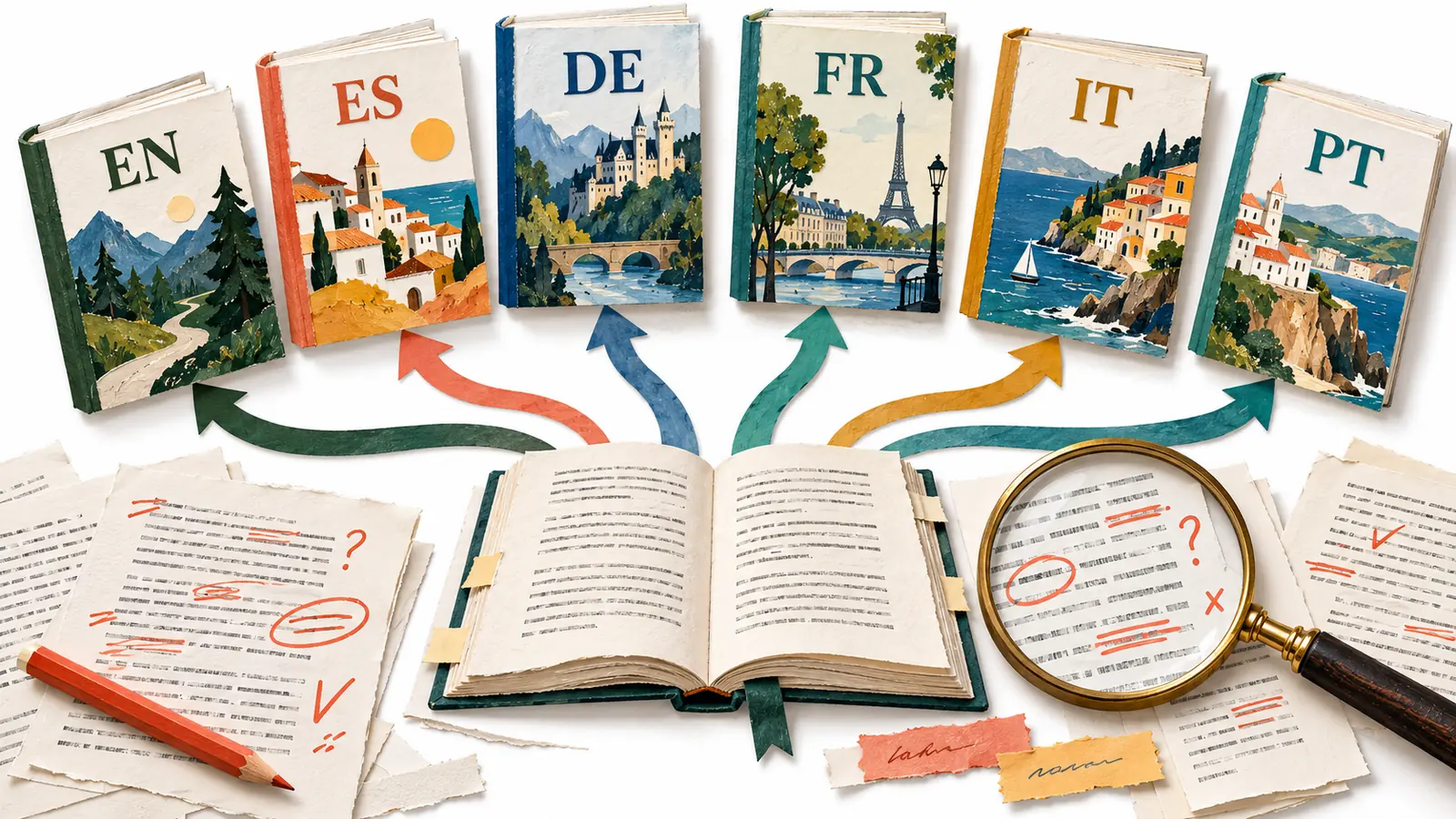
Amazon's Kindle Translate announcement, updated on June 30, 2026, added French, Italian and Portuguese to the programme. Together with English, Spanish and German, the service now covers six languages. The announcement follows the beta's November 2025 introduction. It does not mean that every author, title or language pair is automatically eligible.
The current KDP overview describes an invitation-only beta and identifies eligible titles through the Bookshelf. It is free during the beta, not promised free indefinitely. Authors can preview translations, but direct editing of the translated text is not currently available. Those limits should shape the publication decision from the beginning.
Check eligibility before building a launch plan
A language appearing in an announcement does not establish that a particular manuscript can be translated. KDP's eligibility guidance includes requirements around live, reflowable ebooks and excludes categories such as public-domain titles and already translated editions. The actual Bookshelf option and current guidance are more useful than an old screenshot shared in a discussion group.
The same documentation flags content that may not travel well through the service, including wordplay and material embedded in images. That matters to a puzzle publisher, a poet or an author whose diagrams carry essential instructions. The existence of selectable text elsewhere in the book does not make every page equally suitable.
Check the intended language variant as well. KDP's supported-language guidance distinguishes variants such as Portuguese for Brazil and Spanish for Spain in the documented options. A broad language label is not a complete description of the reader market or an assurance that local terminology will be right for every audience.
Read the rights terms before evaluating the prose
The Kindle Translate terms require appropriate translation rights and place restrictions on the resulting edition files, including distribution outside the programme. Do not assume that a translation produced through the beta is an exportable manuscript you can distribute anywhere. If the terms are unclear for a contract you hold, seek qualified advice before proceeding.
An author may control the original English ebook but have assigned a particular translation right to another publisher. A co-author agreement may require approval. A licensed quotation or illustration may have territorial limits. These are ordinary publishing questions that remain relevant even when the technical translation is quick.
Build a rights note that identifies the work, language, territories and decision owner. Avoid treating an informal recollection as a contract review. The note does not need to become public marketing copy; it needs to make the internal decision understandable and prevent the same uncertainty from returning for every new edition.
Create a reader-quality review, not just a spelling check
Consider a fictional self-help book that uses a repeated phrase about setting boundaries. A literal translation might preserve the words while losing the emotional meaning or making the advice sound abrupt. A sample reviewer should explain that problem in context, rather than simply count spelling mistakes.
Choose passages with different functions: the opening promise, a difficult explanation, dialogue if present, a technical instruction and a passage with humour or cultural references. Ask a competent reader of the target language what they understand, what sounds unnatural and whether the tone suits the intended audience. Do not ask only whether the text is generally understandable.
Use a glossary for names, recurring concepts and specialist vocabulary. It provides a consistent basis for evaluating the preview even when the programme does not permit direct editing. If an essential concept is unreliable and cannot be corrected within the available workflow, postponing publication can be the better editorial decision.
The editing limitation changes the decision
In a conventional translation project, a publisher may commission revisions to a particular paragraph. The current beta's lack of direct text editing means that an author should not plan around that same revision loop. A recommendation to “just fix the awkward sentences in Kindle Translate” would describe a capability the help page does not currently provide.
Instead, define acceptance conditions before previewing. Which errors would make the edition unsuitable? Which phrases are central to the book's promise? Does the author have a way to assess the text independently? Without those conditions, a fast preview can become an exercise in looking for reassurance.
The choice need not be between publishing everything automatically and rejecting translation altogether. An author can investigate the programme, defer an unsuitable title or commission a separate translation under appropriate agreements. Each route has different control, cost and rights considerations. The beta should be evaluated as one publishing option, not the default answer to every international expansion question.
Treat the target-language edition as a reader-facing edition
A new language does not automatically create an audience. Check the description, title presentation, genre fit and expectations created by the cover. A practical handbook aimed at one country's institutions may need contextual work before it is useful elsewhere, even if the sentences are fluent.
Write a target-reader brief: who the edition serves, what prior knowledge it assumes and what problem it addresses. Compare that brief with the actual sample. Avoid claiming local expertise that the original book never contained. Translation should not be used to expand a book's promise beyond its substance.
Public reviews also require restraint. Do not assume that feedback from one language edition proves the quality of another, or that a new edition will inherit a particular review display. Our review guidance and author-platform guide can help separate reader communication from expectations about retailer-controlled outcomes.
A contained first experiment
Start with one eligible title, one intended audience and a defined sample review. Confirm rights, read the current programme terms, inspect the preview and document the publication decision. A small controlled experiment produces more useful information than enabling every available language before anyone has evaluated the first result.
The June expansion is a significant product development because it opens more potential reading markets. Its value to an individual author depends on the book, the available control and the quality of the edition readers actually receive. Publication speed is only one part of that assessment.
Sources and scope: Amazon's dated announcement establishes the launch and expansion. Linked KDP documentation establishes current beta limits. Examples and the sample-review framework are original editorial analysis, not claims about measured translation accuracy or future programme features.