

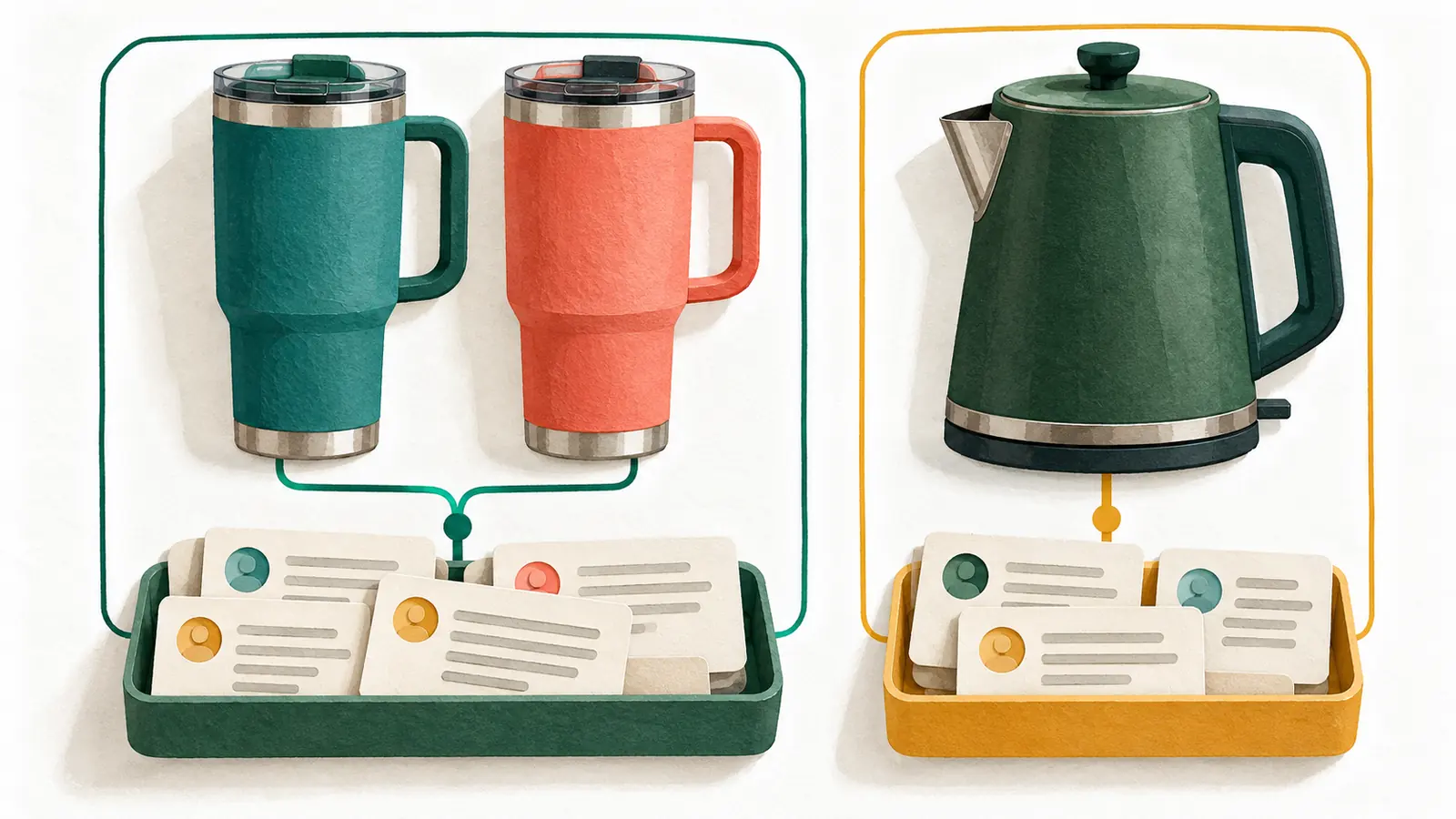
News analysis. Rollout announced for February 12 to May 31, 2026; reviewed October 19, 2026. A lower review count on an Amazon product page is not, by itself, proof that customers deleted their feedback. Amazon's 2026 change to review sharing introduced another explanation: some reviews may no longer be displayed across materially different variations. The useful response is to identify the exact product and display that changed before attempting a repair.
What Amazon announced
In its official Seller Forums announcement, Amazon described a category-by-category rollout between February 12 and May 31, 2026. Reviews would be shared between variations with minor differences that do not affect functionality, rather than across products with significant differences. Amazon said affected sellers would receive notice 30 days before their change.
The announcement gave examples of continuing eligibility, including certain colour, size and pack variations. It also warned that displayed ratings and counts could change. Those examples are not permission to place unrelated products in one family. The published announcement should be read alongside the current rules for the actual category, not converted into a universal catalogue-building formula.
A display change is not the same as deletion
Consider a fictional stationery seller offering an unlined notebook and a separate puzzle workbook. The products share a visual identity, but their interiors serve different purposes. If a visitor previously saw feedback associated with several items together, a later, narrower display could show fewer entries on one page. That observation tells the seller what is visible now. It does not establish whether an individual review was removed, reassigned, filtered or simply absent from the selected view.
A useful incident note therefore describes the observation without supplying an unproved cause. Write the marketplace, child product identifier, selected variation, visible count and observation time. Keep an earlier screenshot if one exists. A statement such as “the green notebook page showed a different count on these two dates” is supportable. “Amazon deleted my genuine customers” is a conclusion that requires additional evidence.
This distinction also changes the support request. A question about which product receives a review is different from a request to reconsider moderation of a specific submission. Combining both issues into one accusation can make a legitimate catalogue problem harder to explain.
What book authors should not infer
The announcement concerns Seller Central product variations. It does not establish that every Kindle, paperback and hardcover relationship was changed in the same way. A novelist should not take an example about bedding or pack quantities as an instruction for linking book editions. Nor does it show that unrelated titles, translations or revised books are entitled to share a review history.
For a book, begin with its edition, ASIN, title, author pen name and marketplace. Compare those details with the destination the reader actually used. Our missing-review guide separates visible evidence from possible causes, while the Verified Purchase explanation addresses a different question: what a purchase label does and does not establish. Neither label nor edition choice is a shortcut around independent reviewing.
Audit one product family before changing it
Start with one affected family, not a bulk upload across the catalogue. Make a simple record for each item: identifier, customer-facing name, physical or functional difference, current relationship and a link to the live page. Then ask whether the relationship helps a customer choose the right version. If the only explanation is that one item has a useful review count, the commercial objective has displaced the product explanation.
Check the actual goods or files as well as the listing. A shared cover design does not make two interiors identical. An extra accessory, different formulation or substantially different use case deserves its own inspection. These are editorial checks for the seller's records, not a substitute for Amazon's category-specific eligibility decision.
When an issue is unclear, preserve the existing facts and seek clarification before repeatedly changing relationships. Several rapid changes can leave you with no reliable record of which state produced the display you are trying to understand.
A fictional record that supports a decision
Imagine the notebook seller records three observations. The teal notebook still displays a familiar set of comments. The coral notebook now shows a smaller set. The puzzle workbook includes comments about a binding that the workbook has never used. The third observation is the most actionable because it identifies a mismatch in the content of the feedback, not merely a disappointing total.
The seller's next step is to document the workbook specification, capture the mismatched comment in context and review the relationship that associates it with that item. The seller does not solicit replacement ratings while investigating. If the relationship is corrected, the follow-up record compares the same identifiers and views. It does not assume that a larger number means the repair succeeded.
For an author, the equivalent evidence might be a review discussing another title or an edition detail that does not belong to the selected book. Record that specific discrepancy. A vague request to “restore all my stars” provides much less information.
Change the message you send to readers
Customer-facing explanations should stay narrow. If a support team has not confirmed the cause, say you are checking the listing relationship rather than announcing a platform error. Do not ask readers to recreate missing text, submit the same opinion repeatedly or post on a different product to rebuild a count. That can turn an unresolved display issue into a new review-management problem.
For future outreach, identify the exact book or product the invitation concerns and let the reader choose whether to comment. Keep private feedback separate from an optional public contribution. Our review-rules guide explains the boundaries; the companion news analysis on Amazon's 2026 trust report explains why a vendor's promise of permanent reviews is not evidence of safety.
The practical takeaway
The rollout dates are now in the past. This is not a warning to prepare for a future February launch. It is a reason to revisit unexplained historical changes with better questions. Separate relationship eligibility, the selected display, the underlying review and any moderation notice. Fix a demonstrated product mismatch, not an imagined ranking formula. The aim is feedback that describes what the customer is considering, even when the most accurate display is smaller than the number the seller would prefer.