

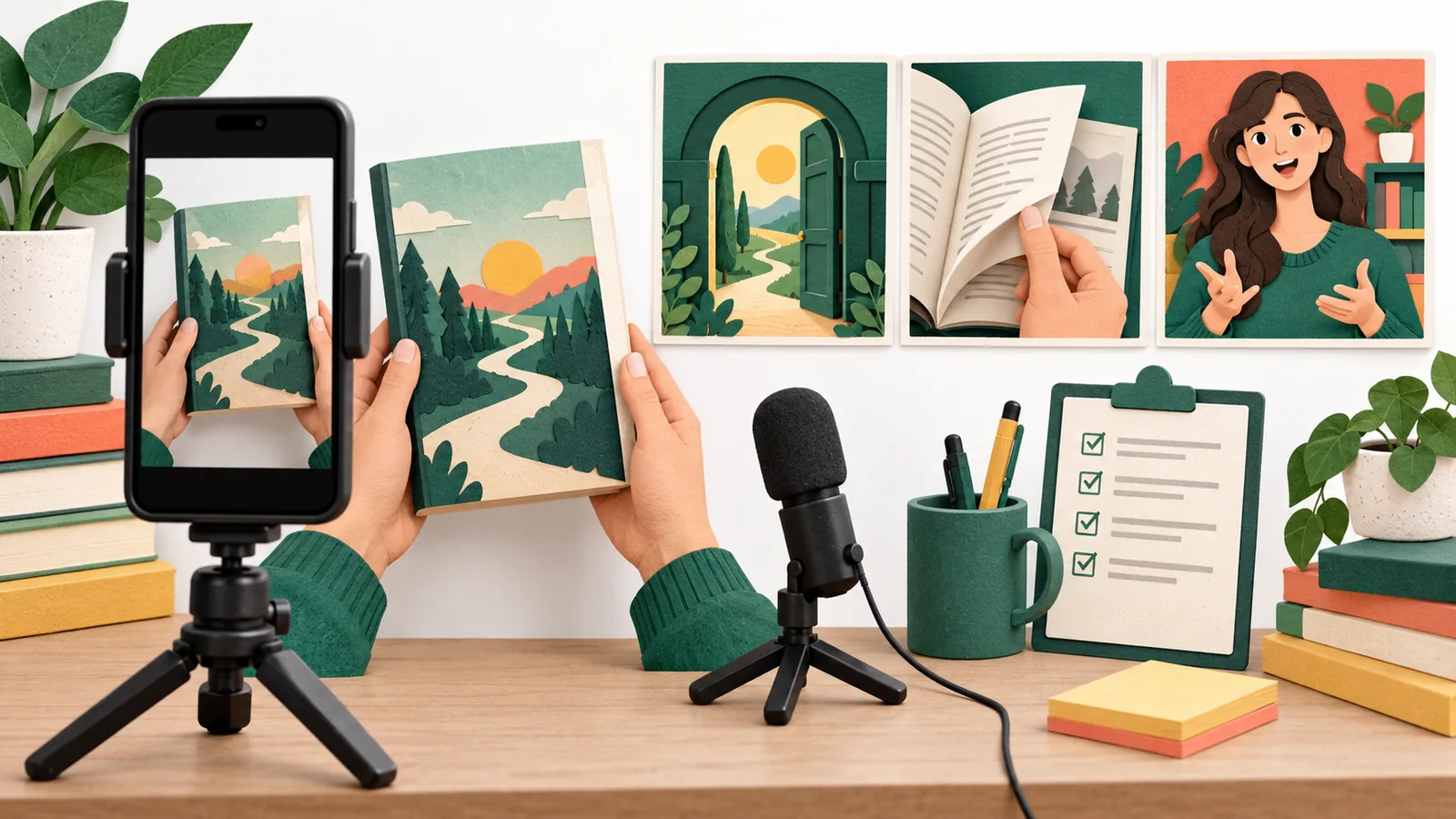
How to promote a book on TikTok: demonstrate why a particular reader might care
Start with one concrete premise, useful step or reading experience. Film original material that makes it understandable, identify the book honestly and offer one available next step. A trend or a large view count is not a substitute for a relevant reader.
The scripts below are original fictional examples, not successful campaign transcripts. Their suggested lengths are production starting points, not a TikTok requirement or ranking formula. Platform sources checked on 14 October 2026; tools and account eligibility vary by region and can change.
Write the question your video answers
Examples: "What kind of mystery is this?", "Will these exercises suit a beginner?" or "Can I understand the recipe before buying the book?" Choose a question you can answer truthfully on screen. Avoid opening with a generic plea to support an author.
If available in your region, Creator Search Insights can surface searched topics and content gaps. Use relevant questions as research prompts, not as a license to claim demand for your particular title. A topic's popularity does not establish purchase intent.
Use search language naturally
Describe the actual genre or task in the opening, on-screen text and caption where useful. Do not repeat unrelated keywords or promise that an exact hashtag combination guarantees distribution. "Closed-door coastal mystery" tells a reader more than a stack of generic trending labels.
1. Adapt three shot-by-shot video scripts
Use your own book, demonstrations and authorized assets. Replace the invented details with facts. Each script has one next action; use the link wording only if the route exists on your account.
Script A: a fiction premise, about 20-30 seconds
| Beat | Picture | Voice or text |
|---|---|---|
| Opening | Actual book, then your own shot of an atlas and key | "A returned atlas contains a key to a building demolished twenty years ago." |
| Reader fit | Cover and a short authorized page close-up | "I wrote this closed-door coastal mystery for readers who enjoy a small-town puzzle." |
| One next step | Clear title and the real sample destination | "Read the opening chapter to see whether the voice is for you. [Available route]." |
Do not label prop footage as a literal scene from a nonfiction book. If you use an illustration for mood, make its role clear. The purpose is to communicate the real premise, not fabricate a reader reaction or sell a different genre.
Script B: a nonfiction demonstration, about 25-40 seconds
Opening shot: ingredients beside the actual recipe.
Say: "These ingredients do not cook at the same speed. Here is the order used in one recipe from my beginner cookbook."
Middle: show the first step and the later addition; explain the reason accurately.
End: "The complete sample includes quantities and timing. Preview it at [available route]."
Make the demonstration genuinely useful and faithful to the recipe. Do not compress a safety-critical process into misleading footage. Avoid unsupported promises about health, weight loss or guaranteed results.
Script C: an activity-book fit check, about 20-35 seconds
Opening shot: actual interior at a readable scale.
Say: "Not sure whether this puzzle book is too difficult? Start with this first placement, which needs no guessing."
Middle: explain one real step and show the printed instructions.
End: "This is the same type size and difficulty used in the sample. Check the pages before choosing the paperback at [available route]."
A close-up should help inspection, not conceal that the real print is too small or that the sample differs from the book. Show the actual promoted edition. A reader who decides the difficulty is wrong has still received a useful answer.
2. Make the video understandable before adding effects
- Frame for vertical viewing and show the subject clearly.
- Record clear narration without unnecessary background noise.
- Check and correct captions, especially book titles and technical terms.
- Keep essential text away from interface controls and preview the result on a phone.
- Use enough time for the page or instruction to be read.
- Keep a clean master of footage you created, before adding platform-specific audio.
You do not have to put your face on camera
Hands turning pages, an overhead task demonstration or a narrated authorized excerpt can convey the book. Show the reading experience instead of spending the whole clip on an animated cover. When a face-to-camera explanation is useful, keep it tied to the reader's question.
Reusing your own footage is different from reuploading another person's clip. Also check permission before using identifiable reader photos, private messages or comments. Do not turn an ordinary question into an apparent testimonial.
3. Check commercial disclosure and audio rights
TikTok's commercial-content guidance covers promotion of your own business as well as incentivized third-party promotion. Turn on the required content disclosure setting for a promotional book post and select the appropriate relationship. Your own promotion and a paid partnership are different labels.
A popular sound is not automatic commercial permission
TikTok's music guidance recommends its Commercial Music Library for promotional content. Music outside that library needs the necessary rights; availability in the app's general music catalog does not establish them. Your own voice with no copyrighted background track is a simple starting point.
Do not assume a track licensed for one platform is cleared for reposting elsewhere or for a later paid ad. An "original sound" label also does not prove that a recording contains no third-party music.
Creator partnerships need truthful disclosure, not scripted praise
If you pay a creator or provide a copy for an endorsement, agree on the deliverable, rights and disclosure without requiring a positive opinion. For US-facing endorsements, consult FTC guidance. Do not bury the relationship in a profile or assume a platform label alone covers every requirement.
Buying publicity is not buying customer reviews. Do not use a creator campaign to obtain compensated retailer ratings, fake reactions or purchase reimbursement for reviews.
4. Verify the route from video to book
Check what your profile actually allows before filming a "link in bio" ending. TikTok's profile-link help describes website access for accounts with at least 1,000 followers or a Registered Business Account. It also notes regional availability limits for linking features. Do not assume merely switching account type unlocks every control.
If a website link is unavailable, use an honest route such as the exact book and author name for searching. Do not display a fake clickable button or offer an account workaround. Check current account guidance before choosing tools for an author business.
Keep the destination aligned
A sample promise should lead to a sample. Explain a required signup before sending someone there, and use clear subscription expectations. For a retailer offer, check format, territory and live price. The general social guide shows how to tag links to your own website without pretending they expose retailer checkout data.
5. Run a six-video learning cycle
| Pair | Keep consistent | Change deliberately |
|---|---|---|
| Videos 1 and 2 | Book, audience and next action | Two truthful premise openings |
| Videos 3 and 4 | Relevant task and destination | Two actual page demonstrations |
| Videos 5 and 6 | Reader question and format | A clearer explanation of the most common uncertainty |
Spread production across a schedule you can sustain. This is not a randomized experiment: timing, audience delivery and account history also differ. A few posts can produce ideas for the next cycle without proving which message will always win.
Reply to relevant questions, and create a follow-up only when it adds information. Do not ask people to manufacture comments or trade engagement. Buying followers changes a counter, not necessarily the audience that wants your book.
6. Measure the next reader action separately from views
TikTok Studio provides tools for content analysis. Inspect the metrics actually available to your account. Record the viewing window and definitions before comparing posts of different lengths or paid and organic distribution.
- Record video, opening, format, length and next action.
- Inspect watch-related measures where available, not only total views.
- Record relevant questions and profile or destination activity separately.
- Use configured website analytics for sample use or voluntary signup.
- Keep retailer orders and royalties distinct from platform engagement.
- Record production time, creator fees and paid distribution costs.
A shared profile link usually represents several posts, not a uniquely attributable click from one video. Keep that limitation visible. A rise in retailer orders during the same week is not proof that TikTok caused every order, especially when a newsletter or discount also ran.
7. Promote only when the destination and measurement justify it
TikTok's Promote requirements include public videos, eligible commercial audio and an adult advertiser, alongside advertising policies. An ordinary post is not automatically eligible for paid distribution. Check product and account restrictions before setting a budget.
Choose an observable objective and a spending limit, then keep paid results separate. Do not optimize for purchases on a checkout you cannot measure as if that data were available. A video with many views but little suitable reader response is a reason to diagnose the message, not automatically to buy more views.
Repeat clear demonstrations with new examples when they produce relevant interest. Repair a confusing destination, stop an inaccurate offer or change the reader promise when needed. Build the next cycle around your author platform and marketing checklist, not an expectation of guaranteed BookTok virality.