

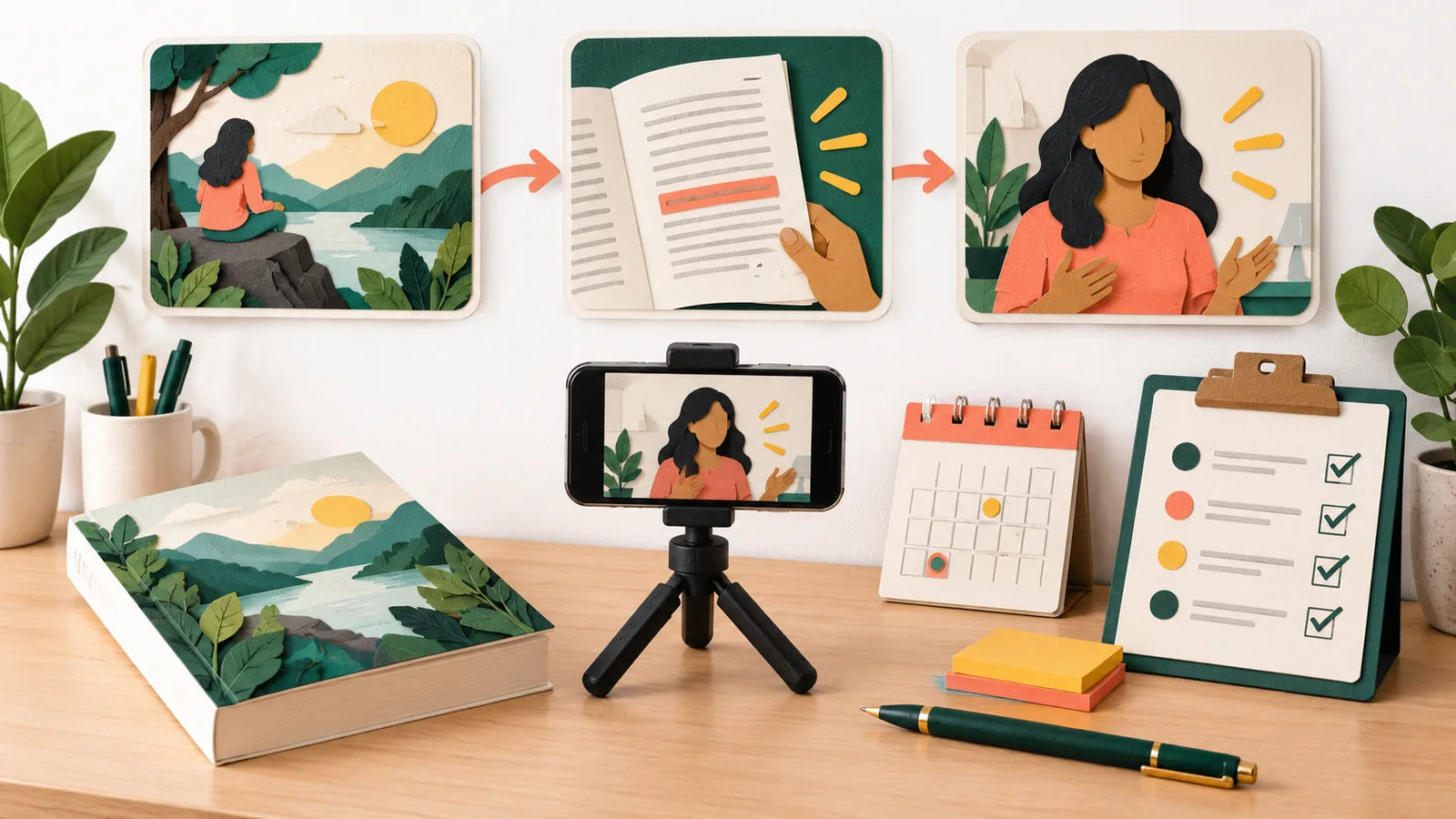
How to promote a book on social media: make a useful reader promise
Pick one reading audience, one primary platform and one next action. Show what makes the book relevant through an original scene, demonstration, explanation or sample. Repeating a cover and a purchase link is an announcement, not a complete content plan.
The examples here are original, fictional planning samples, not posts from successful campaigns. Suggested schedules and video lengths are starting points to test, not algorithm rules. Platform sources checked on 14 October 2026; account features and policies can change.
Fill in this brief before creating anything
"This book is for [specific reader]. It delivers [reading experience or practical task]. This campaign will show [one truthful feature] and invite people to [sample, purchase page or clearly described signup]. I can spend [hours] each week and will review results after [period]."
For a closed-door mystery, the promise might be a curious retired librarian and a coastal setting. For a beginner cookbook, it might be clear one-pan instructions. For an activity book, demonstrate legibility and puzzle difficulty. Do not market all three with the same vague claim that everyone will love them.
Choose a platform you can actually serve
Look for relevant discussions and content you can produce consistently. Do not assume demographics from a platform stereotype. The Facebook guide focuses on useful Page posts and permitted community participation; the TikTok guide supplies short-video scripts and platform-specific checks.
1. Build a small library of repeatable formats
| Format | What to show | Reasonable next action |
|---|---|---|
| Premise or reader-fit post | Genre, situation and tone; a specific reason to care | Read the description or sample |
| Page demonstration | One real recipe step, exercise or puzzle explanation | Inspect the sample pages |
| Short reading | A small authorized passage that conveys the voice | Continue with the sample |
| Research or making-of | A relevant creative decision, source or revision | Ask a substantive question or explore the book |
| Reader question answered | Format, difficulty, age suitability or reading order | Check the edition that fits |
| Offer or release update | Verified edition, territory, price and dates | Visit the correct retailer page |
Choose two or three formats initially. A clear close-up of the actual pages can be more informative than a complicated mockup. Label illustrative artwork as illustration rather than presenting it as a photograph of the delivered product.
Give each post one job
An explanation can end with a sample; an availability update can end with a purchase link. Avoid asking someone to follow, comment, share, subscribe, buy and review in the same sentence. A useful discussion does not have to carry an immediate sales request.
2. Adapt these three concrete examples
Fiction: sell the situation, not a generic adjective
Visual: your book beside an original photo of its setting inspiration.
Caption: "A retired librarian finds a borrowed key inside a returned atlas. The locked room it opens was demolished twenty years ago. My coastal mystery pairs a small-town cast with a puzzle that grows stranger one detail at a time. The opening chapter is available at [sample destination]."
This invented premise illustrates structure. Replace it with your book's real conflict and tone, and remove any claim the story cannot deliver. Do not borrow another author's premise, testimonial or cover to imply an association.
Nonfiction: teach a small complete step
Visual: an overhead demonstration using your own recipe and photographs.
Caption: "One-pan dinners become harder when the ingredients need different cooking times. This example starts the potatoes first and adds the quicker-cooking ingredients later. The photographed recipe is from my beginner cookbook. See the ingredient list and complete sample recipe at [destination]."
Publish enough information to be useful, and keep safety, health or performance claims within what you can support. A book advertisement should not turn an ordinary tip into an unsupported promise of a medical or financial outcome.
Activity book: demonstrate the actual difficulty
Visual: one real large-print puzzle with a clearly marked first step.
Caption: "This beginner puzzle starts with one forced placement. Here is how to find it without guessing. The sample shows the same type size and instructions used in the book. Preview the pages before choosing the paperback at [destination]."
Show the promoted edition at a readable scale. Do not enlarge a tiny-print interior in a way that falsely suggests the printed book is large print. A short explanation is useful even to a person who decides not to buy.
3. Make the next step easy to complete
Match the destination to the promise: a sample request should lead to a sample, not a homepage containing unrelated offers. Test it on a phone. The title, cover, format and availability should agree with the post.
- Use one clear destination appropriate to the post.
- Check the actual edition, currency and territory for a purchase offer.
- Explain whether a sample requires a newsletter signup.
- Make subscription expectations clear before collecting an email address.
- Provide captions or readable text alternatives for essential spoken information.
If an account does not offer the link control you expected, change the call to action to an available, honest route. Do not tell viewers to tap a nonexistent button. Use the email-list guide for a clear signup and welcome sequence rather than adding commenters to a list.
4. Keep promotion transparent and welcome
Read the rules of each community before posting. Moderator approval for one thread is not permission to post the same advertisement everywhere. Do not scrape members, send unsolicited bulk messages or add people to a newsletter because they reacted to a post.
Use your own work and authorized material
Check rights to excerpts, photographs, cover art, music and third-party footage. A reader's public comment is not automatic permission to turn their name and photograph into an ad. Ask for permission to use an exact quote, and preserve its meaning.
Meta's spam guidance warns about irrelevant captions, hashtag stuffing and coordinated fake engagement. Keep the caption relevant and avoid purchased interactions. There is no need to invent a mandatory hashtag count or claim that moving every link into a comment defeats the algorithm.
Disclose commercial relationships
Make authorship clear. If a creator receives money, a free copy or another material benefit for an endorsement, agree on clear disclosure without dictating a favorable opinion. The FTC's US-facing guidance explains that disclosures belong with the endorsement, including within a video when appropriate. Platform tools do not replace every applicable obligation.
A paid publicity post is not an independent retailer customer review. Follow KDP's review guidance separately; do not condition a free copy on a review or offer payment for ratings.
5. Run a manageable two-week test
| Window | Post | Question to test |
|---|---|---|
| Week 1, first post | Specific premise or reader-fit message | Do suitable readers recognize the book? |
| Week 1, second post | Real page demonstration or short reading | Does showing the experience prompt interest? |
| Week 1, third post | Answer a genuine reader question | What uncertainty prevents the next step? |
| Week 2, first post | New example using the strongest format | Does the pattern repeat beyond one post? |
| Week 2, second post | Relevant making-of explanation | Does this deepen interest in the actual book? |
| Week 2, third post | Accurate availability or offer update | Do interested readers reach the right destination? |
Batch the photographs and recordings, but leave time for genuine replies. Adjust the workload to what you can sustain. A small account may need several cycles to produce interpretable evidence; six posts do not guarantee a statistically meaningful result.
6. Measure the path from attention to action
Record post ID, date, format, message, next step, production time and paid spend. Use the platform metrics available to your account, retaining their definitions and reporting window. A view, a unique person reached and a link click are not interchangeable.
Tag links to a page you control
When your website analytics supports campaign parameters, use consistent source, medium and campaign names, plus a content label for the creative. Google's campaign URL guidance explains these fields. Example for your own sample page:
https://author.example/sample?utm_source=facebook&utm_medium=organic_social&utm_campaign=coastal_launch&utm_content=atlas_hook
This is an example address, not a live link. Test collection in your configured analytics; parameters alone do not install tracking. They do not give you access to a retailer's checkout. Do not claim that a tagged Amazon link exposes every purchase in your own analytics.
Calculate with a named denominator
Illustrative calculation: 18 confirmed signups from 120 measured sample-page visits is a 15% visit-to-signup rate, if both counts cover the same period and the signup tracking is configured. It is not a view-to-sale rate. Account for consent, blockers, repeat visits and reporting differences before interpreting small changes.
7. Diagnose one weak step, then change one thing
Attention without destination visits can signal an unclear next step or the wrong reader promise. Visits without sample use can signal a slow or mismatched page. Sample interest without purchases may involve price, format or a reading decision that takes longer. These are hypotheses to investigate, not conclusions from likes.
Repeat a useful format with a new example; change the opening or destination when evidence points there. If you test paid distribution, define a spending cap and observable goal first. Keep it separate from organic results. Combine the learning with your marketing checklist and author platform, rather than making every campaign depend on a viral post.