

How the Amazon KDP Algorithm Works
Separate publication, live availability, query appearance and reported outcomes before diagnosing a problem.
Use public guidance and reproducible checks, not a promised shortcut through Amazon's private ranking formula.
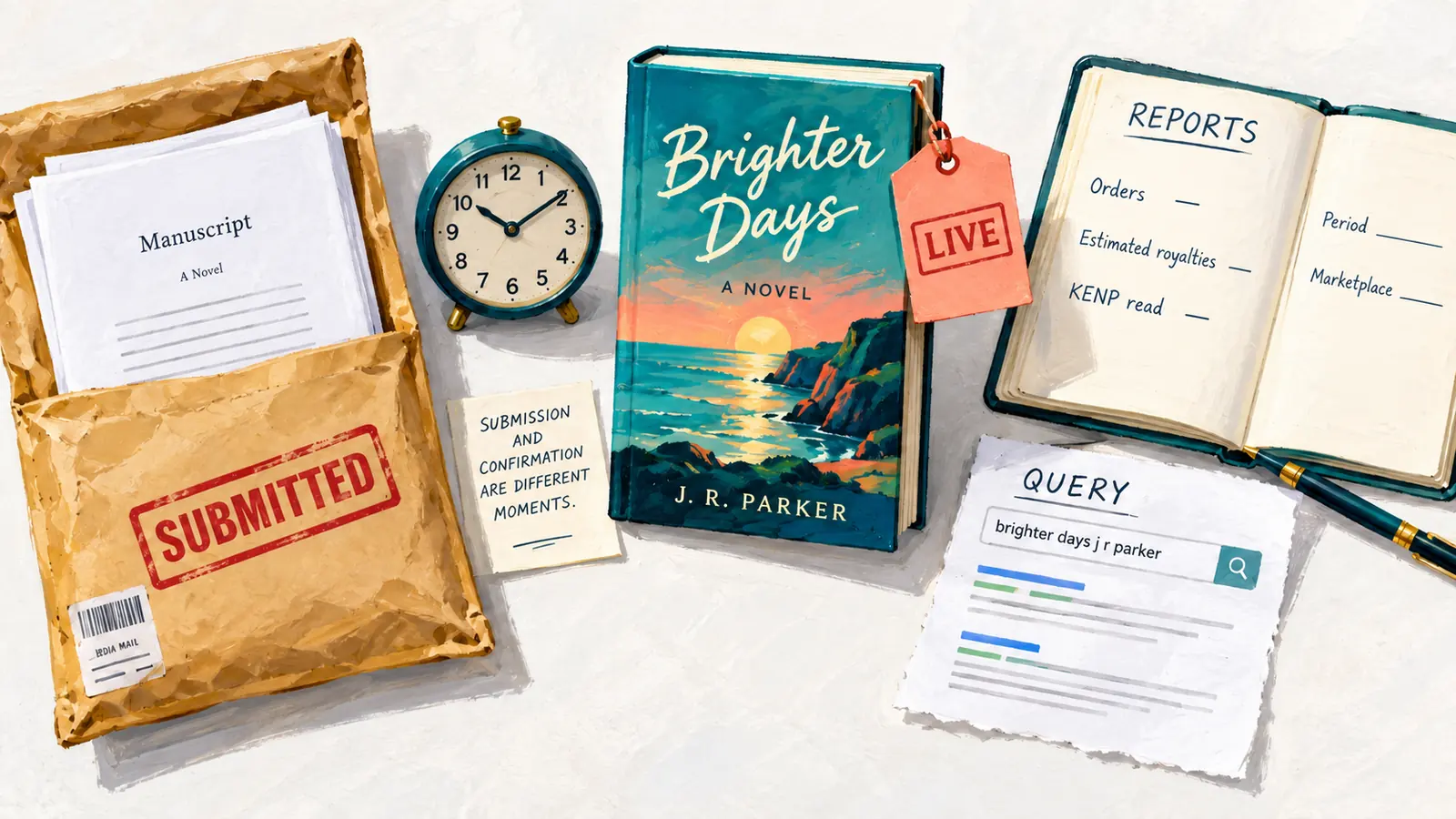
There is no public formula called the KDP algorithm
"The KDP algorithm" often bundles together processing, live availability, search, classification and reported outcomes. Name the actual question before changing the book.
Amazon publishes guidance for these tasks, not a single author-facing formula that promises visibility. Start by naming the failed observation. "The eBook is unavailable in the intended store" can be investigated. "The algorithm dislikes my book" is not yet a diagnosis.
A task map is not reverse engineering
The map organizes author checks. It is not Amazon's disclosed architecture or a promised sequence of ranking stages.
Replace "the algorithm stopped working" with "the intended edition is available directly, but we did not observe it within the first 20 ordinary results for the recorded query."
That narrower statement is inspectable. Use the evidence audit to classify a claim instead of inventing a hidden penalty.
Map the task to the evidence you can inspect
A saved field is not a live-state confirmation. A live detail page does not prove query placement, and a placement does not prove a profitable promotion. Keep these records separate.
| Task | Useful evidence | What it does not establish |
|---|---|---|
| Publication or update | Submission, status, edition and applicable operation | Immediate live availability or future position |
| Storefront availability | Actual edition page and intended market | Appearance for every topic query |
| Search or category observation | Exact query or list, format, date and range | Orders, organic clicks or algorithm weights |
| Outcome review | Scoped reports, costs and known concurrent actions | Which individual change caused the result |
Paid placement needs a separate label
Amazon's introductory Ads guide describes sponsored placements. Record them separately from ordinary results. A campaign appearing above a book list is evidence about advertising delivery, not a certificate of organic placement.
Use the Ads guide map for campaign operations. Do not pay to test a publishing problem until the intended offer can actually be inspected and purchased where appropriate.
Read public guidance at the level it supports
KDP's search guidance names sales history, availability, time listed and popularity. Its keyword guidance also relates relevant keywords and BSR to placement. Neither supplies numerical weights or a guaranteed position.
Sales-rank guidance describes relative activity and rank scope. It is not interchangeable with a keyword position. Use the rank explanation for those distinctions instead of applying one meaning of rank to every screen.
Operational waiting is not a performance promise
KDP's timelines differ by operation, format and market. Check the relevant entry when confirming a publication or update. Do not turn a processing estimate into a guarantee of a better position by the same date.
Save the source and date. If help pages describe timing differently, check the applicable operation instead of announcing one universal refresh schedule.
Trace a change without turning the timeline into causality
Brighter Days is a fictional novel for adult readers. Suppose its description is clarified, a newsletter feature runs and a new paperback becomes available in the same period. Later, the author sees more orders and a different query position.
The record contains useful events, but it does not isolate one cause. A before-and-after sequence is not a randomized experiment. Price, availability, exposure, reader demand and the surrounding result set may all differ.
Record five fields for each change
- Action: what was submitted, changed or scheduled.
- Confirmation: what was actually live, where and when.
- Observation: what was measured or inspected afterward.
- Concurrent event: what else could explain the result.
- Decision: what the available evidence justifies next.
Keep a truthful clarification because it repairs the description; evaluate its commercial effect separately.
Investigate a missing appearance before inventing a penalty
Check the actual edition and store, then repeat a defined search context. KDP's find-your-book guidance distinguishes contextual searches and dynamic results. A title appearing in one search does not guarantee topic-query placement elsewhere.
| Observation | Next check | Avoid concluding |
|---|---|---|
| An update was just submitted | Relevant status, operation and later live confirmation | The submission instantly changed search performance |
| The intended edition is unavailable | Market, edition link and publishing discrepancy | The cover needs more clicks |
| Title search works; topic search is unobserved | Query fit, department, filters and inspected range | A global account restriction is proven |
| A sponsored card appears | Ordinary results checked separately | The organic position equals the ad position |
Missing within a range is not an exact outside-range rank
"Not observed within 20" does not mean position 21 or zero. Keep the uncertainty in the record. Use the query-observation protocol to make later checks comparable.
If the record cannot distinguish a wrong link from unavailability, resolve that ambiguity first. Use the measurement scorecard to keep availability, query observations and outcomes separate.
Audit a claim before building a plan around it
Ask a service promising an algorithm boost for its outcome, market, edition and period. Is its evidence a rule, an observation, a model or a testimonial?
Three questions for an impressive screenshot
Was the same context used before and after? What else changed? What result would have counted against the claim? A claim that explains every possible outcome after the fact does not provide a useful test.
"A9" or "A10" labels do not establish current book-specific weights or review thresholds. Ask for a source and an inspectable method, not a version-name shortcut.
Reject manufactured behavior as an experiment
Do not organize sham purchases, borrowing or repeated self-click tasks to test a theory. KDP warns against manipulated purchasing or borrowing. An introduction to genuinely interested readers is different from a scripted transaction sequence.
Escalate a reproducible discrepancy, not a demand for placement
Send edition, store, dates, expected versus actual state, relevant guidance and reproduction steps. A useful case describes an observable discrepancy, not a ranking theory.
Exclude passwords, payment details and unrelated customer information. Do not send a pile of speculative rank theories when the reproducible problem is a broken edition link. Support evidence should help investigate an operational question.
Know when the next step is strategy
A request to guarantee first-page placement is different from a report that a completed update is absent. Use the ranking workflow map to choose the next strategic task rather than treating support as a placement service.
Choose one controllable action and an honest review
Correct a verified publishing discrepancy, clarify an inaccurate promise or choose a suitable reader route. State what you can confirm and what will remain uncertain. If several necessary changes are made together, record them as a combined intervention.
Keep operational and business decisions distinct
KDP Reports defines activity and earnings views. Compare those outcomes with costs separately from query screenshots. A better observed position does not automatically make a route affordable.
Return to the discovery plan when the audience is unclear. For sales models, use the estimate audit. An unresolved operational problem cannot be diagnosed by converting a rank into modeled units.
Explore the KDP discoverability guides to connect this question with keywords, categories and ranking evidence.
Sources and scope
Official references checked on 16 October 2026. Book, artwork and diagnostic examples are fictional. The task map is editorial guidance, not internal architecture. No live account audit, private formula or guaranteed position is claimed.
Frequently asked questions
Is there one public KDP algorithm formula for authors?
Amazon provides guidance for publishing, search, classification and reporting, not a single author-facing formula that guarantees placement. Treat the task map here as an editorial diagnostic framework, not disclosed internal architecture.
Does a live book page guarantee topic-query placement?
No. Availability and appearance for a specific query are different observations. Record the intended edition, market, department, filters, date and inspected result range.
Does a publishing timeline promise a ranking improvement?
No. A processing estimate concerns the relevant operation. Verify the actual live state separately from later performance; it is not a placement deadline.
Does an A9 or A10 label prove a current book ranking formula?
No. An alleged version name does not establish numerical weights, review thresholds or a guaranteed result. Ask for the current source, exact outcome and an inspectable method.
What does not observed within 20 results mean?
It describes the inspected range, not an exact position outside it. Do not replace that missing observation with position 21 or zero.
When should I contact support rather than change strategy?
A reproducible publishing discrepancy can justify a concise case with edition, market, dates and expected versus actual state. A demand for first-page placement is a different matter.