

Getting Amazon Book Reviews for Food and Wine Books
Match the reader to the reference task, not a requested star rating.
Separate taste preferences, comprehension problems and factual checks. No tasting or purchase is required for a reading invitation.
Food and wine books need more than a generic review request
A regional food history, beginner wine reference and pairing handbook serve different reading jobs. One needs clear context and sources, another needs understandable terminology, and another needs a usable way to locate suggestions. Name the job before deciding who should read the book and what feedback would help.
This guide focuses on reference and explanatory food-and-drink books. A recipe-led title belongs with the cookbook feedback workflow. For health or dietary claims, use the separate health and fitness guide. Do not combine all three into a promise to generate Amazon ratings.
Your useful prepublication output is a better manuscript: clarified terms, corrected references and easier navigation. A public customer review is an independent person's assessment, not a commissionable approval of the book's authority.
Match experience level and reference needs
A beginner reader can identify unexplained terms that an expert overlooks. An experienced reader may notice an unsupported generalization but cannot represent every beginner. Recruit both only if you have different questions for them. Describe the language, geographical scope, edition and intended level in the invitation.
Look for readers already interested in the subject through your opted-in audience, relevant reading groups and communities that permit invitations. Ask a moderator before promoting in a specialist group. Avoid treating a wine seller, supplier or author with a commercial stake as interchangeable with an independent customer.
| Book type | Suitable reading task | Separate specialist work |
|---|---|---|
| Beginner reference | Explain an unfamiliar term using only the supplied pages | Verify definitions and factual accuracy |
| Regional food history | Follow the narrative and locate the cited source | Check historical claims, translations and permissions |
| Pairing handbook | Find the stated suggestion and understand its rationale | Review factual claims separately from personal taste |
| Cocktail reference | Navigate ingredients, terminology and cross-references | Review technical accuracy without requiring reader consumption |
For alcohol-related material, address an appropriate adult audience and follow local restrictions. Do not recruit through a challenge that requires drinking. A reader can assess structure, clarity and references without buying or consuming any alcohol.
Make the reference trail usable
Give the reading copy a version, date and stated coverage. In a geographical guide, explain whether the discussion is introductory, historical or intended to describe current rules. A statement that was accurate for a named date is different from an unqualified claim about the present.
Check that maps, glossary entries, image captions, units and index links remain legible in the delivered format. Credit and license maps, photographs and quotations before distribution. A beautiful spread does not solve an index that directs readers to the wrong page. Inspect both the export and, where offered, the physical proof.
Keep a separate fact-check ledger with the claim, exact source, edition or publication date, reviewer and decision. Do not ask general readers to validate an entire region's regulations from memory. Where an important fact remains unresolved, qualify it accurately or remove it rather than letting confident design imply certainty.
KDP's content-quality guidance addresses publishing problems such as formatting and missing content. It does not verify your specialist subject matter. Use the ARC handoff checklist to distinguish the reviewed copy from the live edition.
Classify preference, comprehension and factual concern
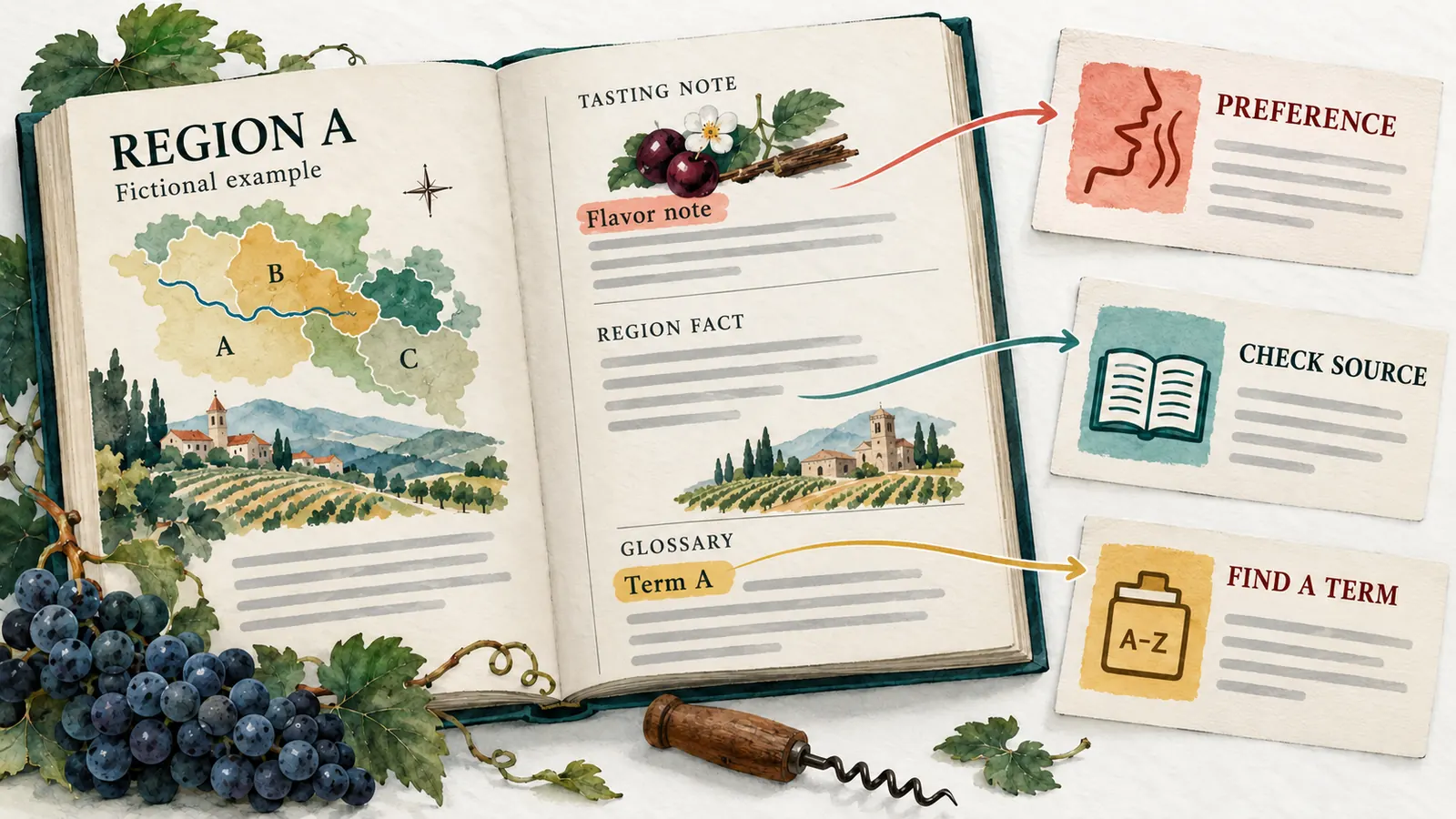
Ask readers to mark the page and choose a type of comment. A personal preference might be that a suggested pairing sounds unappealing. A comprehension problem might be that a term is used before being explained. A factual concern points to a statement that needs a source check. These should not be collapsed into a single good-or-bad score.
Useful prompts include: Could you find the explanation from the index? Which word needed a definition? Is the recommendation presented as a suggestion or as a universal rule? Does the chapter explain its limits? Avoid asking whether the book proves that a particular drink is healthy.
Any private tasting or recipe-development commission belongs in a separate technical project with appropriate conditions. It must not become a purchase of a public customer opinion. For ordinary reading invitations, do not require a bottle purchase, receipts, tasting photographs or reports of consumption.
Use one fictional record to keep the categories separate
Reference draft F-039 explains a fictional Region A. The illustration is not a real wine map. A beginner cannot find a term, a second reader dislikes a flavor description, and a specialist asks for the source behind a regional statement. Three comments require three different responses.
| Reader note | Classification and action | Limit |
|---|---|---|
| Term A is absent from the glossary | Navigation issue: add a checked definition and test the link | Definition accuracy still needs editorial verification |
| I do not enjoy that flavor profile | Preference: retain the reader's view without rewriting it as an error | Does not invalidate another reader's taste |
| The regional statement has no reference | Factual concern: assign a source check before publication | A confident reader is not itself a primary source |
| Map text is too small on my device | Presentation issue: record the device and inspect the corrected export | One screen test does not validate every format |
Close the record only after the appropriate check. If an editor chooses not to make a change, document why; do not pressure the reader to withdraw the comment. Preserve the copy version so later feedback is not attributed to a correction the reader never received.
Offer reading access without a purchase or posting condition
KDP's review-copy permission is conditional: the opinion must not be required or influenced. Use the review-rules guide to inspect the complete arrangement, not just the invitation's wording.
Would you like to read this introductory food-and-wine reference? You can comment on clarity and navigation without tasting or purchasing anything. You may decline or stop. A public review and a particular opinion are not conditions of access.
Use this only where the actual terms agree. Do not reclaim a benefit because no review appears, filter invitations to favorable readers, or provide a prepared customer-review script. A reader's own wording and decision belong to them.
Do not frame alcohol consumption as a health improvement. The NIAAA clinical resource advises against recommending that nondrinkers start for health benefits. This is a boundary for the invitation, not personal drinking advice.
Evaluate the manuscript, not a promised star yield
Count documented glossary problems, unresolved references and corrected navigation errors separately. Keep preferences as qualitative observations. Ten favorable comments cannot overrule one verified factual error; one reader's dislike does not establish that everyone will reject the subject.
Record working deliveries and private responses only where readers agreed to that communication. Do not treat a download as evidence of a completed read, tasting session or purchase. If you observe a public review, distinguish the observation from its cause and from your private editorial log.
Missing public contributions belong to the review-timing workflow, not escalating pressure on readers. No campaign can promise that Amazon will publish, retain or combine reviews across editions and markets.
Take the next step that matches the evidence
Prepare one representative chapter, a glossary or index task and a brief reader-fit description. Arrange specialist verification for claims readers cannot resolve. Start small enough that you can inspect every reported obstruction and send a corrected copy where appropriate.
Use the review guide hub for policy and service comparisons, or browse the public ARC library for actual listings. Availability and access depend on each offer; this page does not promise a Food & Wine inventory, a free format or a result on Amazon.
Sources and scope
KDP review-copy and quality guidance and the NIAAA resource were checked on 17 October 2026. The reader brief and F-039 record are fictional editorial examples. This is not alcohol-use advice, a factual wine reference, legal clearance or certification of Virtalibry's external-policy compliance.
Frequently asked questions
Is this the same process as reviewing a cookbook?
Not exactly. Recipe-led books need checks of ingredients, steps and kitchen assumptions. Reference books need clear terminology, source trails and navigation; use the workflow that matches the book.
Must readers buy or taste the drinks described?
No. Reading invitations should not depend on bottle purchases, receipts, tasting photographs or consumption. Readers can comment on clarity, structure and references without drinking.
How do I separate taste from factual errors?
Record a flavor preference as a personal impression. Assign a disputed factual statement to a source check, and treat a missing definition or broken index as a navigation issue.
Should experts and beginners receive the same brief?
Give each an appropriate task. Beginners can expose unexplained terms; specialists can review a defined technical scope. Neither group represents every reader.
Can a positive reader review support a health claim about wine?
No. Reader enthusiasm is not health evidence. This guide does not recommend alcohol use or starting to drink for health benefits.
Can I promise a public review when offering a reading copy?
No result is guaranteed. Inspect the actual invitation, benefits and completion conditions using the review-rules guide, not only an optional label.