

Amazon Reviews for Health and Fitness Books
Improve clarity without treating reader praise as proof of safety or effectiveness.
Reader feedback, qualified technical review and claim substantiation are separate tasks. This is an editorial guide, not medical advice.
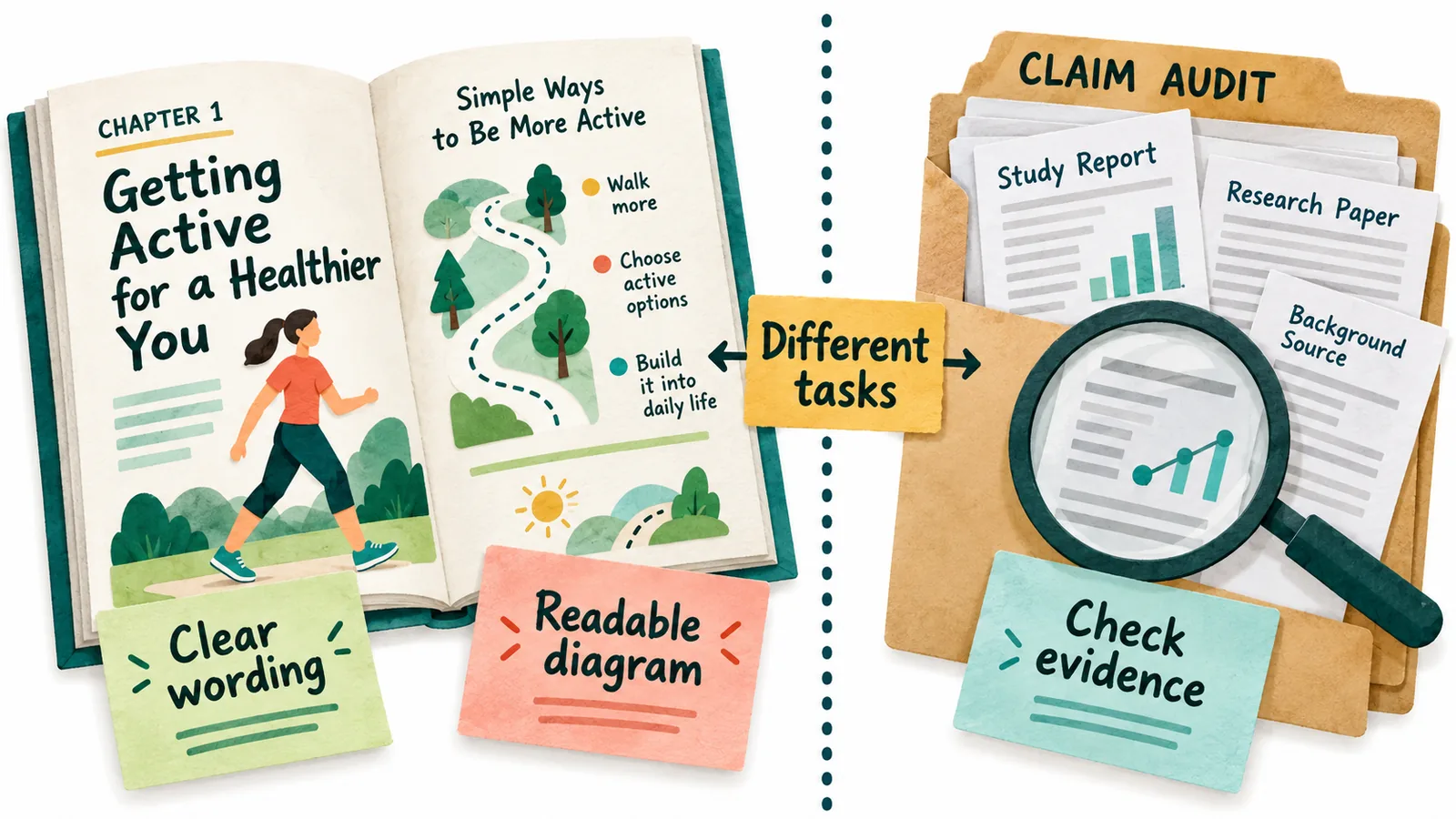
A readable health book is not necessarily an evidence-based one
Readers can tell you where an explanation is confusing, a diagram is unreadable or the promised audience does not match the text. Their satisfaction cannot establish that a treatment works, a diet is appropriate or an exercise is safe for every person. Keep reader feedback separate from technical review and scientific substantiation.
Before publication, the useful question is not how to collect approval but which claims and instructions need competent scrutiny. After publication, a customer review reports an individual's experience. Do not present a favorable rating as clinical evidence or ask readers to produce health outcomes as a condition of receiving a book.
This is an editorial workflow, not personal medical advice. For general review arrangements, start with the review guide hub. For recipe-led material, use the cookbook workflow while keeping health claims in this separate check.
Choose a reading role without collecting a medical history
Describe the intended reading level, subject, format and assumed knowledge. A beginner can test whether terminology is explained; a qualified subject specialist can inspect an assigned technical scope. Neither should be represented as having reviewed matters outside that scope.
Recruit interested adults through permission-based channels and communities that allow invitations. Avoid asking applicants to disclose diagnoses, medications, weight, injuries, photographs or medical records. If a specialist genuinely needs sensitive information for a separate professional engagement, that requires its own appropriate consent and safeguards, not an open reading-group form.
| Job | Appropriate output | Not established |
|---|---|---|
| Intended-reader feedback | Page-specific notes on clarity, navigation and expectations | Safety, efficacy or a diagnosis |
| Qualified technical review | A documented assessment within the specialist's actual competence | Universal approval, a public endorsement or regulator approval |
| Claim substantiation | Evidence appropriate to the precise population, intervention and claim | Proof supplied by sales, stars or enthusiastic anecdotes |
Check a professional's relevant qualifications and agree on the deliverable before commissioning work. Compensation for technical work does not purchase an independent Amazon customer review. Do not label a book medically reviewed when only its spelling or layout was checked.
Build a claim ledger before using testimonials
Record each consequential claim, its location, the supporting source, the studied population, important limits and the person responsible for checking it. Include the cover, subtitle, description, diagrams and promotional copy, not just the manuscript's cautious paragraphs.
The FTC's Health Products Compliance Guidance explains substantiation for health-related marketing and why testimonials are not scientific proof. It is U.S. business guidance, not a ruling that a particular book is approved. The applicable obligations depend on the actual claim, product, market and circumstances.
The guidance distinguishes independently published noncommercial literature from its deceptive use to market products. Do not treat it as a blanket rule that every health book is a regulated health product. Obtain case-specific advice where a book, supplement or related service is marketed together.
Do not promote a general walking guide using unsupported promises to treat a named disease. If a source supports a narrower observation, do not enlarge it into a universal outcome. An attractive chart or impressive credential does not repair missing support. Refer unresolved high-stakes claims to a suitably qualified professional; remove or appropriately revise claims you cannot support.
A disclaimer is not permission to leave a misleading headline intact. The FTC guidance also explains the limits of disclosures. Inspect the overall message rather than relying on a small notice to reverse an explicit promise.
Prepare the edition readers will actually see
Give the copy a version and date, and state whether it is a draft. Include the references, diagram captions, qualifications and scope notes needed to understand the material. Do not send an attractive excerpt that omits important limitations while asking readers to endorse the whole book.
Check text size, labels, contrast, table headings and page references in the offered format. A diagram that requires color should not become ambiguous in a grayscale print edition. Ask about readability rather than whether the reader successfully performed the depicted activity. Use KDP's quality guidance for publishing checks alongside your own technical review.
Check distribution rights and applicable digital exclusivity before sharing copies. The ARC handoff guide helps retain the version, destination and access conditions. Do not promise that every listed title includes a PDF, print copy or unrestricted download.
Ask about the text, not the reader's body
A useful brief asks: Which term needed an explanation? Could you distinguish background information from an instruction? Were the limits visible where you needed them? Which source was difficult to locate? Could you interpret the diagram without guessing?
Do not require readers to start or change exercise, diet, supplements or medication, or to stop professional care. Do not ask for before-and-after photographs, symptom scores or weight changes as evidence of reading. Those activities are not needed to comment on a book's clarity and could create risks outside an ordinary editorial project.
If a reader reports a potentially harmful instruction, pause the affected material and obtain appropriate technical assessment. Do not ask the person to repeat it for proof. Do not diagnose their symptoms through the reading group. Keep any necessary follow-up private and limited; remove sensitive details from general editing notes.
Separate a layout correction from a health claim
The following H-039 record is fictional. A draft beginner activity book has a small diagram, an undefined term and an unsupported benefit claim in its description. Three favorable private comments do not close any of those issues.
| Issue | Next action | Completion evidence |
|---|---|---|
| Diagram labels cannot be read | Revise size and contrast, then inspect the export | Legible labels in the stated format, not a successful exercise attempt |
| A technical term is undefined | Have the explanation checked and place it where first needed | Accurate wording plus a reader comprehension check |
| Description promises an unsupported benefit | Pause the claim and obtain a qualified assessment of its support | Documented decision to remove or appropriately revise the claim |
| A reader reports improved symptoms | Do not treat the anecdote as substantiation or reuse it automatically | No inferred efficacy; separate assessment before any marketing reuse |
Record what changed, who checked it and which copy was reissued. If evidence remains unresolved, label the issue open. A deadline or positive review does not substitute for closing the underlying concern.
Use an invitation that leaves the opinion independent
KDP's review-copy guidance does not allow requiring or influencing a review. Inspect any incentives and completion rules using the review-rules guide; an optional sentence cannot cancel a contradictory penalty.
Would you like to read the stated edition and comment on its clarity? You do not need to try any exercise, diet or product. You may decline or stop. No public review or favorable opinion is required to receive the offered reading access.
Keep private issue reports separate from any voluntary public contribution. Do not route only satisfied readers to Amazon, prescribe review wording, or condition future access on a rating. If a public contribution is missing, use the timing guide, not pressure or account-workaround instructions.
Finish a bounded editorial cycle
Start with a versioned chapter and the consequential claims it contains. Commission the appropriate technical checks, test the reading copy and invite a relevant group for a short clarity brief. Track working deliveries, documented issues and verified corrections. Do not turn those counts into projected health outcomes, review quotas or guaranteed sales.
Browse the public ARC library for current titles and actual conditions. A listing on Virtalibry is not medical validation or Amazon certification. For food-and-drink reference material, use the Food & Wine guide. For team communication, use the ARC team workflow.
Sources and scope
KDP customer-review and content-quality guidance and FTC health-marketing guidance checked on 17 October 2026. The ledger, reader brief and H-039 record are editorial examples. They do not establish clinical safety, legal compliance, professional credentials, platform approval or a particular person's suitability for any activity.
Frequently asked questions
Do reader reviews establish that health advice is safe?
No. Reviews describe individual impressions, not clinical validation. Consequential claims need evidence and appropriate technical review independent of customer ratings.
Should readers try the exercise or diet before commenting?
Do not require changes to exercise, diet, supplements, medication or care to join a reading project. A clarity brief can evaluate text and diagrams without testing instructions on readers.
What information should a reader application collect?
Keep it to reading fit, format and relevant knowledge. Do not request diagnoses, medication lists, injury details, weight or medical records through an ordinary reading-group application.
What can a qualified specialist review?
Agree on a defined scope within their actual competence, document the assessment and represent credentials accurately. A layout check is not a medical review.
Can a disclaimer fix an unsupported health promise?
Do not rely on a disclaimer to reverse a misleading headline. Review the entire message and the evidence with appropriate professional help where needed.
What if a reader reports a potentially harmful instruction?
Pause the affected material and seek appropriate technical assessment. Do not ask the reader to repeat the activity for proof or diagnose them through the group.