

Amazon Book Reviews for Children's Books
Find adult readers who can assess read-aloud flow, picture clues and the reading experience your children's book promises.
Keep editorial feedback separate from child assessment. No free-copy availability, reading gains or Amazon reviews are guaranteed.
Children's-book feedback starts with how the book is meant to be read
A bedtime picture book, an early reader and an illustrated chapter book ask different things of their audience. Decide whether you need an adult's comments on reading aloud, the clarity of picture clues or the completeness of an independent-reading edition. A general request for a good review will not identify which page needs work.
Describe the intended reading situation in the brief: shared reading with an adult, a child choosing to look through pictures, or independent reading with stated prerequisites. These are project descriptions, not assessments of a real child. Do not infer a reading level from a birthday or claim that every reader in an age band will have the same needs.
This guide concerns adult-led editorial feedback, not a programme for recruiting children onto review platforms. Check actual ARC library listings for available copies and conditions. The review guide hub covers the broader workflow. No free-copy inventory, educational result, star average or publication outcome is promised.
Match adult experience to a bounded question
Invite adult parents, carers, librarians, educators or readers familiar with the type of book. Ask what they can assess, not whether they can arrange a child endorsement. A parent can describe a difficult read-aloud transition; an illustrator can flag an inconsistent visual clue; an educator may identify an unexplained prerequisite. None of those roles automatically establishes expertise in every aspect of development or teaching.
| Reading context | Useful adult perspective | Bounded question |
|---|---|---|
| Shared picture book | Adult familiar with reading aloud | Where do phrasing or page turns interrupt the intended flow? |
| Early reader | Educator familiar with the stated approach | Which vocabulary or instruction assumes knowledge not supplied? |
| Illustrated narrative | Reader inspecting text and images together | Which clue contradicts the words or becomes hard to see? |
Recruit through opt-in adult contacts or communities permitting author invitations. Explain the task before sending files. Avoid collecting family histories, diagnoses or proof of a child's performance to qualify a volunteer. If specialist literacy, developmental or accessibility work is needed, commission a separately scoped assessment rather than treating ordinary customer comments as that service.
Supply the complete page context and name the reading conditions
Label the file, version, format and page references. Include the words, illustrations and page order belonging to that edition. A text-only manuscript cannot reveal whether a picture contradicts a sentence; a low-resolution thumbnail cannot settle the quality of the distributed page. If a spread is omitted, state the omission rather than asking readers to guess what connects the scenes.
Ask adults to read the supplied text first without silently repairing it. On a second pass they can note where they changed a word, supplied a pronunciation or explained a missing relationship. That extra help may be useful in shared reading, but it must not disappear from the record. A smooth adult performance is not evidence of independent readability.
KDP's reading-age guidance describes intended-audience metadata and its role in relevant discovery features. It is not an individual reading assessment. Use an honest audience description rather than choosing an age solely to reach a category. KDP's quality reference also addresses legible images and text; a digital preview does not establish a physical print result.
Keep recruitment and ordinary feedback adult-led
Use an adult contact for communication and delivery in this workflow. Do not open direct author-to-child chats, request a minor's review account or require photographs, voices, names, school details or reading scores. An adult can report a page issue in their own words without identifying a child. Declining, stopping or not responding must remain acceptable.
If a school or specialist project genuinely needs direct participation by minors, pause this ordinary outreach process. Appropriate safeguarding, permissions, privacy arrangements and local requirements need separate consideration; parental agreement alone is not a certificate that every requirement is met. UNICEF's ethics overview provides a research-context reminder to consider harm, agency and accountability. It does not approve this project or replace appropriate professional review.
K-042: a confusing answer may originate in the page
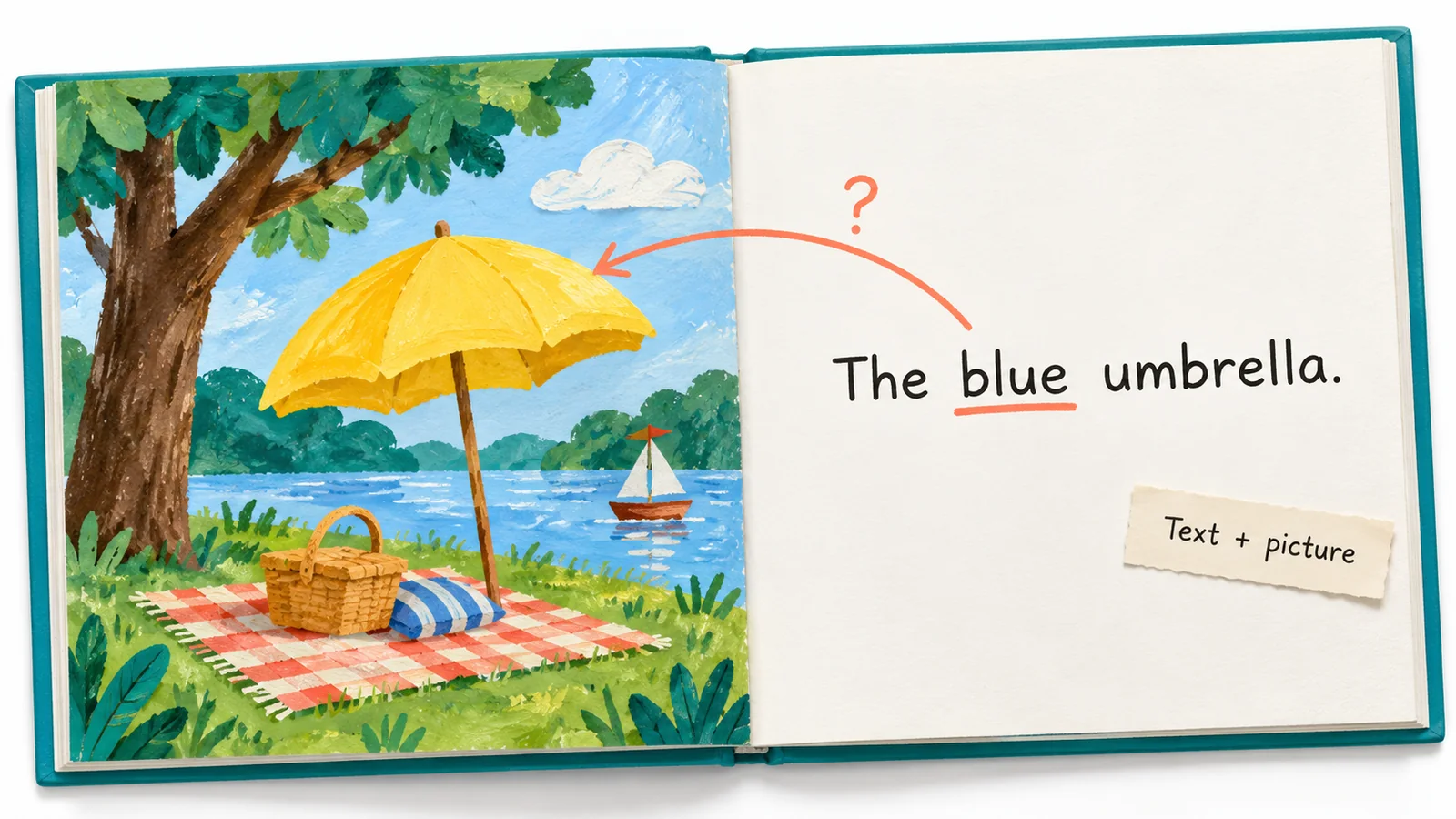
In fictional record K-042, a spread shows a yellow umbrella, while its sentence says, "The blue umbrella." An adult notices the disagreement. The useful first action is to compare the intended manuscript with the placed illustration, not to ask whether a child knows colours. The record contains no real child or reading session.
| Item | Recorded evidence | Not established |
|---|---|---|
| Export v1 sentence | Names a blue umbrella | Whether the intended word was blue or yellow |
| Placed illustration | Shows a yellow umbrella | Whether this is the approved artwork version |
| Reader implication | A text-image mismatch is visible | Any child's ability or the book's learning effect |
Check the source decision, then revise the word or illustration as appropriate. Recheck the exported spread and nearby references before closing the issue. Do not silently coach around the mismatch and record the page as clear. A repaired colour reference still does not validate the entire story, age suitability or all formats.
Offer a copy without requiring an adult's public review
A practical invitation is: "I am seeking adult feedback on the read-aloud flow and text-picture agreement in this picture-book draft. Please report page issues in your own words; no child's details or recordings are needed. You can decline or stop, and posting publicly is not a condition of receiving the copy." Add its format and any agreed follow-up limit.
KDP's customer-review guidance permits book copies without requiring or influencing reviews. This is limited permission, not approval of every incentive arrangement. Check actual review conditions and keep any later opinion independent. Do not supply a parent's review text, require a rating or reward a child's endorsement.
Separate page defects, preferences and claims needing evidence
Classify comments before changing the book. A clipped caption needs an export check. A request for a different ending may reflect taste. A claim that the book improves reading requires a different evidence base, not a collection of enthusiastic parent messages. Keep the original observation and the author's decision together so the reason for a change remains inspectable.
Track file deliveries, useful adult observations and rechecked corrections separately from public reviews. A download does not prove reading; an adult reporting enjoyment does not measure a child's progress. Do not quote a family anecdote in marketing without appropriate permission or turn a single comment into a universal developmental claim.
Prepare one adult-led brief before expanding outreach
Start with a versioned spread or complete edition and one clear question. Use young adult feedback for narrative expectations, and education-book feedback for goals and exercises. The ARC handoff guide separates copy delivery from a reader's optional public opinion.
Sources and limits
Linked KDP audience, quality and customer-review references and UNICEF's ethics overview were checked on 18 October 2026. K-042 and the editorial brief are original fictional tools. No child was recruited, observed or assessed; no consent system, physical edition, live inventory or educational intervention was tested.
Frequently asked questions
Who should receive a children's-book feedback invitation?
For this workflow, recruit adult parents, carers, educators or adult readers with relevant experience. Do not create direct author-to-child recruitment or require child accounts.
Can a reading-age field certify that a book suits every child?
No. It describes an intended audience, not a diagnosis, developmental assessment or guarantee of an individual child's experience.
What should a read-aloud note record?
Record the edition, page, unclear phrase or picture and the adult reader's observation. Do not request a child's identity, recording, school details or private assessment.
Does an adult's fluent performance prove independent readability?
No. Reading aloud can supply pronunciation, pacing and explanations. Report that context rather than interpreting it as an independent reading result.
Must a parent post publicly after receiving a copy?
Do not require or influence a customer review in exchange for a book. Any public opinion should be the adult's own, subject to the applicable platform rules.
Are free children's-book copies promised here?
No. This is an editorial guide, not an inventory. Inspect actual listings, formats and conditions; availability and review publication are not guaranteed.