

How to Use the BSR Calculator
Check the edition, unit baseline and per-copy amount before interpreting a calculator result.
A worked example explains the arithmetic. It does not validate the sales assumption.
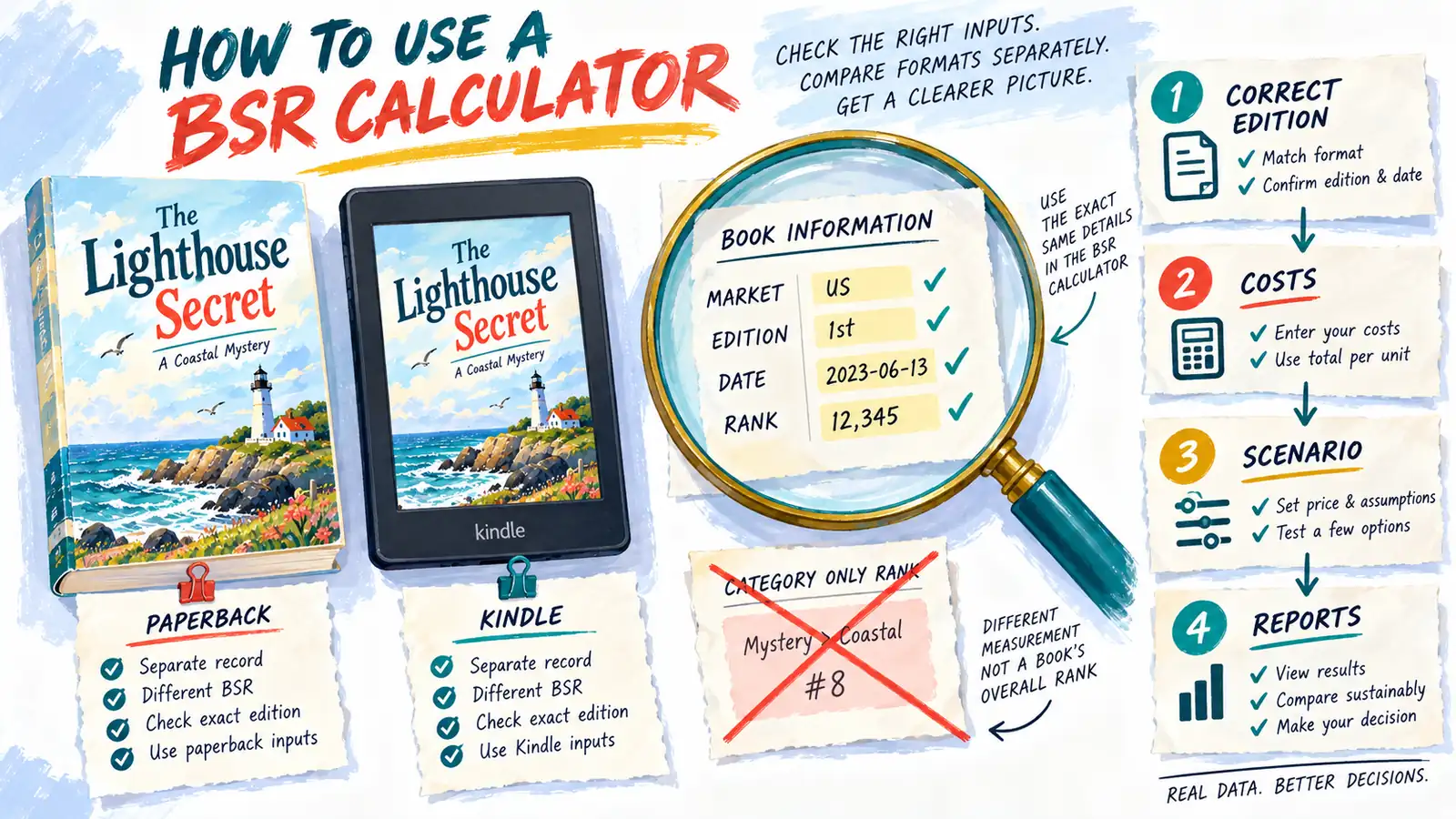
Start with a comparable observation
Open the Amazon BSR Calculator and choose the edition you actually observed. Record the marketplace, edition identifier, observation time and overall book rank. Keep category rankings in a separate column; they describe a different comparison.
Do not average a Kindle rank with a paperback rank, mix countries or describe a promotional snapshot as an ordinary trading period. If you have your own paid-unit reports, calculate a stated daily average and use the manual baseline instead of the legacy rank lookup.
- Choose the unit source. Legacy BSR mode uses fixed, uncalibrated tiers. Manual mode uses the average units you supply. More decimal places do not make either input more certain.
- Set edition and list price. This calculator is a US-dollar Amazon.com scenario, not a currency converter or a universal royalty engine.
- Check the per-copy amount. For paperback, choose supported printing specifications or enter your KDP printing quote. For Kindle, enter the net royalty shown for the relevant paid-sale scenario in KDP; do not treat a headline percentage as the net amount.
- Choose the horizon. Start quarter and year determine the twelve calendar months. Constant daily allocation is the default. The optional seasonal profile is a hypothetical distribution, not an observed seasonal pattern.
- Calculate and preserve the assumptions. Record the input values with the result. Reset restores the same defaults and clears the previous result.
Walk through a bounded example
Suppose you want to model five paid paperback units per day, starting in January 2026. The edition has 150 final printed pages, regular trim, black ink on white/cream paper and a $15.99 US list price. This is an original teaching scenario, not a claim about a real book.
| Step | Modeled result | What still needs evidence |
|---|---|---|
| Printing | $1.00 + 150 x $0.012 = $2.80 | The actual final specification and current KDP quote |
| Per-copy royalty | 60% x $15.99 - $2.80, rounded to $6.79 | The applicable edition, channel and current pricing rules |
| January units | 5 x 31 = 155 modeled units | Whether five units per day is a useful assumption |
| January royalty | 155 x $6.79 = $1,052.45 | Actual paid transactions, returns and expenses |
Use the official printing tables and paperback royalty guidance to check the cost portion. Correct arithmetic does not validate the sales assumption.
Read the output without upgrading it into evidence
Gross list value is modeled units multiplied by list price, not a payout. Royalty is the modeled per-copy amount applied to those units, not business profit. The monthly chart and table show the same calculation; switching the metric changes the view, not the underlying scenario.
Run a second case by changing one assumption, such as your daily baseline or print specification. Keep the original record so you can explain the difference. Repeatedly clicking Calculate with unchanged inputs no longer produces a different answer.
If a price cannot cover printing, the tool rejects the scenario instead of silently presenting zero royalty. If rank is outside the legacy lookup, choose a manual baseline. An unsupported input is not proof that a book cannot sell.
Compare results with your own reports over a clearly stated period. Do not infer competitor revenue, review conversion or advertising performance from a modeled total. Use BSR versus discoverability for the signal distinction and rank interpretation for a repeatable observation routine. Return to KDP Tools or KDP Earnings.
Official references checked on 16 October 2026. The worked example and illustration are conceptual; no account reports are accessed.
Frequently asked questions
Which rank should I enter?
Use an overall book rank from the same marketplace and edition, recording its date and time. Do not substitute a category rank or mix Kindle and paperback observations.
What is the safer input when I have my own reports?
Use the manual daily baseline with a clearly stated period. The tool does not access or validate those reports, but it avoids substituting an uncalibrated rank tier for your own observation.
How do I enter Kindle royalties?
Use the net royalty per paid copy from the relevant KDP pricing preview or report context. A headline royalty percentage is not the net amount and does not establish eligibility.
Why do monthly rows have different units in constant mode?
Calendar months have different numbers of days. The selected start quarter and year determine the twelve-month horizon, including leap-year days where applicable.
Is the modeled royalty my expected profit?
No. The unit baseline is an assumption, and the calculation excludes expenses, refunds and other payout adjustments. Use actual records for business reporting.